

A View On Plato’s Last Evening
The obituary of Plato (born Aristocles; BC 427 – BC 348) was buried beneath layers of volcanic ashes following the eruption of Mount Vesuvius in AD 79! Researchers recently uncovered the history of the Greek Philosopher’s final few hours by deciphering almost a 2,000-year-old papyrus scroll!
The volcanic eruption of Mount Vesuvius in AD 79 had destroyed large areas of the Roman Empire, including Herculaneum and Pompeii. Excavations have been going on there since the beginning of the 19th Century. Researchers have slowly removed the ashes and congealed lava from large parts of these two ancient Roman cities, thus revealing various historic and cultural information of that period of time.

There was a library of papyrus in a village, called Villa of the Papyri, in Herculaneum. Archaeologists had discovered the library in 1750. Many believe that the father-in-law of Roman Emperor Julius Caesar was the owner of that library from which more than 1,800 papyrus scrolls were recovered. Most of the papyri were badly damaged as they were buried under the once-hot ashes for a long time. Hence, researchers initially thought that it would be impossible to decipher them. However, it has become possible to decipher all those papyri with the help of modern technology!
Professor Graziano Ranocchia of the University of Pisa, who spearheaded the team responsible for unearthing the carbonised scroll, recently described their research findings at the National Library of Naples, stressing that the discovery was an “extraordinary outcome that enriches our understanding of ancient history”. He reportedly said: “Thanks to the most advanced imaging diagnostic techniques, we are finally able to read and decipher new sections of texts that previously seemed inaccessible.”
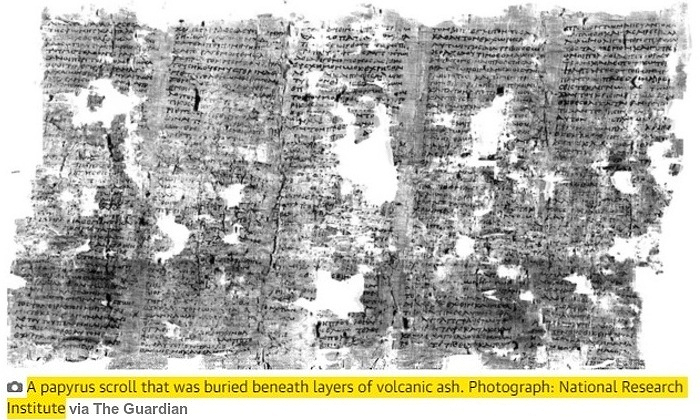
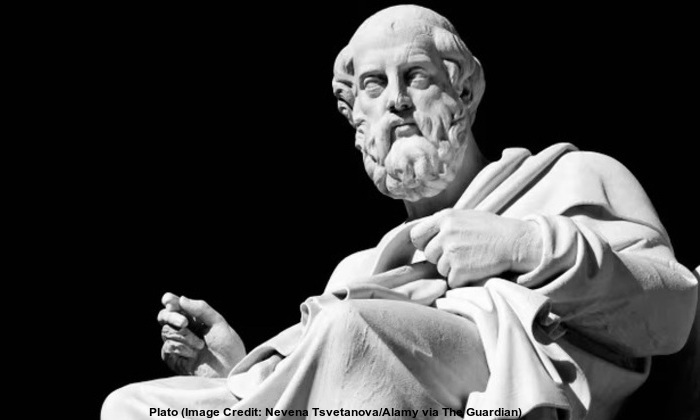
According to Professor Ranocchia, one papyrus contains the biography of Plato, especially about the last evening of his life! He claimed that the Greek Philosopher was listening to music played on a flute by a Thracian slave girl that evening. The account suggests that Plato, in spite of battling a fever and being on the brink of death, criticised the musician for her lack of rhythm. Professor Ranocchia further claimed that Plato was sold into slavery on the island of Aegina, possibly as early as BC 404 when the Spartans conquered the island, or alternatively in BC 399, shortly after the demise of Socrates. He stressed: “Until now, it was believed that Plato was sold into slavery in BC 387 during his sojourn in Sicily at the court of Dionysius I of Syracuse. For the first time, we have been able to read sequences of hidden letters from the papyri that were enfolded within multiple layers, stuck to each other over the centuries, through an unrolling process using a mechanical technique that disrupted whole fragments of text.”
Interestingly, a papyrus also describes the final resting place of Plato to a minute detail. Until recently, it was assumed that Plato’s body rested in the garden of the Academy of Athens, the first university of the world. Meanwhile, the papyrus found from Herculaneum clearly states that Plato was buried in that garden.
Professor Ranocchia informed the press that they just started deciphering the papyrus, stating that more unknown information could be recovered soon. The Guardian quoted Professor Ranocchia as saying: “The ability to identify these layers and virtually realign them to their original positions to restore textual continuity represented a significant advance in terms of gathering vast amounts of information.“
Boundless Ocean of Politics on Facebook
Boundless Ocean of Politics on Twitter
Boundless Ocean of Politics on Linkedin
Contact: kousdas@gmail.com

 ISMC
ISMC Boundless Ocean Of Politics