

Chile & A Climate Phenomenon Termed El Niño
There is an influx of tourists into Viña del Mar, a quiet Pacific Ocean resort in central Chile just northeast of Valparaíso, throughout the year. Wildfires destroyed this beautiful town in the first week of February 2024. Although fires spread in other parts of Valparaíso on February 3-4, the coastal town of Viña del Mar and its surrounding areas were the worst affected. The famous Botanical Garden of the city, built in 1931, was burnt to ashes. In a statement issued on February 4, the Administration of President Gabriel Boric Font mentioned that wildfires claimed 112 lives in the first three days (February 2-4).
For her part, Interior Minister Carolina Toha said on February 2 that intense forest fires, burning around a densely populated area of central Chile, destroyed around 1,100 homes. According to the minister, at least 92 instances of forest fires were seen in the centre and southern part of the Latin American country. Hence, temperatures remained unusually high in those areas. The Interior Minister informed the press that nearly 1,600 people became homeless in Viña del Mar, while members of Chile’s National Disaster Prevention and Response Service were working hard to bring the situation under control. The Government immediately deployed 1,400 firefighters, 1,300 soldiers and 31 firefighting helicopters to rescue people and to recover dead bodies.
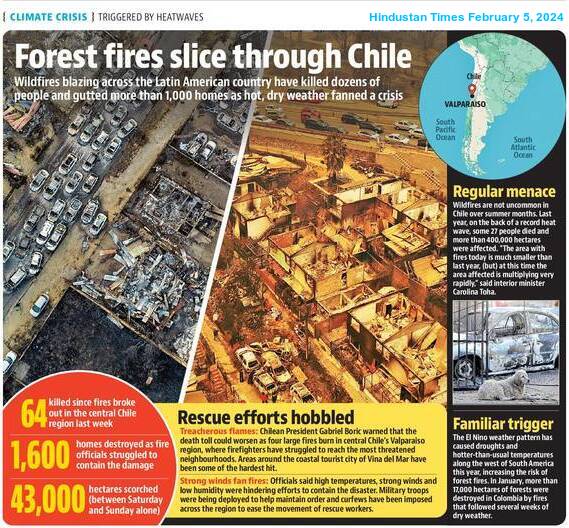
On February 4, Director of the National Disaster Prevention and Response Service Álvaro Hormazábal stressed that there were 161 active fires across the country, and firefighters managed to control 102 of them in the first 72 hours. He claimed that poor weather conditions created troubles for firefighters. Hormazábal told CNN that wildfires spread widely on February 3, prompting the Government to order thousands of people to evacuate their homes. The Government also promised financial assistance to the victims. Meanwhile, neighbouring Argentina announced that it would provide Chile with all sorts of help.
Unfortunately, wildfires have become a common phenomenon in Chile. The country has been experiencing wildfires during summer almost every year since 2017. In 2023, wildfires claimed 27 lives and destroyed 0.4 hectares of land. So far in 2024, 43,000 hectares of land have been destroyed. Most importantly, wildfires spread from 30,000 hectares to 43,000 hectares of land in just two days (February 2-3). The concerned authorities in Santiago believe that the severity is much higher this time. Many areas in Valparaíso were covered with thick black smoke on February 4. President Boric admitted that the situation was indeed alarming!
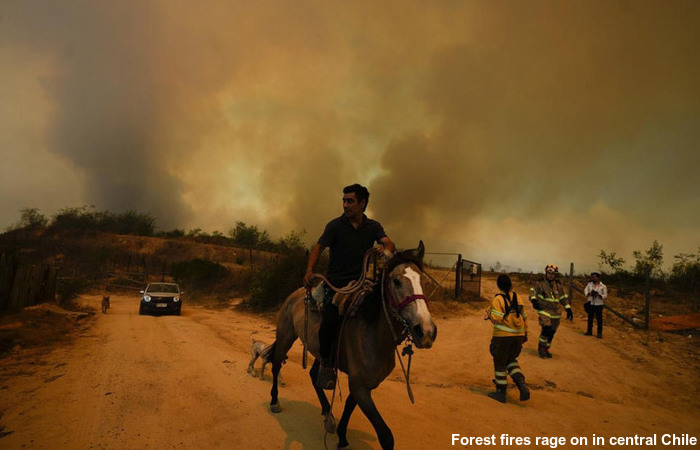
Environmentalists, too, are worried about the growing incidents of wildfires in Chile. They are of the opinion that the fires have taken a terrible shape in such a short period of time this year mainly because of El Niño, drought and heat wave. Also, there is the effect of Global Warming. AFP reported that the fires began in hard-to-reach mountainous and forested areas of central Chile. Experts believe that it would be difficult for the firefighters to control fires. Naturally, the death toll is all set to rise. The Chilean earthquake and tsunami had killed 500 people in 2010. Since then, the wildfires have caused the biggest damage.
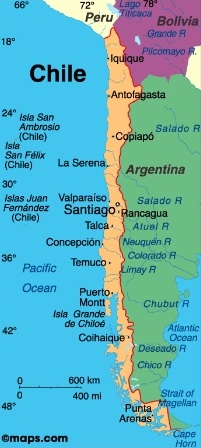
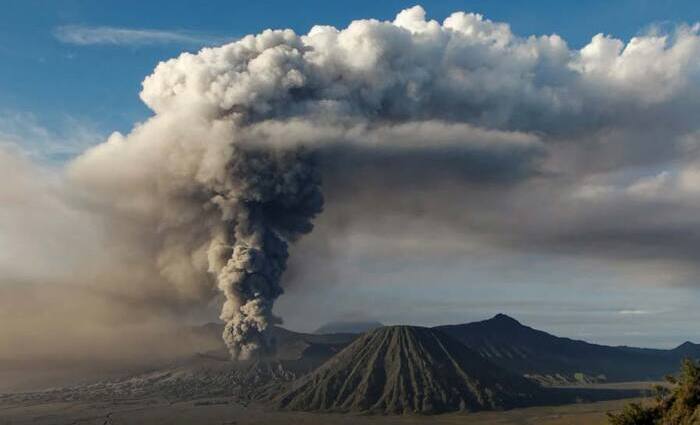
A warm southerly current is formed in the eastern Pacific along the western coast of the South American continent (near the coastal areas of Chile, Peru and Ecuador) towards the end of the year. This particular climate pattern is called El Niño. Environmentalists have opined that the tropical heat wave triggered wildfires in Chile this year. They have warned that El Niño would also have an impact on other countries in Latin America in the coming months!
Boundless Ocean of Politics on Facebook
Boundless Ocean of Politics on Twitter
Boundless Ocean of Politics on Linkedin
Contact: kousdas@gmail.com

 ISMC
ISMC Boundless Ocean Of Politics