

Ancient Landscape Discovered
When one thinks of Antarctica, s/he kind of thinks of a place covered with ice. However, there are numerous mountains and islands, too, in this region. And now, researchers have found ancient rivers and valleys buried under Antarctica. Where there are ice sheets today, it was covered by dense forests once upon a time. Scientists have claimed that Antarctica once had no ice sheets. A team of scientists from the University of Durham in Britain recently conducted research on an area of 32,000sqkm covered by ice sheets, using satellite data and radio-echo sound technology.
According to an article published on Live Science web portal on October 24, 2023, the study was conducted in the Wilkes Land region of East Antarctica, adjacent to the Indian Ocean. The area equivalent to the size of Belgium once had rivers, forests and ridges. Scientists are of the opinion that one can trace the history of billions of years in that region. They studied the topography of the eastern region of Antarctica, and also tested the soil structure. Scientists discovered that rivers had formed the landmass of Antarctica 145 million to 66 million years ago.
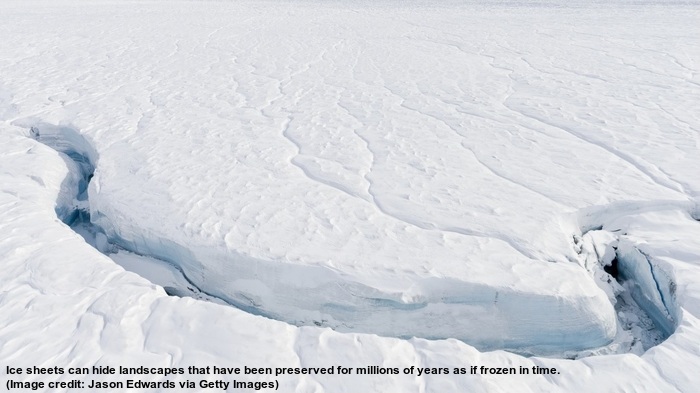
Stewart Jamieson, Co-lead author of the study and a Professor of Geography at the University of Durham, stressed: “We could see that there was something like the ghost of the landscape under the ice. At some point in the past, there’s been rivers flowing over it, which automatically must mean that it’s from before the ice sheet grew.” He said that the landmass of Antarctica was formed from the river sediments and sands around 34 million years ago.
The team of researchers further claimed that the type of landmass seen in North Wales in Britain was similar to the landmass of Antarctica. Professor Jamieson stated that as much research has been done on the topography of Mars, there has been far less research on the topography of the Antarctic. Hence, they have little information about Antarctica’s topography. The professor believes that Antarctica’s topography has not changed much over the years. It is also believed that the ice sheets of this region would have melted in the past.
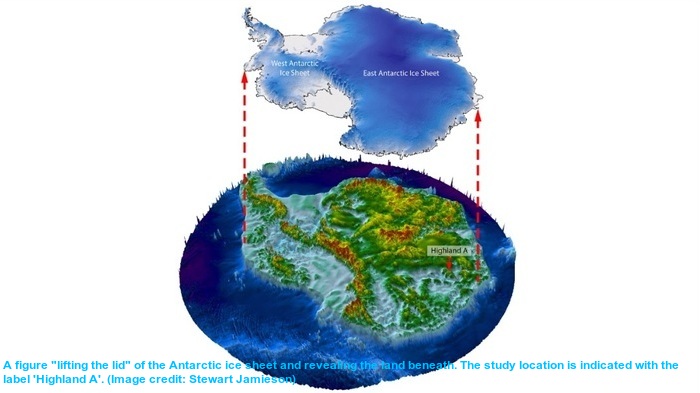
Neil Ross, the Professor of Polar Science and Environmental Geophysics at Britain’s Newcastle University, stated that the landscape of Antarctica had been hidden from the eyes of common people and explorers for years. However, this particular region of East Antarctica has revealed its own history. The landmass also indicates how the climate will change in the future. The latest research has further revealed that East Antarctica once had mountain ranges, creeks and even lakes. Antarctica had much more… They are all beneath the ice now. According to Professor Ross, not all have been discovered yet, as Antarctica is now covered by a 2.2-3km-thick ice sheet. It is not possible to search for those things by removing the ice sheets. It is still not possible to know what kind of animals used to live in Antarctica billions of years ago.
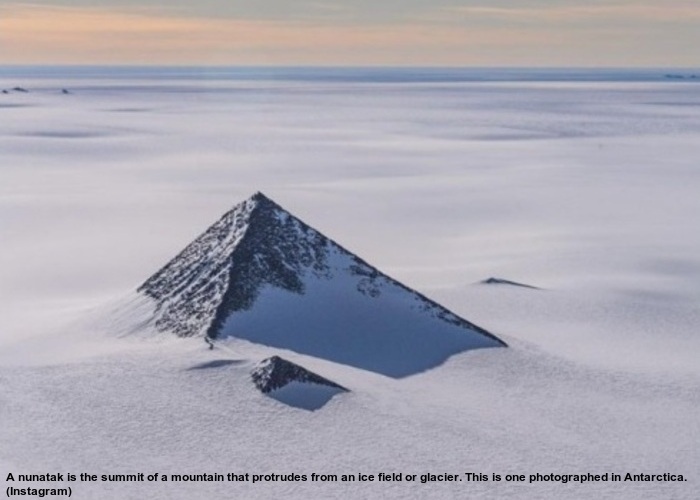
Researchers are currently trying to remove the thick ice sheets in order to collect soil from Antarctica for testing. If they succeed, then the researchers will have more information about Antarctica. Satellites have been taking images of the landscape of ice-covered Antarctica for a long time, and those images have revealed the actual snow-covered landmass of the region. The type of landmass and small plants that one can find in the temperate rainforests of New Zealand’s Tasmania and Patagonia region in South America are similar to those of Antarctica 34 million years ago, said Professor Ross.
Interestingly, Antarctica was located on the same land with present-day Africa, South America, Australia, the Indian Subcontinent and the Arabian Peninsula millions of years ago. As per the Theory of Plate Tectonics, those land areas were separated later. Hence, it is not unusual for Antarctica to have similar landmass. Professor Jamieson has opined that rivers used to flow through Antarctica towards the coastal areas when the temperature of this region was relatively high in the past. As the temperature of Antarctica gradually decreased, those rivers turned into glaciers. The valley has deepened due to the erosion of some glaciers.
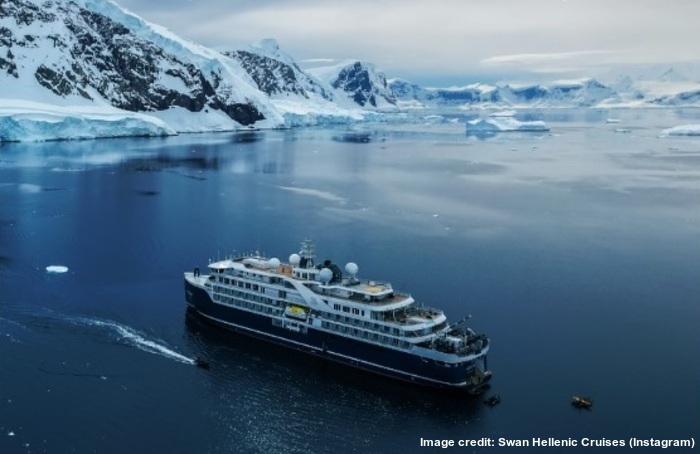
With decreasing temperature, ice sheets have completely covered Antarctica. However, the landmass of the region has remained intact beneath the ice for 34 million years! Now, scientists are trying to dig up the landmass.
Boundless Ocean of Politics on Facebook
Boundless Ocean of Politics on Twitter
Boundless Ocean of Politics on Linkedin
Contact: kousdas@gmail.com

 ISMC
ISMC
