

Gaza Conflict: Partial Volte-Face By Biden
US President Joseph Robinette Biden Jr has claimed that Israel’s attempt to occupy Gaza is a big mistake! In a rare first, the US has openly opposed any Israeli action against the Palestinians. However, the White House has hinted that the President may travel to Tel Aviv on October 18 in order to deliver a message of solidarity.
Talking to the local media in Washington DC in the third week of October (2023), President Biden said that Israel made a mistake by attacking Gaza, as the Hamas Movement does not represent all Palestinians. Hence, Israel should not take full control of the Gaza Strip, he added. It may be noted that the three-hour deadline set by the Israeli Defence Forces (IDF) ended on October 15 afternoon (local time). The Israeli Forces were waiting for the permission from the concerned authorities in Tel Aviv to resume the military operation in Gaza by land.

On October 15, the IDF urged residents of the Gaza Strip to move to safer places, giving Gazans a deadline to flee in order to save their lives. The deadline ended at 3:30pm on October 15. The IDF made it clear that they would launch an all-out attack on the Gaza Strip after this deadline. Therefore, the global community is worried about the consequences.
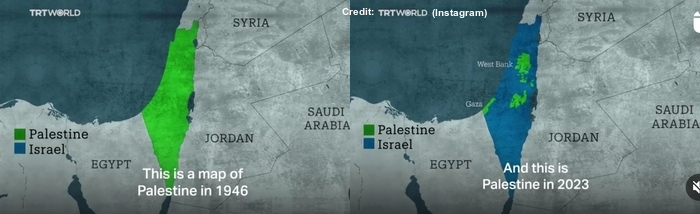
A senior IDF personnel stated that they requested residents of Gaza Strip and North Gaza to move to the southern region for security purposes. The IDF also vowed to keep Gaza’s northern-southern corridor safe and secure from 10am to 1pm on October 15. Later, the UN confirmed that nearly one million residents of Gaza moved from the northern part of the territory to the south before the deadline. However, it is not yet clear whether Israel will start an operation in Gaza after President Biden’s warning.

Meanwhile, the UN has stressed that over 187,500 people have been displaced in the Gaza Strip since Hamas’ assault on Israel on October 7. In a statement, the world body has mentioned that these people have taken refuge in a school run by the UN. According to the statement, among them, 3,000 people had already been homeless due to the Israel-Hamas conflict.
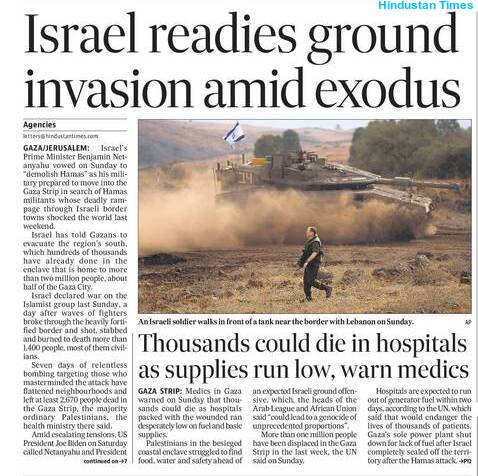
Apart from launching military operations, Israel has also cut off food, electricity, drinking water and other emergency services to Gaza. The World Health Organisation (WHO) has expressed serious concern over the development, saying that a humanitarian corridor should be created to evacuate citizens trapped in Gaza. WHO has further stated that many injured have perished even after being admitted to the hospital due to lack of treatment.
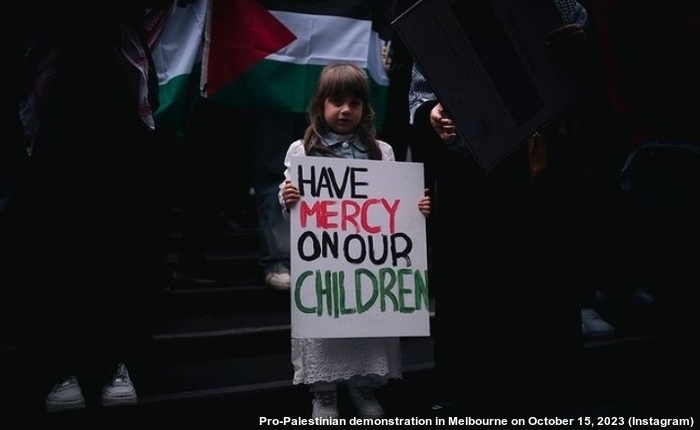
Tarik Jašarević, the WHO spokesperson in Geneva, told Reuters: “There are severely ill people whose injuries mean their only chances of survival is being on life support, such as mechanical ventilators. So, moving those people is a death sentence. Asking health workers to do so is beyond cruel.” He added: “Hospitals have only a few hours of electricity each day as they are forced to ration depleting fuel reserves and rely on generators to sustain the most critical functions. And even those functions will have to cease in a few days when fuel stocks run out.” “Time is running out to prevent a humanitarian catastrophe, if fuel, water, food and life-saving health and humanitarian supplies cannot be urgently delivered to the Gaza Strip amidst the complete blockade,” stressed Jašarević.
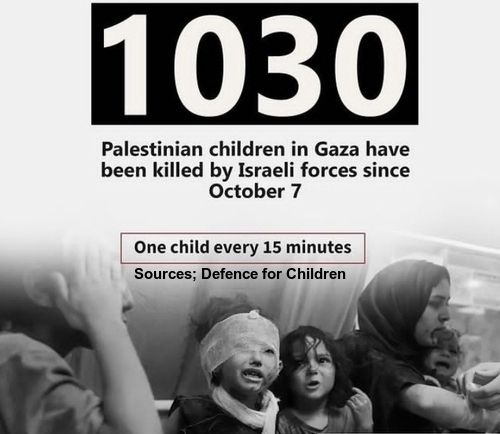
The ongoing conflict in Israel erupted following a surprise attack by the Palestinian Hamas Movement based in the Gaza Strip. The conflict marked another chapter in the long-standing and deeply rooted Israeli-Palestinian conflict. Hamas’ unexpected attack, which included the taking of both military and civilian hostages, caught Israeli Security Forces off guard. In response, Israel initiated a series of retaliatory strikes on the Gaza Strip. The situation escalated rapidly, with expectations of a potential ground incursion into the enclave.
Tensions leading up to this latest round of violence had been steadily increasing. These tensions were exacerbated by various factors, including clashes in Jerusalem and the West Bank, violence at the sacred al-Aqsa Mosque, and the ongoing Israeli occupation and blockade of Palestinian territories. In addition, the presence of Right-Wing elements in the Israeli Government added to the volatility of the situation. Also, the involvement of Hezbollah, a Lebanese militant group and political party that expressed solidarity with Hamas and launched attacks on Israeli targets in the Shebaa Farms area, has raised concerns about the conflict’s potential to spill over into a broader regional confrontation.
The conflict underscored the complexity and sensitivity of the Israel-Palestine issue, with deep-seated grievances on both sides. It highlighted the need for a sustainable and peaceful resolution to the conflict, which has been a source of instability in the region for decades.
(With inputs from Talk Diplomacy)
Boundless Ocean of Politics on Facebook
Boundless Ocean of Politics on Twitter
Boundless Ocean of Politics on Linkedin
Contact: kousdas@gmail.com

 ISMC
ISMC Boundless Ocean Of Politics