

Indian Judiciary: Judge Blames Recruitment Process
Justice Ujjal Bhuyan, a senior Judge of the Indian Supreme Court, recently expressed serious concern over the conduct of judges in the South Asian country. He also demanded disclosure of the reasons behind judicial appointments, stating: “Failure to do so allows space for judges who make unconstitutional remarks, like describing ‘groups of people as ants’.” Justice Bhuyan asked the Supreme Court Collegium to disclose reasons behind judicial appointments in order to make the process a transparent one.
Speaking at a panel discussion in New Delhi in the first week of August 2026, Justice Bhuyan said: “I have noticed that the last three collegium resolutions contain no reasons whatsoever. Is this a step back from the principle of transparency? By not giving reasons, the institution actually does a disservice to many judges who are genuinely outstanding and have done tremendous work.“
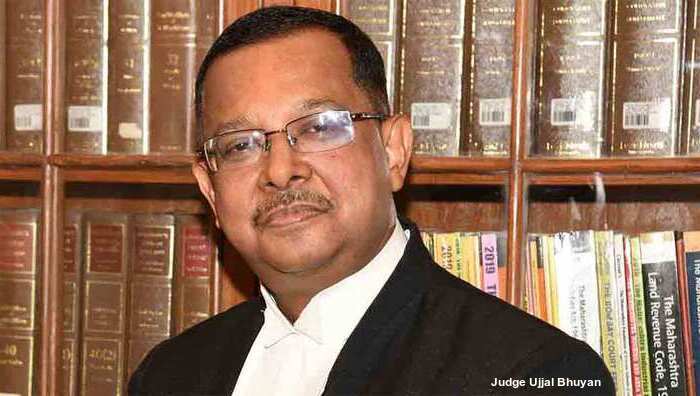
He further said: “Conversely, by withholding reasons, we also create space for individuals to enter the judiciary who may later describe groups of people as ‘ants’ and make other remarks that are wholly unconstitutional and contrary to the values of the Constitution. To prevent entry of such people, there should be some discussion, there should be some reasons given.“
As expected, Justice Bhuyan’s remarks have sparked a debate within political circles. The question arises here: Is Justice Bhuyan actually alluding to Chief Justice of India (CJI) Surya Kant?
It may be noted that CJI Surya Kant, during a Supreme Court hearing on May 15, 2026, remarked: “There are youngsters, like cockroaches, who don’t get any employment or have any place in the profession. Some of them become media, some of them become social media, RTI activists and other activists, and they start attacking everyone.” He also described youngsters as parasites of society, who attack the system. The comment sparked widespread public debate and subsequent clarifications, with critics and commentators on social media arguing that the remark generalised, as well as insulted, unemployed youth and legitimate activists.
In response to the CJI’s May 15, 2026 remarks, Abhijeet Dipke, a political communications strategist and activist, founded the Cockroach Janta Party (CJP; lit. Cockroach People’s Party), also known as the Cockroach Movement, an Indian youth-based satirical political movement, on May 16. The party not only achieved significant popularity online, rapidly gaining a large following across social media platforms shortly after its formation; but also issued a five-point manifesto relating to the conduct of Parliament members and of Election Commissioners, reservation of seats for women in politics and media licensing. In June, the party led protests in New Delhi and other parts of India over the fallout from irregularities in 2026 entrance examinations for undergraduate biomedical studies.
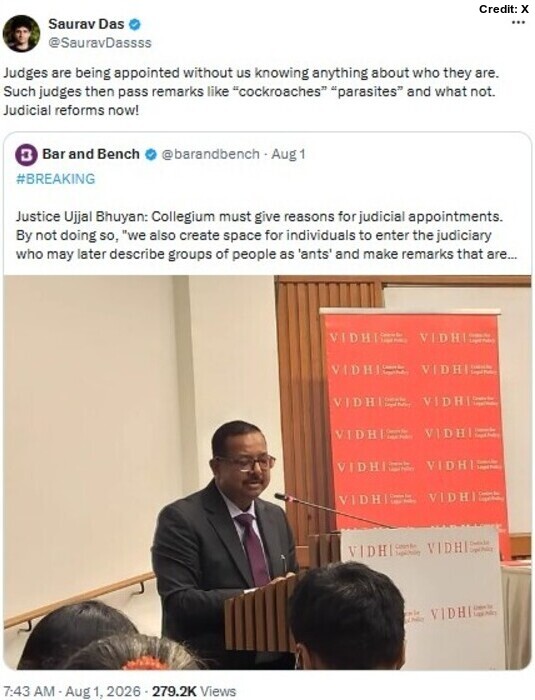
Saurav Das, the Chief Spokesperson of the Cockroach Janta Party, has stressed: “Judges are being appointed without us knowing anything about who they are. Such judges then pass remarks, like ‘cockroaches’, ‘parasites’, and what not. Judicial reforms now!“
Meanwhile,











Boundless Ocean of Politics on Facebook
Boundless Ocean of Politics on Twitter
Boundless Ocean of Politics on Linkedin
Contact us: kousdas@gmail.com

 ISMC
ISMC
