

Behind The Cooperation
As per the Rajamandala Theory (Circle of States) of ancient Indian strategist Chanakya, the immediate geographical neighbour of a state is its natural rival or enemy, whereas the state situated beyond the neighbouring country is its natural ally. Amidst the current geopolitical instability in South Asia, if there is any country that stands as a strong contender to meet that benchmark in India’s case, it is Japan. Japan has emerged as India’s most natural and formidable strategic partner in Asia, serving as a critical hedge against regional instability and unreliability in the US-China axis.
The recent state visit of Japanese Prime Minister Sanae Takaichi to India and the signing of 16 significant agreements with Prime Minister Narendra Modi signal the expanding scope of the partnership between the two nations. Although economic and technological cooperation forms the cornerstone of the bilateral relationship, the two Prime Ministers have agreed to elevate their Special Strategic and Global Partnership with major security agreements designed to counter regional instability. Japan has formalised a massive investment plan of JPY 2 trillion in the South Asian country, driven by 129 private-sector agreements.
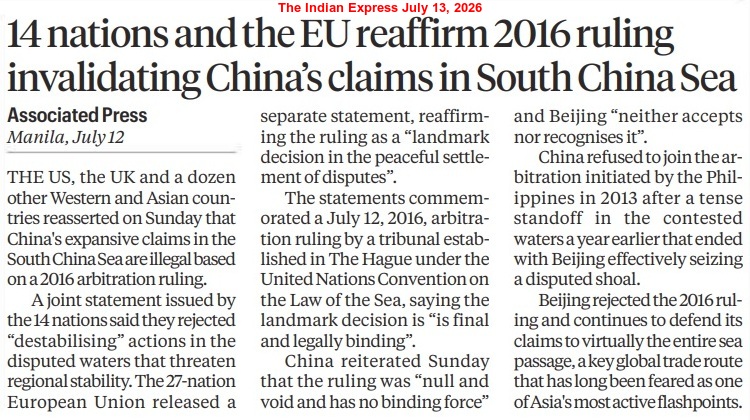
Both Tokyo and New Delhi are focussing on their relationship against the backdrop of the rapidly changing geopolitical situation in the Indo-Pacific region. The Donald Trump Administration‘s decision to revert US Indo-Pacific Command (INDOPACOM) to its historic US Pacific Command (USPACOM) designation, coupled with shifts in Quad (or the Quadrilateral Security Dialogue – an informal strategic forum comprising Australia, India, Japan and the US) priorities and the rise of tighter frameworks, like the Squad, signals a recalibration of Washington DC’s strategic focus toward more transactional bilateral partnerships in order to counter China. This trajectory of recent US policy has raised questions about the stability of the regional security architecture in the Indo-Pacific region. All these factors have sparked fresh security concerns for Japan (whose security has long relied on an alliance with the US) and also for India.
On the other hand, China’s maritime and economic expansion in the Indo-Pacific presents significant strategic challenges to India, including its String of Pearls network, submarine deployments and growing control over critical supply chains. In response, India actively secures its strategic interests by expanding maritime surveillance, upgrading infrastructure in the Andaman and Nicobar Islands, and deepening defence partnerships, such as through the Quad and bilateral agreements.
It may be noted that Tokyo made a historic policy shift in April 2026 by officially lifting (Japan’s) decades-long ban on exporting lethal weapons. The relaxed guidelines replaced strict postwar pacifist limitations, permitting Japanese defence firms to globally export advanced military hardware, including fighter jets, missiles and warships. The move is widely viewed as a coordinated effort to strengthen the Free and Open Indo-Pacific framework and to deter Chinese territorial expansion. Interestingly, the revised Three Principles on Transfer of Defence Equipment and Technology of Japan officially permits the export of lethal weaponry to 17 designated partner nations, including India.
For the past two decades, the key question for Asian powers has been how to keep the US – regarded as an indispensable power – engaged in the Indo-Pacific region. Now, the powerful nations in this region have decided to control their own strategic sphere. The recent meeting between Indian Prime Minister Modi and his Japanese counterpart Takaichi conveyed a message of profound strategic alignment, going far beyond mere mutual understanding.
Meanwhile,







Boundless Ocean of Politics on Facebook
Boundless Ocean of Politics on Twitter
Boundless Ocean of Politics on Linkedin
Contact us: kousdas@gmail.com

 ISMC
ISMC
