

Not Just A Choice Of Words
Sometimes, the disappearance of a single word can reveal more than a major policy announcement. The growing tendency within the Donald Trump Administration to prioritise Asia over the Indo-Pacific may seem like a mere choice of words, yet the use of language often signals strategic intent in the realm of geopolitics. This particular tendency of the Trump Administration represents a significant shift from broad, coalition-based security frameworks to a narrower, transactional approach.
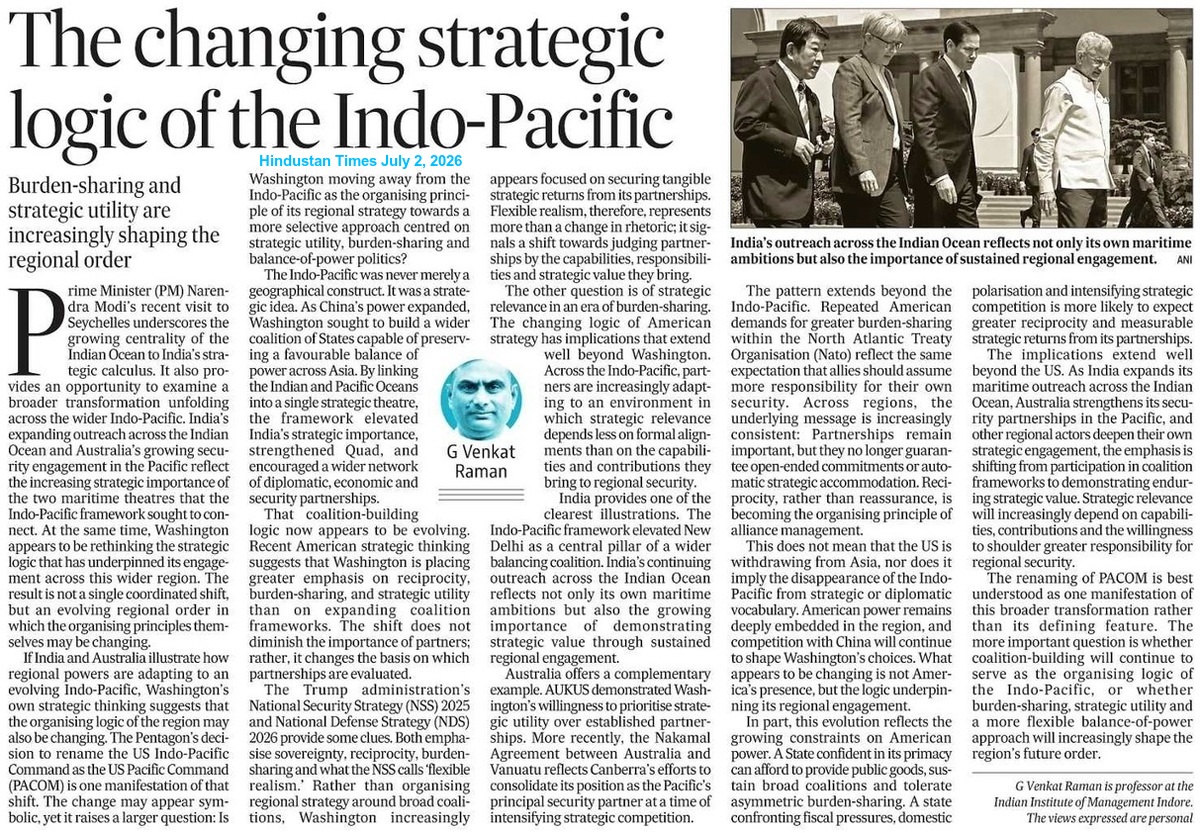
On June 16, 2026, the US Department of Defence officially restored the name of the US Indo-Pacific Command (INDOPACOM) to its historic designation, the US Pacific Command (USPACOM). Although the Command’s fundamental mission and geographic jurisdiction remain entirely unchanged despite the reversion to its original 1947 title, the move has triggered a widespread geopolitical debate and also sparked divergent views regarding its potential impact on India, the Quad (or the Quadrilateral Security Dialogue – a strategic diplomatic partnership between Australia, Japan, India and the US) and the balance of power in Asia.
It may be noted that the concept of the Indo-Pacific originated from an ambition as it replaced the Cold War-era Asia-Pacific framework to treat the Indian and Pacific Oceans as one contiguous strategic theatre, thus, removing the historical, geographic and bureaucratic boundaries that separated South Asia from East Asia. The Indo-Pacific concept also emerged with the aims of integrating India into a strategic framework and conveying the message to China that the region stretching from the Persian Gulf to the Pacific Ocean falls under the US’ integrated oversight.
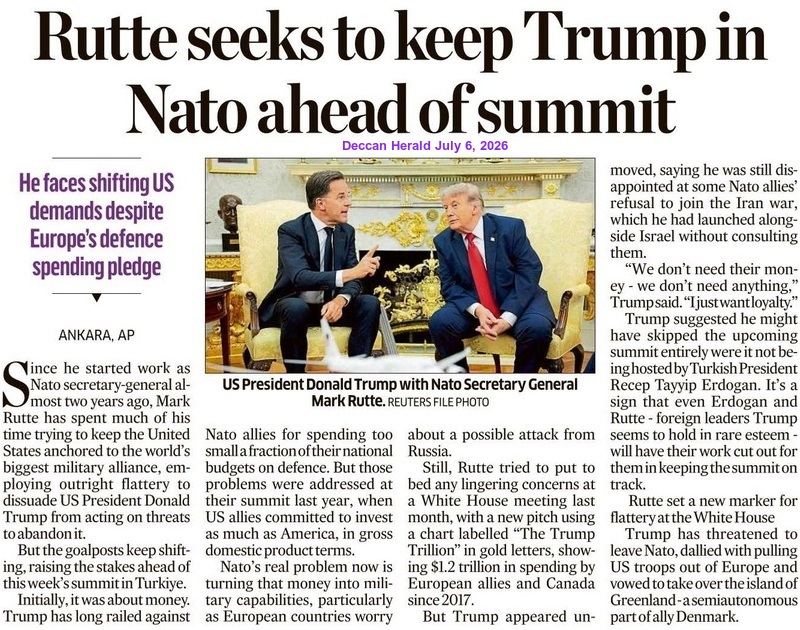
However, the Pentagon has hinted that it is unable to maintain strategic cooperation equally across the board while simultaneously deploying limited military resources across the vast regions of Eastern Europe, West Asia and East Asia. In such a situation, the Pentagon’s decision to drop the Indo prefix and revert the INDOPACOM to USPACOM signals a significant strategic recalibration as the move narrows the US military’s focus to its core Pacific and East Asian contingencies, marking a departure from the broader, pan-oceanic strategic framework.
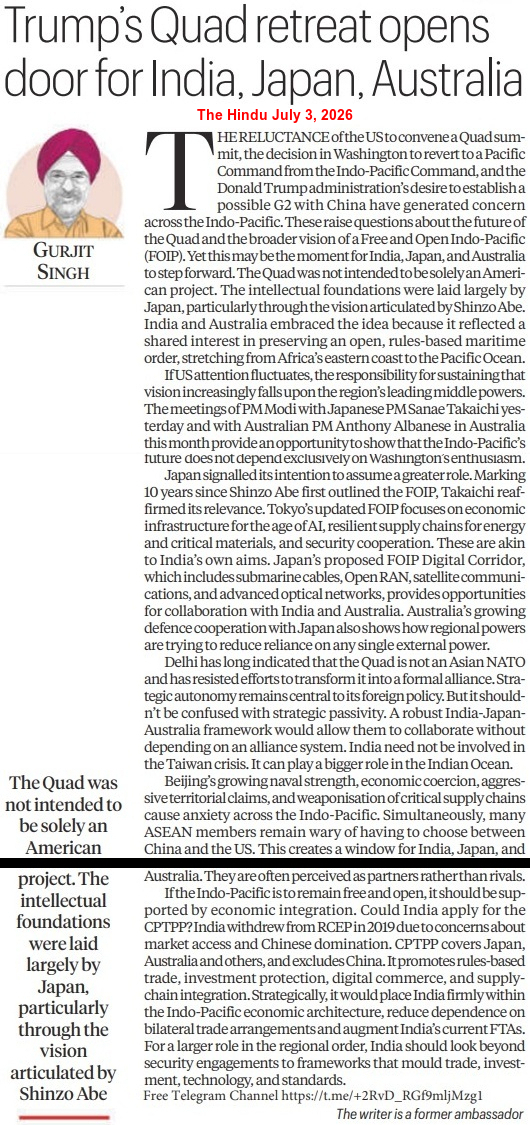
During his first term as US President, Trump used to view China as a strategic rival that needed to be confronted across various domains. Now, he has taken a different approach towards Beijing, with the US President emphasising on economic realism and top-level diplomacy. The structural impact of this change is most evident in the case of the Quad. Once, the Quad was projected as the primary framework for maintaining a free and open Indo-Pacific region. Unfortunately, that particular idea increasingly appears to be devoid of substance.
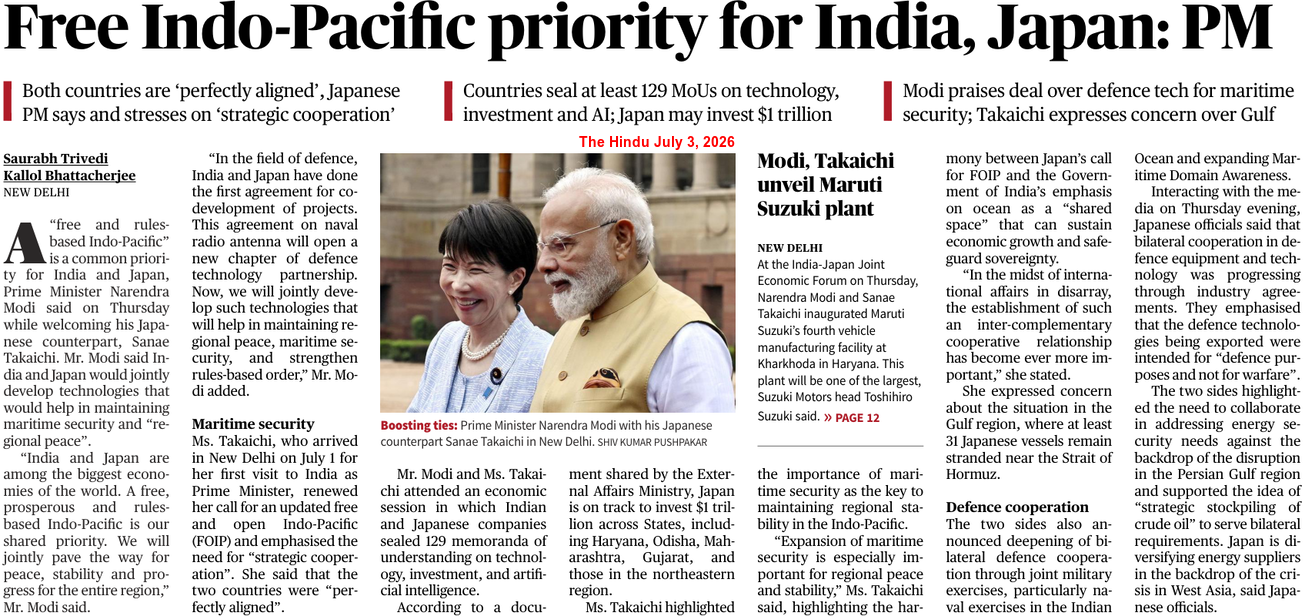
The Pentagon’s reversion of USINDOPACOM to its legacy name, USPACOM, has sparked debate over the US’ strategic priorities, as well. A section of analysts argues that the change signals a shift away from the seamless Indo-Pacific solidarity of the past toward a more fragmented, transactional approach that focusses heavily on the Pacific, potentially increasing the burden on regional powers, like India. In that case, the resulting situation should not be viewed as a disaster for India or an act of abandonment.
Rather, the time has come for India to take appropriate steps, such as rapid naval expansion, sharper diplomacy and the adoption of a foreign policy rooted in self-reliance, instead of reliance on external guarantees. It is India that must carefully define its maritime ambitions in the ocean that bears its name. To secure its role as a regional leader, the South Asian nation would have to ensure its transition from a historically land-centric power to a net security provider and a major global power.
Meanwhile,
Boundless Ocean of Politics on Facebook
Boundless Ocean of Politics on Twitter
Boundless Ocean of Politics on Linkedin
Contact us: kousdas@gmail.com

 ISMC
ISMC
