

A Deep Crack In Modern Civilisation
The history of human civilisation is basically the history of moral choices. Society has always decided whose life will be counted, whose suffering will be heard and who will be pushed to the margins of the system. The Nation-State was born with the promise of removing this choice from the whims of the individual and placing it in the hands of the Rule of Law. Here, choice refers to the arbitrary exercise of power, personal justice or private vengeance. Members of the society expected that power would no longer determine who is human and who is extra (or burden for the society). However, when the law fails to serve justice, the issue is no longer limited to the crime committed by an individual. Then, the self-identity of civilisation becomes important… The question arises here: Is it even able to take the responsibility for moral choices?
This is why the Jeffrey Edward Epstein Scandal becomes an important issue. If one considers the scandal a crime committed by a corrupt rich person, then s/he overlooks a deep crack in modern civilisation. This incident raises a fundamental question: Who does the framework of state, law and morality (that we consider the foundation of modernity) actually protect?
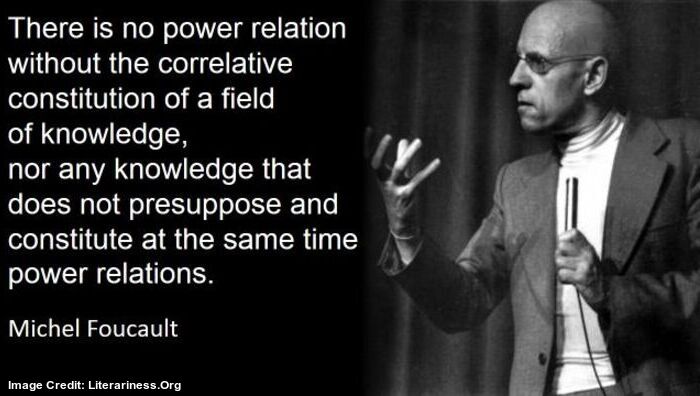
Power has never been the same in history as it highlights its transient, shifting and evolving nature across civilisations. In the Feudal Era, power was highly personalised and centred on the lord or king who held the land. The modern Nation-State promised to confine power within the framework of law. It was said that “Everyone is equal in the eyes of the law“. This is a foundational democratic principle (Rule of Law), ensuring laws apply equally to all citizens regardless of status, preventing discrimination based on race, religion, caste or wealth. In other words, institutional justice, and not personal goodwill, shall be the standard of civilisation. It emphasises that a civilised society should be built on fair, predictable and impartial systems rather than the arbitrary kindness or benevolence of individuals in power.
The Epstein Scandal has exposed the limits of this promise. Epstein’s power and influence were not solely a byproduct of his financial strength; rather, his wealth was a tool to construct a complex, strategic network designed to ensure impunity and gain access to the highest levels of global elites. His sphere of influence was neither outside the state, nor entirely under the control of the state. Epstein used to enjoy a liminal or autonomous position within a political system where an individual or entity operates with significant, but not absolute, power. Modern power is best maintained by avoiding extremes and embracing the middle ground.
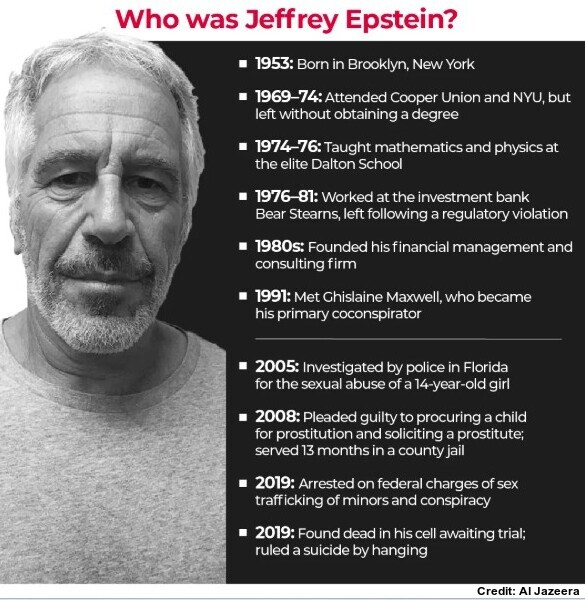
This system does not ensure punishment for crime. Instead, a calculation is done first as the state does not consider whether such an act is morally wrong, but considers the political, economic or social damage after the revelation of a crime. This is one of the main characteristics of modern civilisation. The timeline of the Epstein Scandal is quite important, as well. The US Police began an investigation in 2005 after a 14-year-old girl reported Jeffery Epstein to authorities, saying that she received a warning from someone who claimed to be in contact with the well-connected financier. The Police received similar complaints from other minor girls and tried to file a case against Epstein (January 20, 1953 – August 10, 2019) on multiple charges in 2006. However, there was an abrupt change in the pace of the criminal case upon reaching state prosecutors.
Epstein reached a secret Non-Prosecution Agreement (NPA) with Federal prosecutors in Florida. Under the agreement, Federal prosecutors in the Southern District of Florida agreed not to prosecute him for Federal sex-trafficking charges. Instead of facing Federal charges that could have resulted in a life sentence, Epstein pleaded guilty to lesser state-level charges – solicitation of prostitution and solicitation of a minor for prostitution – in Florida State Court. He was sentenced to 18 months in a county jail, of which he served 13 months, with significant work-release privileges that allowed him to leave the facility for 12 hours a day. The deal was reached without inputs from his victims and the agreement was kept under seal, leading to widespread criticism and investigations into the handling of the case by the then-US Attorney, Alexander Acosta.
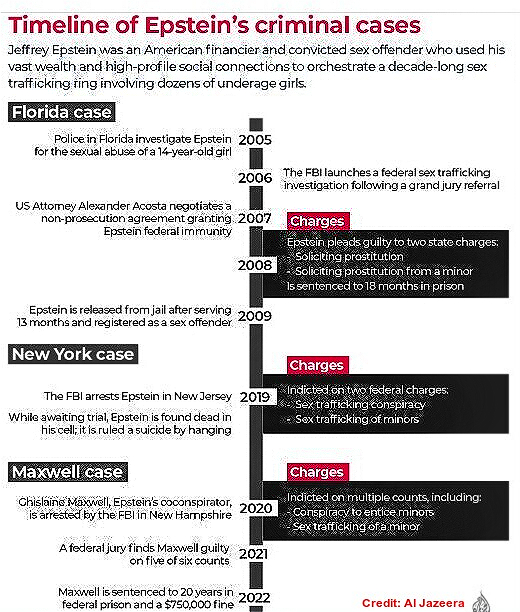
In 2019, a Federal District Court ruled that the US Government violated the Crime Victims‘ Rights Act (CVRA) by failing to confer with sex trafficking victims before entering a secret NPA with Epstein. The court also found the Government breached its duty to treat victims with dignity and respect. Although a November 2020 report by the Department of Justice‘s Office of Professional Responsibility (OPR) regarding the 2007-08 investigation into Epstein Case concluded that the Federal prosecutors involved in the NPA did not engage in “professional misconduct“, it stated that Attorney Acosta exercised “poor judgment” and prosecutors violated the CVRA by keeping the plea negotiations secret from victims. This outcome of the Epstein Scandal is no exception. Rather, it shows how the flexibility of the law becomes a shield for the wealthy and powerful.
The most uncomfortable aspect of the Epstein Scandal is that the state did not apply the law, but used it. In this case, no rules were broken, but they were used to manage, limit and contain injustice within a tolerable, predetermined range. Here, justice is no longer a moral standard, but becomes an administrative practice that is applied only when it threatens the status quo. This incident shows how justice in the modern state gradually becomes a conditional concept whose application depends on social status, communication skills and levels of discomfort. The victims were not invisible as they were heard and their complaints were registered. However, they did not belong to the group whose suffering became politically important to the state. Historical analysis frequently shows such incidents. From slavery to colonisation, from genocide to ethnic cleansing, lives of some humans have always been deemed relatively less valuable by the state.
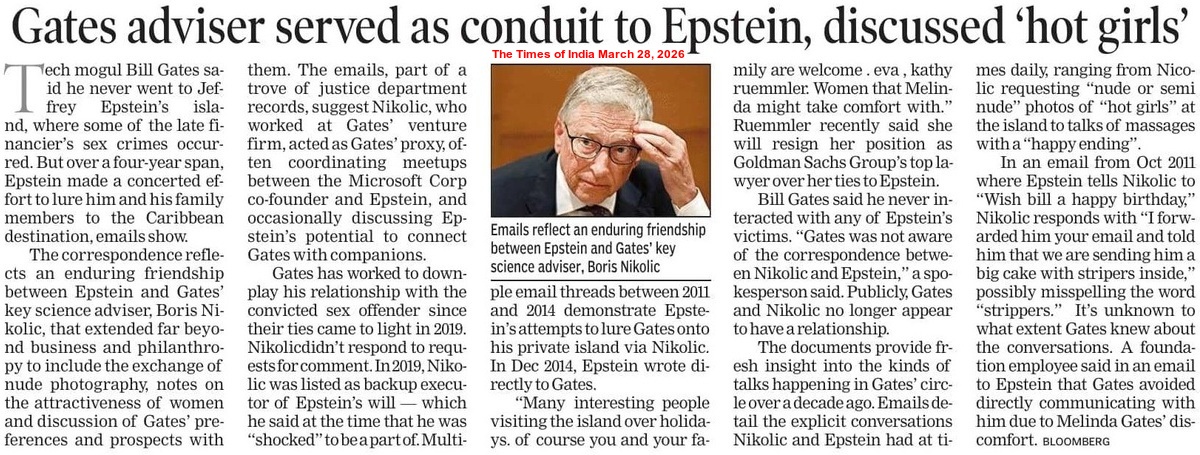
The Epstein Scandal has revealed no secret conspiracy, but unveiled a silent consensus: Some lives are valuable to the state, while some lives are manageable. The proven facts are quite disturbing – minors have been trafficked, tortured and even murdered for years. The state had the information, institutions took advantage, and elite educational institutions accepted donations from the high-level political and social figures who were involved in this network. Most importantly, the socio-political structure did not change itself even after the revelation of all these. Instead, it handled the situation.
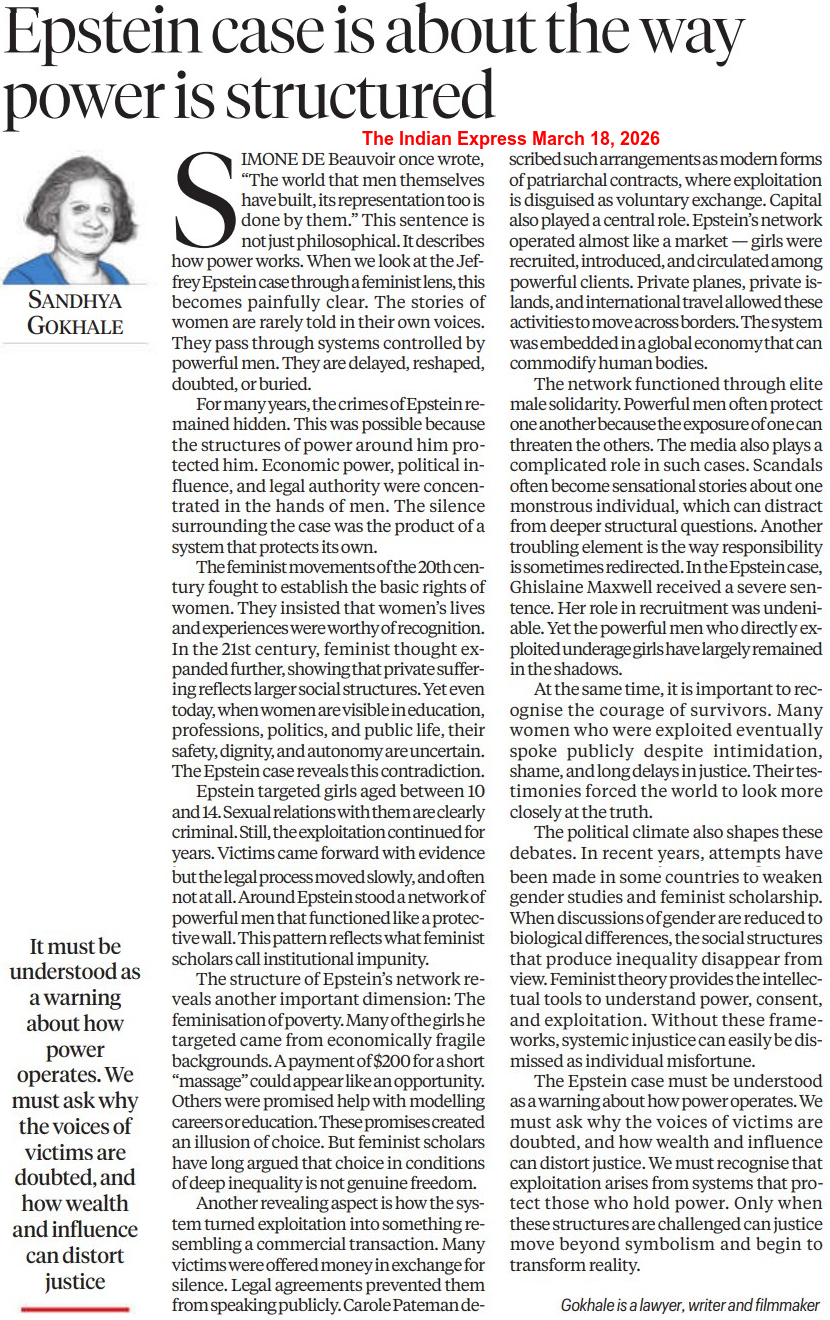
Civilisation defines itself through law, but law cannot create moral courage. The greatest demand of the Nation-State was to institutionalise justice. If the judiciary (or judicial institutions) starts managing injustice, then the state begins to lose its moral legitimacy. The Epstein Scandal shows that the danger of modern civilisation is not lawlessness, but a legal system which has learned to coexist with injustice. The future of civilisation will depend on whether we can restore the judicial system as a vanguard of justice by emphasising the critical, foundational role of law, fairness and institutional integrity (in order to sustain a stable society).
Currently, human civilisation is at a critical, multifaceted ethical crossroads, facing a serious issue: Whether human existence will be valued for its inherent, complex potential or reduced to a cold, bureaucratic statistic (a case file). In other words, the future of morality depends on whether we treat individuals with empathy, understanding and dignity, or merely as data points to be managed or disregarded.
Meanwhile,











Boundless Ocean of Politics on Facebook
Boundless Ocean of Politics on Twitter
Boundless Ocean of Politics on Linkedin
Contact us: kousdas@gmail.com

 ISMC
ISMC
