

Leading The Global South
For the Indian foreign policy-makers, the Year 2025 was not a stable one, but a year of (receiving) diplomatic shocks. From the return of Donald John Trump to the White House to instability in the Indian Subcontinent and other parts of the globe, New Delhi faced a number of tough tests as far as diplomacy was concerned.
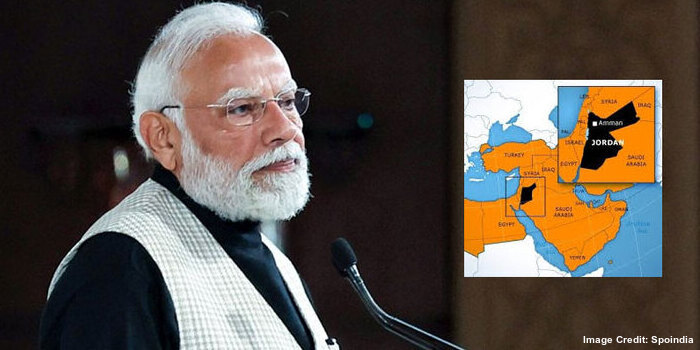
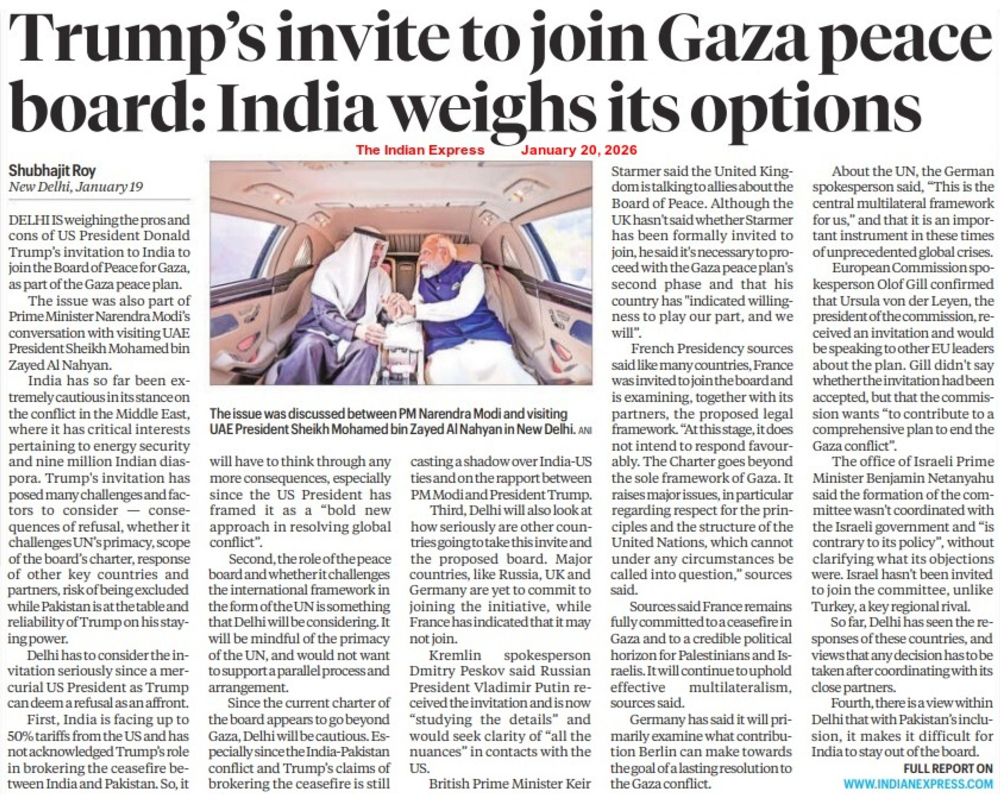
In such a scenario, Prime Minister Narendra Modi‘s visit to Jordan, Ethiopia and Oman at the end of 2025 was a small yet significant step towards strengthening the historical trade, as well as security, ties of the South Asian nation with West Asia and Africa. The visit took place at a time when serious geopolitical uncertainty, triggered by the US, prevailed in the region, especially in global trade. Interestingly, Jordan, Ethiopia and Oman are part of the Global South that India aspires to lead. Moreover, each of these countries holds a special importance in their respective regions.
It may be noted that the Global South refers to a group of often less economically developed nations in Africa, Asia and Latin America, characterised by shared histories of colonialism, lower incomes and inequality. The group seeks greater global influence against wealthier Global North countries. The Global South is a geopolitical concept, but not strictly geographical. It is used to describe nations advocating for reformed global structures, pooling influence and asserting themselves in international politics, replacing older terms, like Third World.
Prime Minister Modi arrived in Jordan, which holds special diplomatic significance for India, in the first leg of his trip. The strategic location and moderate political stance of Jordan allow the West Asian nation to play a unique role in regional diplomacy. Hence, New Delhi views Amman as a natural partner. During his visit to mark the 75th anniversary of bilateral diplomatic relations, Prime Minister Modi stressed on various aspects of bilateral trade ties, apart from discussing regional political developments, including Gaza, and other important issues, such as counter-terrorism, with King Abdullah II (born Abdullah bin Hussein).
The visiting Indian Prime Minister outlined a framework for relations with Ethiopia as a strategic partnership in Addis Ababa. It may be noted that India had played a crucial role in Ethiopia’s membership of the BRICS (an intergovernmental organisation comprising 10 countries: Brazil, China, Egypt, Ethiopia, India, Indonesia, Iran, Russia, South Africa and the UAE) in January 2024. Although India is a major foreign investor in Ethiopia (often cited as one of the top three or top five foreign investors), Addis Ababa enjoys deeper ties with China and Turkey in the fields of trade, security and military cooperation. New Delhi needs to put more emphasis on strengthening cooperation with the second most populous country in Africa, with recent estimates placing its population well over 130 million.
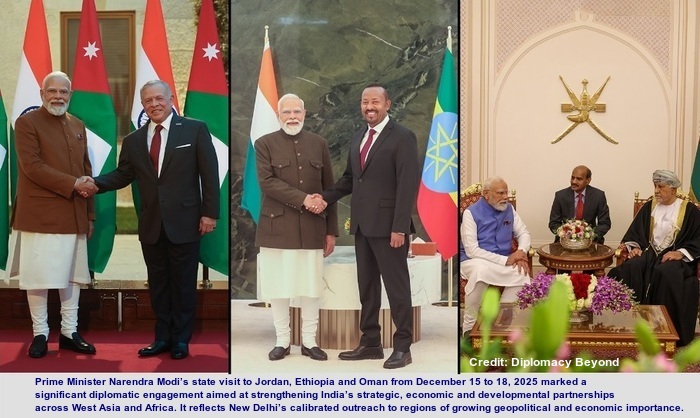
In Oman, Prime Minister Modi affirmed India’s deeper partnership with the Persian Gulf region. He signed a Comprehensive Economic Partnership Agreement (CEPA) in Muscat to encourage trade, employment and investment between the two countries. The CEPA could also open up avenues for Indian manufacturers to re-export goods to Africa and some parts of Europe. Analysts consider this move a part of India’s broader strategy to expand export destinations in an attempt to mitigate the impact of high US tariffs.
The three-nation tour of Prime Minister Modi has highlighted several important aspects of the Indian foreign policy, such as security in West Asia, economic development in Africa and connectivity in the Indian Ocean Region. With China and Pakistan increasing their activities in West Asia and Africa, India has no room to be complacent.
China, India Can Anchor Global South: Former Indian Diplomat
(Executive Intelligence Review; January 18, 2026): Shyam Saran, the former Foreign Secretary of India, has called for a new Non-Aligned Movement, arguing that the Global South must unify as the current international order is collapsing under growing great-power rivalry (instigated by the US). The old order is “unlikely to be restored”, he said.
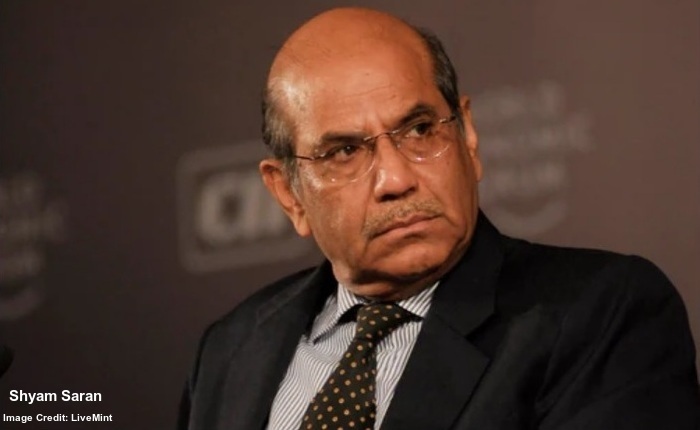
Speaking at the 2026 Answer Show, Thinker Spring Festival Gala hosted by China’s Guancha.cn (Observer Network), Saran has stressed that global debate has become too fixated on US-China competition, ignoring the wider spread of power across developing nations. He has argued that the future would be Multipolar, rather than a Bipolar World dominated by the US and China, or even a Monopolar World which, according to him, would be dominated by China.
Saran has warned that the world faces increasingly transnational threats, from pandemics to cybersecurity and Artificial Intelligence (AI), none of which can be solved by military strength alone. Yet, he has stated that international institutions are declining precisely when global cooperation is increasingly necessary. He has pointed to the contradiction between the need for international cooperation to address prominent challenges on the one hand, and the move away from multilateralism on the other.
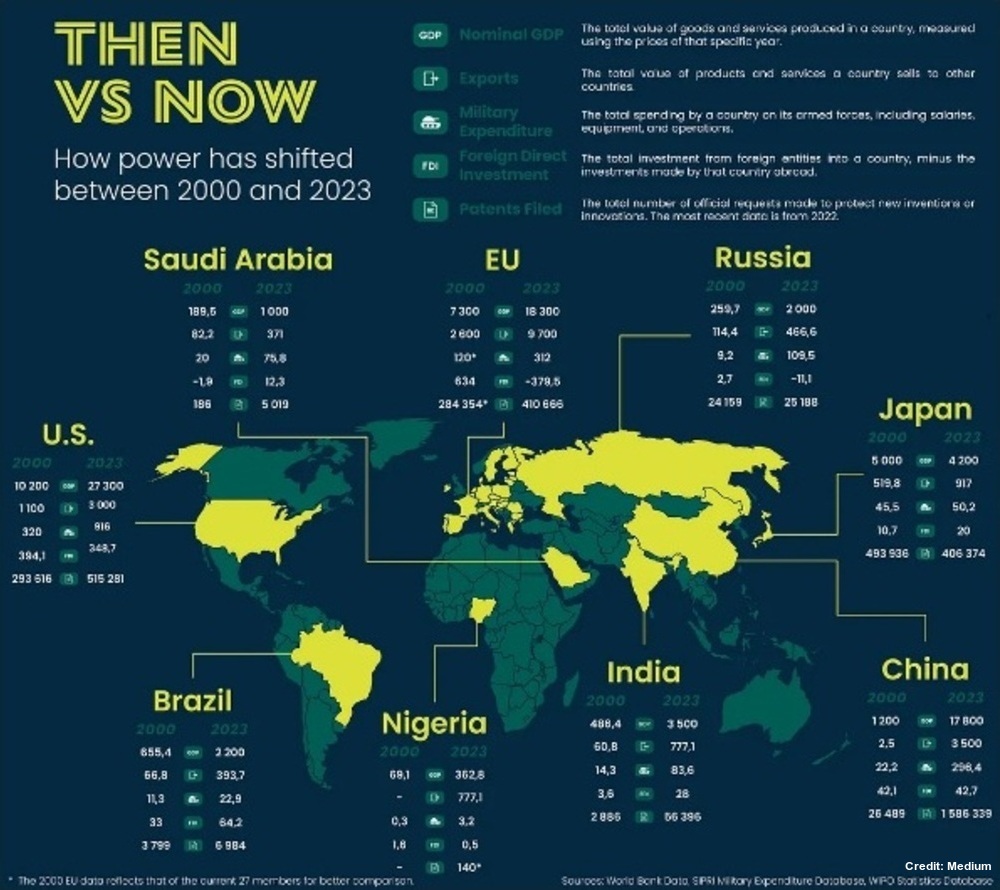
Invoking the Bandung Conference of 1955 and the Non-Aligned Movement formed in 1961, Saran has argued the Global South needs renewed leadership under modern conditions, rejecting the idea that any single country can act as a “pope” deciding who belongs. He has also called the Non-Aligned Movement “the largest peace movement in history”.
The former Indian diplomat has further said that leadership must come from India and China, which should work together to promote stability, development and peace. He has pointed to the upcoming BRICS Summit in New Delhi as a potential platform. Despite political turbulence across the globe, he has portrayed China and India as “anchor points for stability” and economic growth.
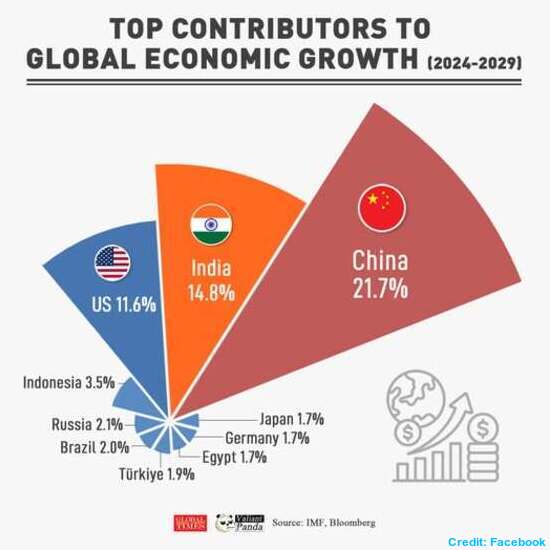
Saran has concluded his speech by warning that technology, including AI, must remain a tool guided by human values, and not a substitute for them. He has insisted that “we continue to value music, art and beauty”.
Meanwhile,
Boundless Ocean of Politics on Facebook
Boundless Ocean of Politics on Twitter
Boundless Ocean of Politics on Linkedin
Contact us: kousdas@gmail.com

 ISMC
ISMC Boundless Ocean Of Politics