

Supplying Nuclear Reactors Without Liability
The Narendra Modi Government introduced the Sustainable Harnessing of Advancement of Nuclear Energy for Transforming India (SHANTI) Bill, also referred to as the Atomic Energy Bill, 2025, in the Lower House of the Indian Parliament on December 15, 2025 in order to allow foreign companies (mainly from France and the US) to supply nuclear reactors to the South Asian nation without incurring any liability in case of an accident at a nuclear power plant. The move has marked the most consequential reform of India’s nuclear sector since the Atomic Energy Act, 1962.
The Government of India has claimed that the main objective of this Bill is to reach 100 gigawatts (GW) of nuclear power capacity by 2047, when India will mark the Centenary of its Independence. To achieve the goal, the Modi Administration has decided to repeal, as well as replace, both the Atomic Energy Act, 1962 and the Civil Liability for Nuclear Damage Act, 2010.

The government has argued that private companies are not interested in investing in the nuclear power sector because of the old laws. Under India’s Civil Liability for Nuclear Damage Act, 2010 (CLNDA), nuclear power companies (operators) could previously pursue claims against suppliers that could amount to unlimited compensation in case of an accident at a nuclear reactor. The SHANTI Bill, 2025 imposes a ceiling on the compensation claims for a nuclear accident and also clarifies the government’s role in liability. The Bill specifies maximum liability limits for operators (which can be private or state-run companies) based on the thermal power of the nuclear installation. Reports suggest that the maximum overall liability for a single nuclear incident is capped at USD 410 million as of December 2025. Meanwhile, the Government of India will be responsible for any nuclear damage claims that exceed the operator’s specified liability amount. The government will also establish a dedicated Nuclear Liability Fund to meet its obligations.
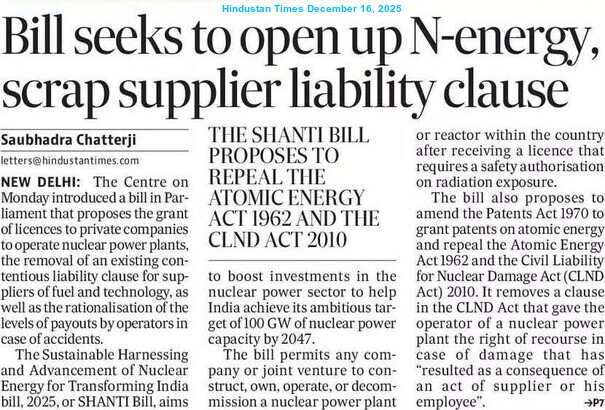
The SHANTI Bill, 2025 significantly limits the right of recourse against suppliers, a major point of contention in the previous Civil Liability for Nuclear Damage Act, 2010. Under the SHANTI Bill, an operator can only seek damages from a supplier if it is explicitly agreed upon in a written contract or if an individual acted with the deliberate intent to cause damage.
The Government of India has explained that the operator shall be liable for damages except those caused by “a grave natural disaster of an exceptional character, an act of armed conflict, hostility, civil war and insurrection or terrorism”. However, the operator would not be liable for damages in “under construction nuclear installation itself and any other nuclear installation, including a nuclear installation under construction, on the site where such installation is located, any property on the same site which is used or to be used in connection with any such installation; or the means of transport upon which the nuclear material involved was carried at the time of nuclear incident”.

The Bill reads: “The maximum amount of liability in respect of each nuclear incident shall be the Rupee equivalent of three hundred million Special Drawing Rights (SDR) or such higher amount as the Indian Government may specify by notification.“
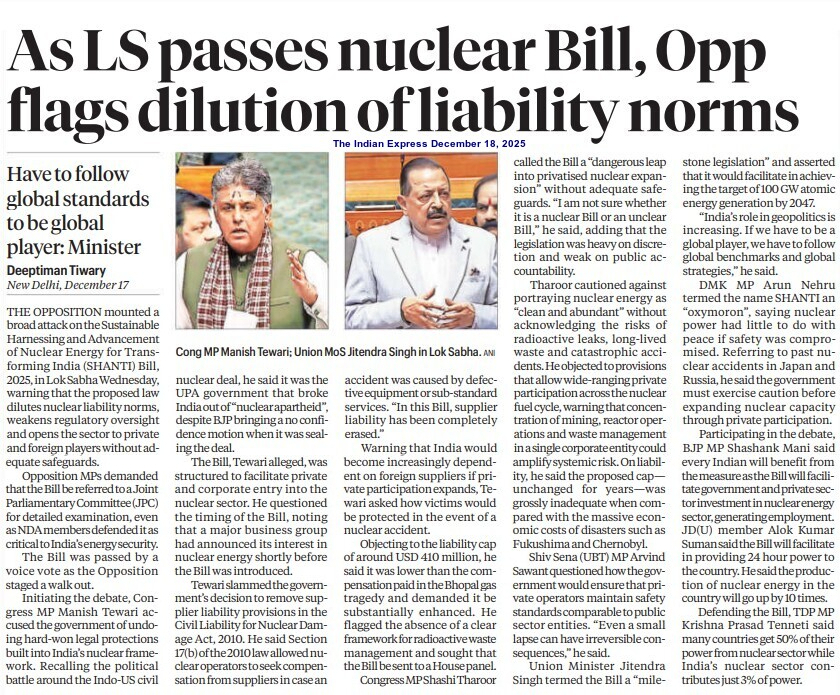
Although the government has claimed that it made the practical decision to attract private investment in the nuclear power sector and to pave the way for the import of nuclear reactors from the US, parties in Opposition are of the opinion that the main objective of the Indian Government is to allow the private companies to generate huge profit without taking any liabilities. In other words, private companies will be given the authority to conduct operations in the high-risk nuclear sector with limited liabilities. The Opposition parties have slammed the government for trying to restrict an individual’s ability to effectively use the judicial system to resolve grievances or to protect their rights. The Oppositions want further discussions on the Bill in the Parliament. However, the government has passed the Bill a couple of days ago.
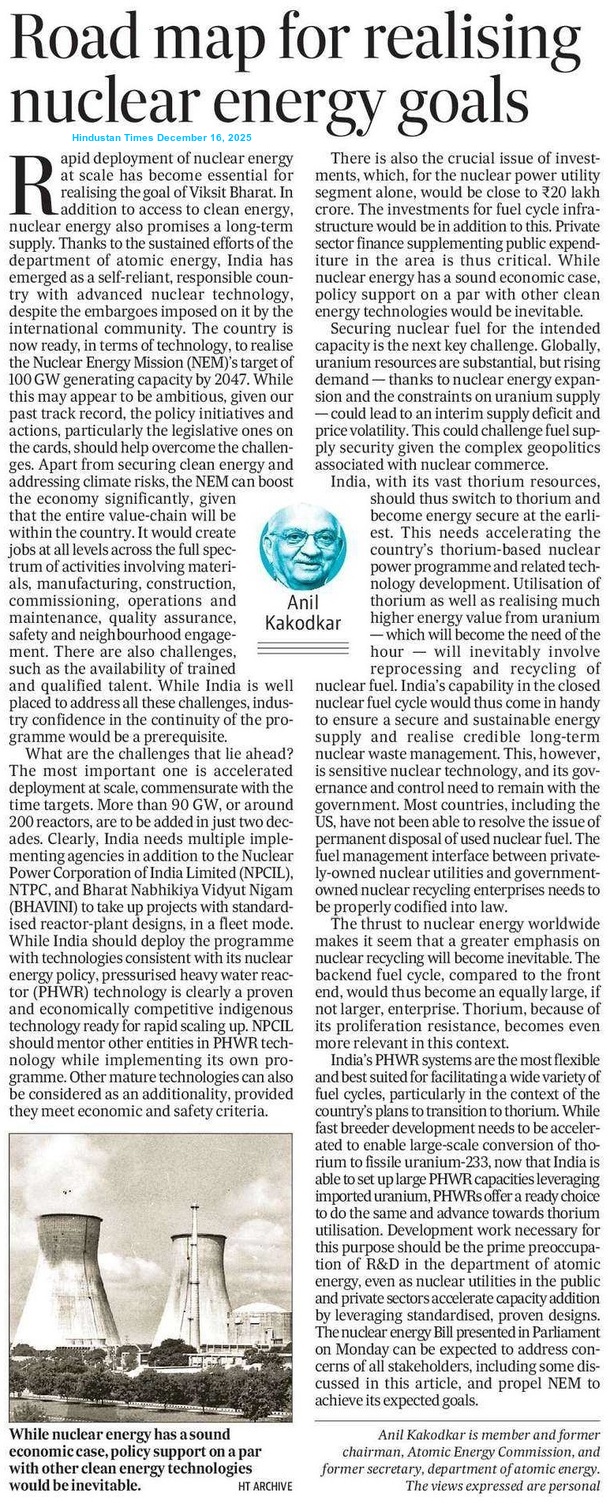
The Modi Government has rejected the allegations, claiming that although the previous government signed a nuclear deal with the US, it did not yield any benefits. The US companies refused to supply nuclear reactors to India as they would have to bear immense liability in case of an accident. The Donald Trump Administration, too, wants India to ease rules and regulations in order to pave the way for acquiring nuclear reactors from the US. The government has further claimed that the Bill would allow up to 49% Foreign Direct Investment (FDI) in certain nuclear activities, helping bring technology and capital into the sector.

Meanwhile,




Boundless Ocean of Politics on Facebook
Boundless Ocean of Politics on Twitter
Boundless Ocean of Politics on Linkedin
Contact us: kousdas@gmail.com

 ISMC
ISMC Boundless Ocean Of Politics