

Ancient Bread Bearing Jesus Christ’s Image Found
In what may be seen as an astonishing archaeological discovery, researchers recently unearthed five 7th-8th Century loaves of bread, including one featuring a depiction of Jesus Christ as a farmer and a Greek inscription, in Turkey. The remarkably well-preserved bread allows one to get a rare glimpse of spiritual, as well as cultural, expressions of early Christian communities.
The Karaman Governorship in south-central Turkey made an announcement in this regard on its official Facebook page on October 8, 2025, stating that the bread was discovered at the Topraktepe archaeological site where the ancient city of Eirenopolis was located.

During the excavation, archaeologists discovered five carbonised loaves, including a blackened loaf with a faint yet recognisable image of Jesus Christ etched on its surface. Interestingly, the ancient bread depicts Jesus Christ as a sower or farmer. It may be noted that the traditional Christ Pantocrator iconography often portrays Jesus’ blessing with his right hand, a gesture that also signifies teaching. It is basically a hallmark of Byzantine and Eastern Orthodox art. However, the image depicted on the recently-discovered loaf is quite different, as it presents him as a farmer. According to the archaeologists, this particular depiction reflects the symbolic importance of fertility, agriculture and labour in the religious beliefs of that period of time. Archaeologists also found other symbols, including one that appears to bear the Maltese Cross, on the loaves.
Interestingly, an inscription (written in Greek) on the loaf reads: “With gratitude to the Blessed Jesus.” Perhaps, it suggests the possible use in early Christian rituals. Experts believe that the Catholics could have used these loaves as Eucharist or communion bread during religious ceremonies. The Karaman Governorship has mentioned that the survival of these loaves through carbonisation indicates “exceptional preservation conditions” as they are the best-preserved examples ever found in Anatolia.
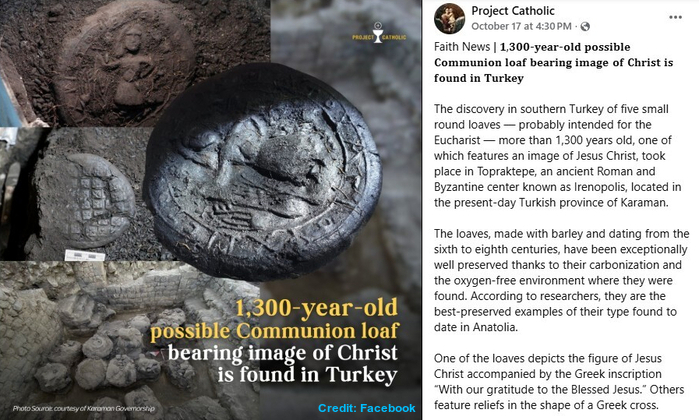
Archaeologists are of the opinion that the discovery of this extraordinary loaf would certainly help historians better understand how faith, food and everyday life intertwined in ancient times. A member of the excavation team has said: “These 1,300-year-old breads shed new light on a fascinating chapter of early Byzantine life. They prove that piety extended beyond prayers and ceremonies, materialising in objects that carried spiritual significance to the most basic human need: bread.” According to the member, these ancient loaves connect one to believers who walked before us and are an inspiring testament to the power of faith!

Meanwhile, the archaeologists have decided to carry out “chemical and botanical analyses” of the loaves to determine which grains and leavening agents were used to make the bread, apart from searching the area in order to locate the house of worship from which the bread might have originated.
Earlier, archaeologists uncovered a 5th-Century Church with an inscription, reading: “Only those on the righteous path may enter here.” This church is situated in Olympus. They had also uncovered one of the world’s oldest churches in neighbouring Armenia in 2024. The Artaxata Church dates to the 4th Century, when Armenia officially adopted Christianity.
Boundless Ocean of Politics on Facebook
Boundless Ocean of Politics on Twitter
Boundless Ocean of Politics on Linkedin
Contact us: kousdas@gmail.com

 ISMC
ISMC Boundless Ocean Of Politics