

India Test-Fires Missile From Train, Joins Elite Club
India has achieved a huge success in the defence sector. Defence Minister Rajnath Singh announced on September 25, 2025 that the South Asian nation successfully test-launched the Agni-Prime missile from a train. The Defence Research and Development Organisation (DRDO) of India has confirmed the news, mentioning in a statement that the advanced nuclear-capable medium-range missile, with a range of 2,000km, could accurately hit targets from a rail-based mobile launch site.
The DRDO has claimed that the Intermediate Range Agni-Prime Missile could be a game changer as it has multiple cutting-edge features. Notable among them is its rail-based mobile launcher which would allow the Army to launch the missile from land, as well as from a specially designed train. Hence, the Army would not have to deploy the missile in a specific location. Interestingly, the missile can be moved from one place to another, hidden if necessary and can be launched from the remotest parts of the country, even without road support.
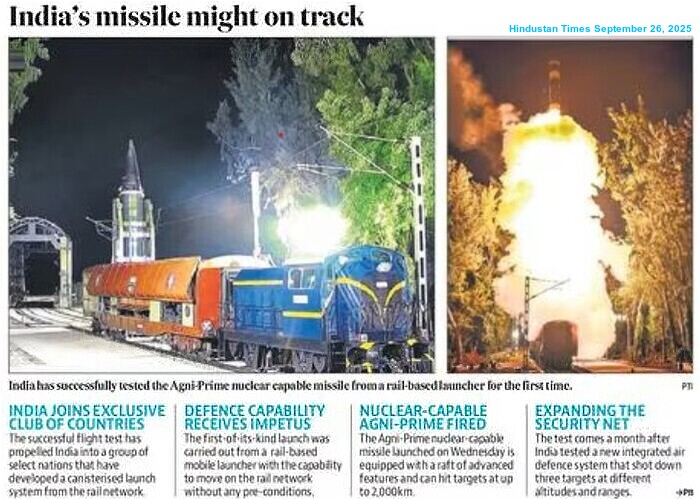
India has also manufactured a specially-designed train for launching the Agni-Prime missile. However, the missile can be transported to any part of the country by a normal goods train. This will make it easier to hide the missile from enemies. If necessary, the Army could launch an attack on the enemy with the Agni-Prime in a very short period of time.
The Defence Minister wrote on X: “… the first-of-its-kind launch was carried out from a specially-designed, rail-based mobile launcher. It has the capability to move on the rail network without pre-conditions (and) that allows shorter reaction time and cross-country mobility.” He added: “This successful test has put India in a group of select nations that have developed canisterised-launch systems from on-the-move rail networks.“

It may be noted that the erstwhile Soviet Union became the first country to launch missiles from railway tracks in the 1980s. Moscow reportedly fired RT-23 Molodets, a three-stage, solid-fuelled Intercontinental Ballistic Missile (ICBM), from special trains. The Molodets could also carry nuclear warheads. Around the same time, the US established the Peacekeeper Rail Garrison that involved placing 50 MGM-118A ICBMs on trains. The idea was to retain strike capability in the event of a nuclear war or a first-strike scenario by the Soviet Union disabling conventional launch platforms.
In 2021, North Korea claimed that it successfully launched missiles from a railway-borne system which reportedly travelled 800km before striking a target off its eastern coast. Later, Japan and South Korea confirmed the launch. However, Tokyo and Seoul could not confirm the platform.
According to defence experts, the fundamental behind all of these efforts, including that by India, is not just to extend launch capabilities. The fact is that ICBMs are high-priority targets, particularly during a nuclear war, as each side wants to neutralise the nuclear strike capacity of its enemy. Hence, it becomes important to hide the ICBMs and to move them to different places, if necessary.
Meanwhile,



Boundless Ocean of Politics on Facebook
Boundless Ocean of Politics on Twitter
Boundless Ocean of Politics on Linkedin
Contact us: kousdas@gmail.com

 ISMC
ISMC Boundless Ocean Of Politics