

Dealing With Storm From A Shelter
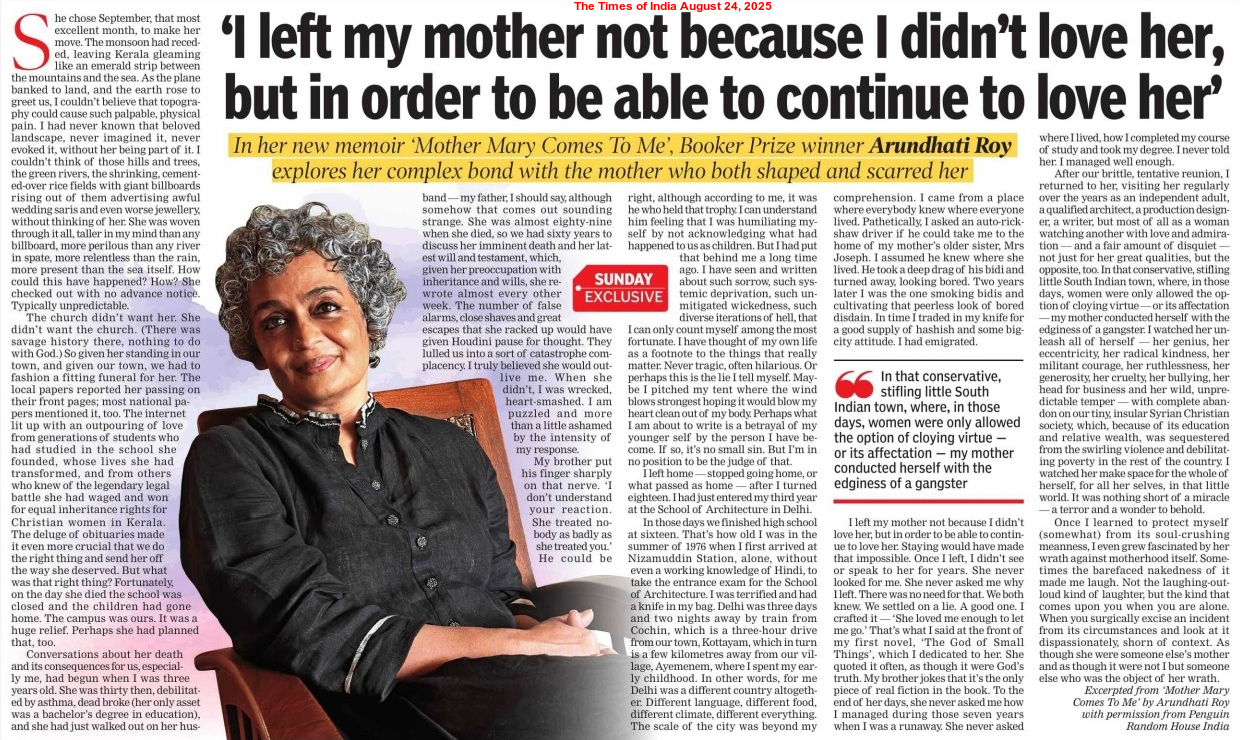
Is it possible for a person who protects others to act like a storm? Suzanna Arundhati Roy, the Indian author best known for her novel The God of Small Things that won the Booker Prize for Fiction in 1997, does not give any specific answer to this in her recently published book Mother Mary Comes to Me. Instead, she has left various clues throughout the 374-page publication for readers to reach a conclusion. In her first work of memoir, Roy has described her complex relationship with her mother that has shaped her personality. She has described her mother as “my shelter and my storm“!

The book has two main characters: the author herself and her mother, Mary Roy (1933 – September 1, 2022), a prominent educationist and feminist activist known for winning the landmark Supreme Court (of India) case Mary Roy etc. versus State of Kerala, which secured equal property inheritance rights for women of the Syrian Christian community in southern Indian Province of Kerala, ending the discriminatory Travancore Christian Succession Act of 1916. She was also the founder-director of Pallikoodam School in Kottayam that she ran for decades. In Indian society, the word mother does often evoke the image of an all-sacrificing lady who endures suffering for the sake of her children. However, the author has contradicted that notion by demonstrating a different reality based on her personal experience.

Roy has mentioned that she grew up under the constant protection of a fiercely ill-tempered, cruel and unloving mother, prompting readers to think whether a mother can be like this. At the same time, they would learn how one, in spite of bearing the pain, could analyse the reasons for such a behaviour of her/his mother with utmost compassion. The author has made a serious attempt to understand her mother not on the basis of the treatment she received from the latter, but as an individual with complex motivations and experiences, similar to how an adult would relate to other adults s/he encounters.
This lesson may also make the Indian society mature. In fact, one often denies the human nature of her/his mother while trying to establish her as an all-sacrificing lady (or goddess). A person also wants to tie the very existence of a lady to the binary of her success and failure as a mother. Only by breaking this binary, one can realise the fact that although a mother always protects her children, she, as a woman, can also be a storm. Even though they exist in the same body, they are actually two different persons or two separate entities. Hence, it would be inappropriate to place one’s responsibility on the other.

The country called India is just like that – both a shelter and a storm. India is a storm, as it wants to take away the citizenship of its people on the basis of some special sources of their identity. In this South Asian country, the fire of communal hatred consumes the lives of countless people with the consent of the ruler or someone can be hanged without any credible evidence against her/him. Here, a temple can be built on the land of a centuries-old mosque with the consent of the judiciary only on the basis of faith of the majority. Roy has further mentioned in her publication that the ruler’s desire to seize mineral resources from a forest region has ultimately turned a large population into declared enemies of the state.
At the same time, India provides many with shelter as they have nowhere else to go. However, single women and people with marginalised sexual identity have to constantly live in the face of the storm. The author has discussed their struggle to survive the storm, mentioning that the storm cannot ultimately take away their shelter.

Roy has analysed personal relationships, as well as the relationship between a state and its citizens, both explicitly and implicitly. Mother Mary Comes to Me is basically a tale of one’s selfless relationship with her mother, and also with a nation. At this point, the narrative turns from a personal to a collective one.
It is a different issue that not everyone is aware of the enduring relationship between the state and its citizens. According to the author, people are not destined to accept the storm or to run away from it and find another shelter. Instead, one should constantly try to resist the storm and to protect her/his shelter. In other words, the state, too, has two separate entities within it. While the state, as a storm, wants to take away even the minimum means of survival from its citizens, it also wants to protect them by providing shelter. Readers would have to draw their own conclusion.
Boundless Ocean of Politics on Facebook
Boundless Ocean of Politics on Twitter
Boundless Ocean of Politics on Linkedin
Contact us: kousdas@gmail.com

 ISMC
ISMC Boundless Ocean Of Politics