

Nepal Crisis Shakes South Asia
Nepal has plunged into a cycle of violence, instability and uncertainty, with the anti-government protests exposing the depth of public anger. Whether to call it a revolution or a rebellion or just an anarchic violence is a debatable issue. Not only the political elites, but also the common people have become the victims of violence. The people of Nepal are quite familiar with political unrest and popular uprisings. Even in light of that experience, the ongoing violence is an unprecedented, as well as historic, one.
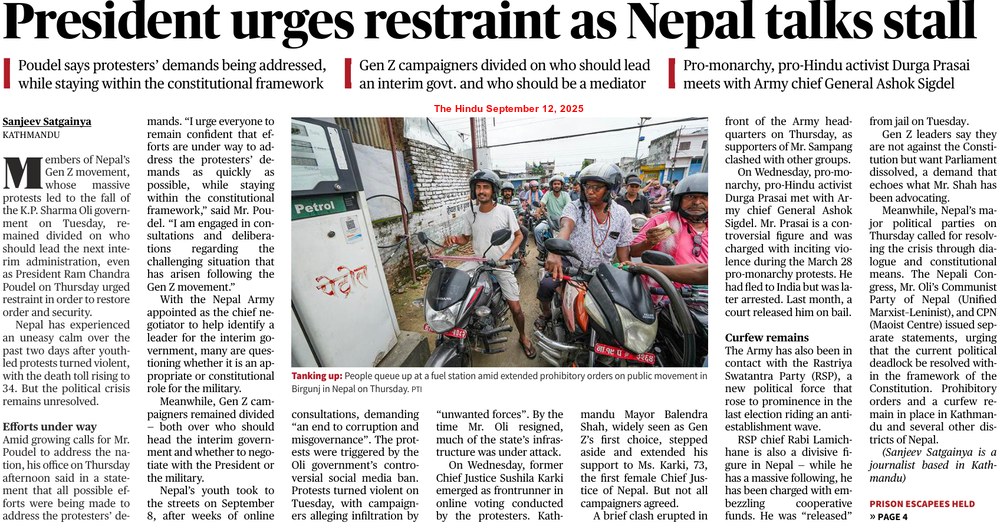
The Army has taken control of Nepal after the bloody protests prompted Prime Minister Khadga Prasad Sharma Oli to resign. Reports suggest that former Chief Justice (of Nepal) Sushila Karki has taken charge as the Interim Prime Minister. Everyone familiar with the political history of the Himalayan nation knows that the regime change became inevitable in recent times. However, the path was not expected to be so terrifying. Rajyalaxmi Chitrakar, the wife of former Prime Minister Jhalanath Khanal, was burnt alive by the protesters who set their residence on fire. Bishnu Prasad Paudel (65), the Finance Minister of Prime Minister Oli, was chased through the streets of Kathmandu. A disturbing video shows brutal kicking and thrashing of the minister. Crowds even set the Parliament on fire on September 9, 2025, sending thick black smoke billowing into the sky. Government buildings and the houses of political elites were also attacked throughout the country.

A section of political analysts believes that the demonstrations are basically pre-planned operations or deep-state conspiracies as Nepal’s youth were reduced to pawns in elaborate plots rather than citizens with legitimate grievances. News18 India’s Aman Chopra has claimed that “the world’s first so-called Gen Z movement” started all on a sudden as if there was “a planned toolkit behind it, some organised conspiracy”. He has suggested that the youth were “instigated and mobilised” rather than acting on genuine frustrations with their government. This sort of violent political change is a sign of curse. Hence, it is important to express hope that peace would return soon in Nepal and that the next government would be able to normalise the situation.
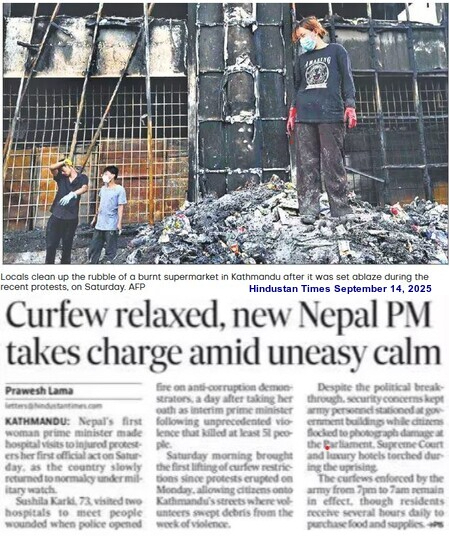
The direct spark for this Gen Z uprising was the Oli Government‘s crackdown on social media sites. The pro-Beijing rulers in Kathmandu were not aware of the fact that the Nepalese society would never accept the Chinese approach to governance. Hence, a fire was instantly created from a spark, the ingredients and conditions for which were certainly in place. Extreme social, as well as economic, inequalities had become increasingly inviolable, with the gap between the privileged elite class and common people widening rapidly. Young people started leaving the country due to the lack of employment opportunities. Those, who have failed to do so, badly wanted to break the shackles of authoritarianism (as evidenced by the ban on social media).

The ruling class did not realise that this sort of pressure cooker situation would cause an explosion. It may be noted that the Mahinda Rajapaksa Government in Sri Lanka and Sheikh Hasina‘s Awami League Government in Bangladesh did a similar mistake in 2022 and 2024, respectively.
India, which has learnt a lesson from the political crisis in Bangladesh, is now on high alert. The Narendra Modi Administration in New Delhi has made no comments on the current political situation in Nepal, apart from calling for peace. However, this development also shows how vulnerable New Delhi’s diplomatic position is. Former Prime Minister Oli strongly criticised India after being ousted from power, and it is quite clear that the next government in Kathmandu would not consider New Delhi a friend. Meanwhile, the Modi Administration has tightened vigilance along the India-Nepal border, creating troubles for an estimated 3.5 million Nepalese citizens working in India.
It is really unfortunate that each of India’s neighbours are currently facing huge problems which are a mix of corruption, unemployment, rising costs and public distrust. For India, these developments are not old events, but issues that directly affect security, trade and diplomacy. In times of danger, Bhushan Ramkrishna Gavai, the Honourable Chief Justice of India, has reminded the rulers in New Delhi of the utmost importance of protecting democracy, stressing: “While many say and believe that the Parliament is supreme, according to me, it is the Constitution of India that is supreme. All three wings of democracy work under the Constitution.” He added: “The Parliament has the power to amend (the Constitution by way of addition, variation or repeal of any provision), but it cannot alter the basic structure of the Constitution.”
Boundless Ocean of Politics on Facebook
Boundless Ocean of Politics on Twitter
Boundless Ocean of Politics on Linkedin
Contact us: kousdas@gmail.com

 ISMC
ISMC Boundless Ocean Of Politics