

Ancient India’s ‘Modern’ Education System
Dedicated to my respected teachers…
Britons often claim that they enlightened the Indians by introducing a modern educational system during the colonial era. However, historical evidence suggests that India had an advanced educational system thousands of years ago!
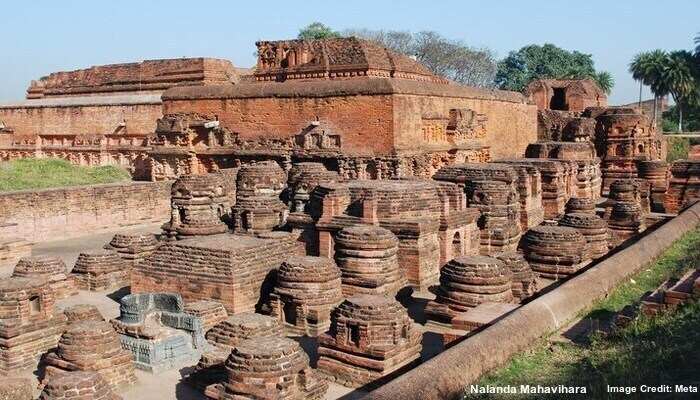
One can get a glimpse of the ancient Indian educational system by visiting the archaeological site of Nalanda Mahavihara in eastern Indian Province of Bihar’s Nalanda District. The archaeological remains of a monastic and scholastic institution, dating from the 3rd Century BCE to the 13th Century CE, include stupas, shrines, viharas (both residential and educational buildings) and important art works made of stucco, stone and metal.
A proper educational system used to exist during the Indus Valley Civilisation, also known as the Harappan Civilisation, a Bronze Age civilisation flourishing in the northwestern region of South Asia (modern-day Pakistan and northwest India) from 3300 BCE to 1300 BCE. It was one of the earliest urban cultures of the Indian Subcontinent and a major ancient civilisation, alongside Egypt and Mesopotamia.
According to archaeologists, the Indus Valley Civilisation had a practical, community-based educational system, focused mainly on transmitting skills and knowledge necessary for daily life and trade. While formal schools were not found, evidence suggests literacy, standardised weights and measures, while specialised crafts indicate a certain form of structured learning, possibly within family units or workshops.
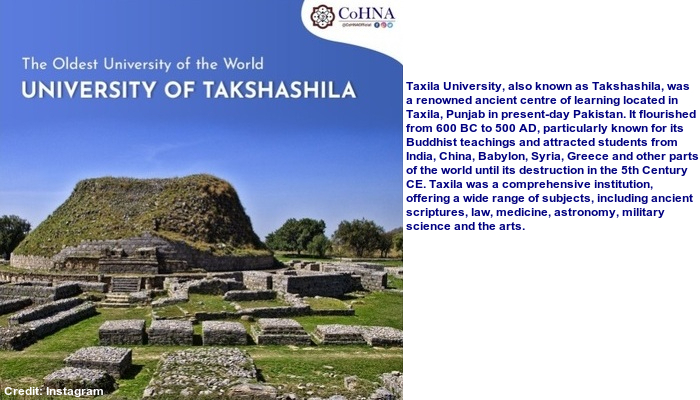
The Vedic Age, spanning from approximately 1500 BCE to 600 BCE, followed the decline of the Indus Valley Civilisation. This Age is characterised by the composition of the Vedas, a collection of sacred texts that form the foundation of Hinduism, and is named after these texts. The Vedic Period is further divided into the Early Vedic (1500-1000 BCE) and Later Vedic (1000-600 BCE) periods. Historians are of the opinion that modern educational institutions were established in India during the Vedic Age.
Educational system of the Vedic Period stressed on holistic development of human beings, with a special importance on spiritual growth, building moral character and developing intellectual curiosity. It was primarily based on the Guru-Shishya tradition (Mentor-Protégé tradition), as students used to live with their teachers in Gurukuls where they received personalised instructions. The curriculum included memorisation and recitation of Vedic texts, philosophy, grammar, astrology, logic, language and literature, alongside professional skills, like riding, dancing and archery.
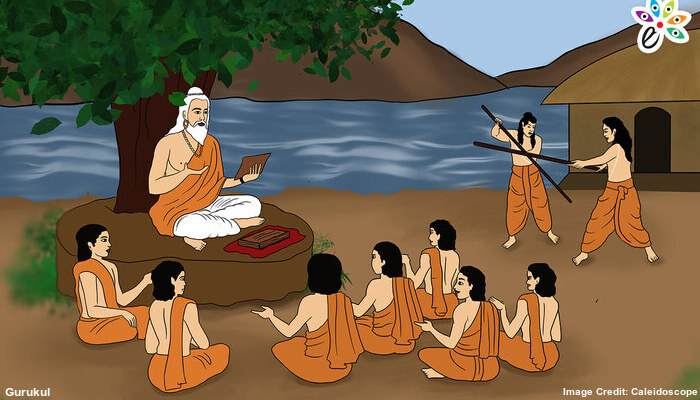
The very essence of the Vedic Age educational system was the close relationship between teacher (Guru) and students (Shishya), fostering a nurturing and personalised learning environment. Research suggests that students used to live with their teachers in forest dwellings, away from the distractions of urban life, to learn not only academic subjects, but also various skills and values. As far as the curriculum is concerned, it encompassed a wide range of subjects, including the four Vedas, Upanishads (a series of Hindu sacred treatises written in Sanskrit in 800-200 BCE, expounding the Vedas in predominantly mystical and monistic terms), grammar, logic, astronomy and medicine.
Although verbal instruction, memorisation, recitation and discussion were common methods of the Vedic educational system, students also learned through observation, practical application and reflection. This method helped them to develop themselves as well-rounded individuals with strong moral character, intellectual capacity and spiritual awareness. Interestingly, the basic education could last for at least 12 years, with academic sessions starting with a ceremony, called Upakarman, and ending with Utsarjan. The emphasis on holistic learning, moral values and critical thinking capabilities in Vedic educational system still remains somewhat relevant.

The concepts of Muni (Hermit), Rishi (Sage), Sanyasi (Monk), Sadhu (Saint) and Yogi (Ascetic) had a close relation with the Vedic higher education system. Those who devoted their lives to research work after completing formal education were called Muni. They used to have a thoughtful mind that allowed them to concentrate on a particular subject. In other words, Munis or research scholars followed the path of knowledge. The term Muni is derived from the Sanskrit word Manan, which means to think. Munis have always been known to think quite deeply and their thinking capacity is far ahead of the common people. They speak very little as they take an oath to keep silent and acquire knowledge. For example, one can mention Kapil Muni and Shakya Muni. Apart from conducting research, Munis used to teach students at gurukuls under the supervision of a Guru (teacher).
Rishis are those who discovered something new through research. One can compare them to persons with a PhD Degree. Each and every Vedic mantra mentions the name of a particular Rishi. In fact, Rishis discovered the basic principles (theses or sources) of the Vedas. In the Vedas, Rishi is a title given to a sacred person, who knows everything about his scriptures and the science (or logic) behind everything. They are considered to be at a high level of learning and understanding because of hundreds of years of penance or meditation. The Vedas mention that the words said by the Rishis never prove to be untrue and that is why the curses, as well as boons, given by them never go in vain. They are believed to have created the hymns and verses of the Vedas, the ancient Hindu scriptures. Rishi (ऋषि) refers to “ray of light, ascetic”. In Sanskrit, Tri (ऋ) means “who has already swum across” Shi (षि) or “the powered appearance which appears time and again“. The term Rishi actually means an “ascetic who has swum across the powered appearance time and again“.
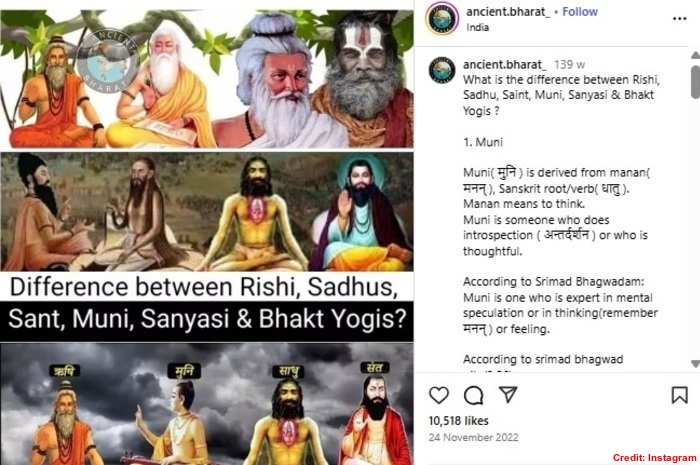
In Hindu tradition, Rishis are categorised into seven types based on their spiritual attainments and roles. They are: Brahmarshi (The highest class of Rishis who said to have attained complete mastery over their senses and passions, apart from possessing the highest divine knowledge of Brahma or the ultimate reality or absolute truth), Maharshi (Rishis of a middle class who might not have complete mastery over their senses, but still held significant spiritual wisdom and power), Rajarshi (Rishis who were also kings, having attained self-realisation while serving as a ruler), Devarshi (Celestial sages, often considered to be of divine origin, who spread the knowledge of the Brahmarshis or the highest level of spiritual enlightenment), Shrutarshi (Rishis who were known for their profound knowledge of the Vedas and scriptures), Paramarshi (A term that can signify a supreme or exalted Rishi) and Saptarishi (The group of seven great sages who are central to Hindu mythology and tradition, often linked to the stars of the Big Dipper. Those seven Rishis are Atri, Angiras, Pulaha, Pulastya, Kratu, Marichi and Vashistha).
It may be noted that Munis and Rishis could lead a family life as many of them had one or more wives. However, Sanyasis did not lead a family life. In fact, they used to leave their family in order to concentrate on higher studies. The main purpose of the Sanyasis was to attain salvation. Sanyasi is basically a person who has renounced all worldly ties and lives a life of complete detachment, focusing solely on spiritual pursuits (or knowledge). They are often associated with the pursuit of ultimate liberation and freedom from the cycle of birth and death. Sanyas (सन्यास) refers to renunciation. In Sanskrit, Sa (स) means “the primal truth”, while Nyas (न्यास) means “trusting“. Hence, Sanyas means “trusting absolute truth, which is not all this (creation)”. Therefore, Sanyasis are those who have renounced this world, given up all worldly desires and have chosen the path to discover Absolute Truth. They devote themselves to the welfare of humanity or society or service of an ideal.
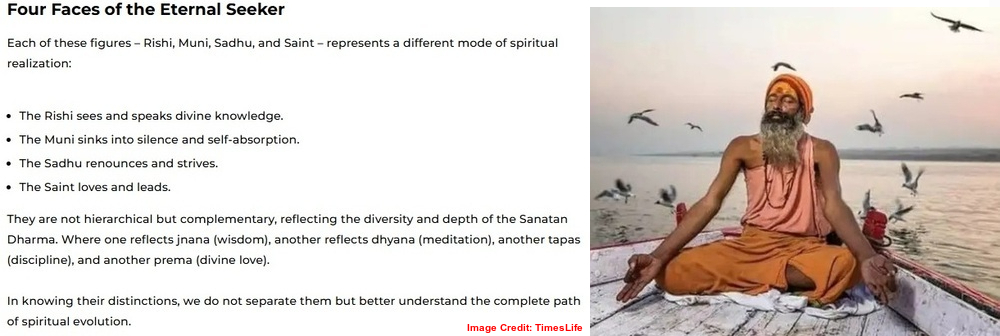
As per ancient Indian literature, Sadhu means an honest person. In other words, any honest person can be called Sadhu. And, the one who practices yoga or meditation is a Yogi. Anyone, be it a Muni or Rishi or Sanyasi, can be a Yogi. Lord Shiva, one of the principal deities of Hinduism who creates, protects and transforms the universe, is called Mahayogi. Yogis could also lead a family life.
It’s amazing to think how strong, as well as modern, the ancient Indian educational system was. India also had Buddhist Gurukuls or monasteries or monastic complexes. Some of them are Nalanda, Vikramashila, Odantapuri, Pushpagiri, Somapura Mahavihara and Bikrampur Vihara (in present-day Bangladesh). Those were centres of learning and spiritual practice in ancient India, similar to the broader gurukul system. These institutions focused mainly on Buddhist philosophy, meditation and monastic life, with students living and studying under the guidance of a Guru who emphasised practical knowledge, spiritual development and a strong sense of community living.

The traditional educational system of India was quite practical, as well as profound. Through their philosophy of life, Munis, Rishis and Sanyasis established truths that are still widely accepted.
Sources:
Ancient Education System of India
Indian Education: Ancient, Medieval and Modern
Education System in Ancient India: An Introduction
Ancient Indian Education: A Timeless Legacy
Education In Ancient India
The importance of the Gurukul system and why Indian education needs it
Boundless Ocean of Politics on Facebook
Boundless Ocean of Politics on Twitter
Boundless Ocean of Politics on Linkedin
Contact us: kousdas@gmail.com

 ISMC
ISMC Boundless Ocean Of Politics