

Understanding Bhagavad Gita
Introduction
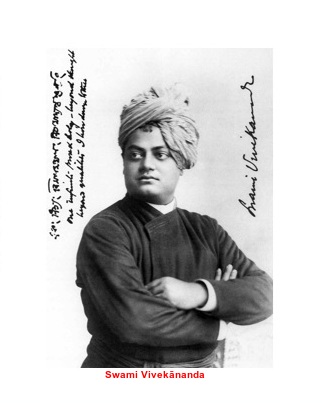
Once, Swami Vivekānanda (born Narendranath Datta; January 12, 1863 – July 4, 1902), an Indian Hindu monk, philosopher, author, religious teacher and the chief disciple of the Indian mystic Ramakrishna, said: “Arise, awake, stop not till the goal is reached.” Swamiji’s words best express what the Bhagavad Gita (often referred to as the Gita, is a Hindu scripture, dated to the 2nd or 1st Century BCE, which forms part of the epic poem Mahabharata) actually emphasises. It intends to inspire humanity to strive for attaining spiritual perfection in life. To be precise, the spiritual gist of the Vedas and the Upanishads is condensed and is rolled in a handbook which is the Bhagavad Gita by Maharishi Vyasa Deva.
The entire Hindu tradition is beautifully woven in a very simple language in the 700 verses of the Gita. Acharya Shankar, considered to be the greatest commentator of the Gita, said that whatever Lord Krishna said to Arjuna at the time of the Kurukshetra War, Vyasa wrote in the Mahabharata versified beautifully in 700 verses, known as the Gita. The philosophical, spiritual and religious truths of the Hinduism is present in the Gita. It harmonises the path of knowledge, of bhakti, that of action and the path of meditation. The Gita helps people to be spiritual and guides on how to be a perfect human being. It is also called the Moksha sastra or scriptures that tells us how to be free ourselves of the cycle of life and death.
What is the Bhagavad Gita?
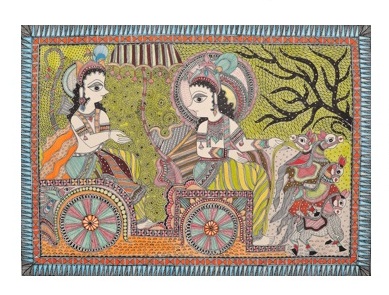
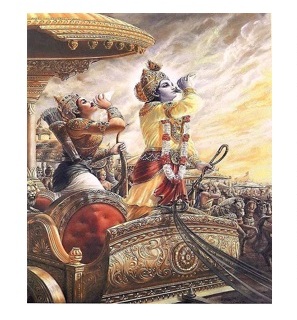
The Bhagavad Gita is an episode in the Mahabharata. It is on the backdrop of the Kurukshetra War between the Kauravas and the Pandavas. It is composed in the form of a dialogue between Arjuna and Lord Krishna as the charioteer of the former.
On the verge of the start of the war between the warring branches of the same family, Arjuna was overwhelmed with doubts when the true import of the war settles in and he was no longer wanted to fight his own family and relatives.
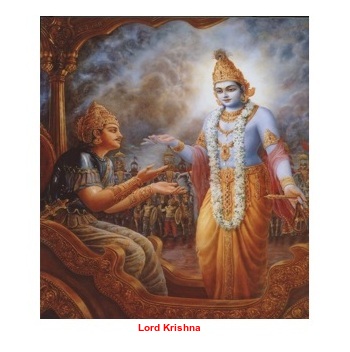
Lord Krishna does not insist Arjuna to fight the war, but presents before him the Philosophy of Life (Jeevan Darshan) and asks him to decide for himself, which forms the central theme of the Gita. He persuades Arjuna to perform his duty as he is born a Kshatriya (i.e., a warrior).
Lord Krishna says…
Lord Krishna puts the three truths before Arjuna – 1. Who are you? 2. What is this world? 3. What is the permanent (or eternal) truth? He reiterates that one cannot give up Swadharma, the natural tendencies or a particular way of life. That is the crux of the Gita.
Contents of Bhagavad Gita
The Gita comprises of 18 chapters. The subject matter or the main idea is given in short in Chapter 2, named the Samkhya Yoga, which stresses the dualism between soul and matter.
In Chapters 3-17, the main content is further elaborated. And, the Chapter 18 sums up the entire content. The Gita talks not of worldly prosperity (Abhyudaya), but Mukti (Nishreyasa, to be free). Every chapter of the Bhagavad Gita is named with the suffix yoga, such as Samkhya Yoga, Karma Yoga, Jyankarmasannyasa Yoga.
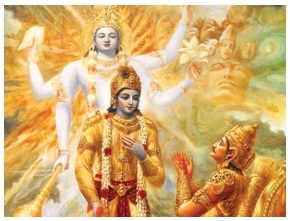
Chapter 2 mentions that the atma (or the soul) is permanent, but the human body perishes (in order to protect the creation which have been immortalised in Verses 20 and 23). Verse 38 says that happiness and sorrow should be taken as the same. The Verse 47 inspires to work sincerely and uphold one’s duty, while from Verse 55 to 72, Lord Krishna explains how one can be a self-composed person (stithaprajna) which will ultimately help the person to be one with the Brahman, the Supreme Lord and the creator of the Universe. The famous verses in Chapter 4 are verses no. 7 and no. 8 that assure the human being that whenever evil spreads, the God, our Creator, reappears.
“यदा यदा हि धर्मस्य ग्लानिर्भवति भारत।
अभ्युत्थानमधर्मस्य तदात्मानं सृजाम्यहम्।।“
The teachings
In the very next verse (no. 9), Lord Krishna says that one who realises God and has full faith in Him, will not have to be born again and will be one with Him. In this way, through all the chapters, the Gita presents the higher ideals following which a person can know her/his true self and attain perfection in this life.
An intensive reading and understanding of this book can help a person to not only reach her/his goal to be spiritual, but also to be inclusive, sincere to his duties, free of temptation, should control her/his senses, body and mind to be a perfect spiritual one. Above all, s/he should love God, have faith in Him, offer the best to Him and realise that the God is within her/his own self and also in every soul.
The Gita, as a text, talks about the four human objectives (purusharthas) of dharma, artha, kama and moksha.
Relevance of the Gita in contemporary times
Indian philosophy and spirituality are fully present in the Gita. It looks at life in a universal way and says: “You exist today, will perish and again you will be born.”
This approach of the Gita is not bound by any narrow religion. A Christian, a Muslim or a person from any creed or religion can follow it in the contemporary time.
It simply talks about attaining perfection as a human being on the earth. The dilemma that Arjuna faced is still present in all human beings in different forms anywhere in this world. One can also find the contradiction explained in the Mahabharata everywhere and in every sphere of life.

The Gita gives strength of mind, as well as spiritual guidance. It inspires the core personality of a person in time of mental crisis. It should be read by young and old people alike all over the world. Young people for implementing the teachings of the Gita, while for the older generation to get mental peace. Man comes on the earth having good qualities, he has a sacred soul and has infinite strength in himself. A transient weakness may make him go haywire, but the teachings will help a person to overcome the crisis and come out unscathed.
by Dipti Ray
Boundless Ocean of Politics has received this article from Dipti Ray. Ms Roy, based in Kolkata, India, is a retired school teacher (of English Language). Now, she is exploring meaningful hobbies and activities that interest her.

Boundless Ocean of Politics on Facebook
Boundless Ocean of Politics on Twitter
Boundless Ocean of Politics on Linkedin
Contact us: kousdas@gmail.com

 ISMC
ISMC Boundless Ocean Of Politics