

Terrorism & Indian Diplomacy
He was a Pakistani Army doctor who masterminded the terror attacks (popularly known as 26/11) in the western Indian city of Mumbai on November 26, 2008. The National Investigation Agency (NIA), a law enforcement agency of India with specific focus on counter-terrorism, claimed that Tahawwur Hussain Rana (64) had helped David Coleman Headley, a Pakistani-origin US terrorist, to get a visa to arrive in India before the terror attacks. During investigation, the NIA came to know that Rana was aware of Headley’s connection to various terrorist organisations, including Lashkar-e-Toiba (LeT). He even advised Headley to hold talks with terrorists in different parts of India.
The US extradited Rana to India on April 9, 2025, 17 years after the Mumbai terror attacks that had claimed 166 innocent lives. The Donald Trump Administration has claimed that Rana’s extradition is a critical step toward seeking justice for the six US nationals and scores of other victims who were killed in the heinous attacks. According to Washington DC, it was a highly sensitive operation that the US officials executed with extreme caution in order to prevent any disruption. The concerned US authorities transported Rana on a Gulfstream G550 aircraft, using a dummy flight code to avoid tracking, as NSG commandos and US Sky Marshals escorted the terrorist throughout the journey from California to New Delhi. Rana was taken into custody upon his arrival in the Indian capital.

Tammy Bruce, the spokesperson of the US State Department, stressed that Rana was extradited to India “to face justice for his role in planning the horrific 2008 Mumbai terrorist attacks“. She told the press: “The US has long supported India’s efforts to ensure those responsible for these attacks are brought to justice, and as President Trump has said, the US and India will continue to work together to combat the global scourge of terrorism.” Bruce added: “Rana is in India’s possession and we are very proud of that dynamic.“
Rana, who grew up in Islamabad, met Headley during his school days. Later, he became a medical practitioner and joined the Pakistani Army. Rana retired from the Army as a Major in 1997 and settled in Canada. He eventually obtained citizenship of Canada and started an immigration consultancy firm there. Later, he moved to the US and set up an office in Chicago.

The NIA investigation has revealed that Rana, through his firm, helped Headley to get a 10-year visa extension. He also helped Headley to carry out a reconnaissance mission in Mumbai ahead of the terror attacks. In India, Headley used the front of running an immigration business and was in constant touch with Rana. There were more than 230 phone calls between the two during that period of time! Rana was also in touch with Major Iqbal, another co-conspirator of the attacks. Rana, along with his wife, visited India in November 2008, days before the terror attacks.
The NIA has started interrogating Rana after taking him in custody. According to sources close to the investigative agency, the Canadian national of Pakistani origin could reveal who else was behind the 26/11 terror attacks and whether there was any active involvement of the Pakistani Army. The interrogation would also shed light on the purpose of his visit to India just before the terror attacks in 2008.

According to the Indian agency, the conspiracy to carry out terror attacks in Mumbai had begun in 2005, with senior LeT operative Sajid Mir and Pakistani national Major Iqbal roping Headley. Later, Headley helped the LeT to rope Rana and another senior Pakistani Army officer. Rana, who has been kept in Tihar Jail in New Delhi, would undergo a trial at a special NIA Court in the Indian capital.
As expected, families who lost their members 17 years ago are happy with the extradition of Rana. However, Washington DC is yet to hand over Headley to New Delhi, although there is an extradition treaty between India and the US (signed in 1997). It may be noted that Headley had played a greater role in the 26/11 terror attacks. He was under the scanner of the Government of India even before that incident. Hence, it was a major intelligence failure for India. Otherwise, Headley could not carry out such a terrible plan while remaining unnoticed.

India has repeatedly sought Pakistan’s cooperation in bringing the masterminds to justice after the terror attacks on its soil in 2008 and beyond. However, Islamabad has been hiding notorious terrorists, like Hafiz Muhammad Saeed and Zakiur Rehman Lakhvi, for so long. In such a situation, the extradition of Rana has provided the Indian investigative agencies with an opportunity to gather necessary information about the involvement of the Pakistani state and non-state actors in terror attacks in India. This information would certainly help India to strengthen its position against Pakistan-sponsored terrorism at global forums, like the UN Security Council.
As expected, Pakistan is trying hard to distance itself from the entire incident by identifying Rana as a Canadian citizen. For now, the only relief is that India has an important piece of evidence to continue its fight against terrorism and to ensure justice for the victims of the 26/11 attacks. New Delhi would have to take advantage of this opportunity in order to succeed in the diplomatic test.
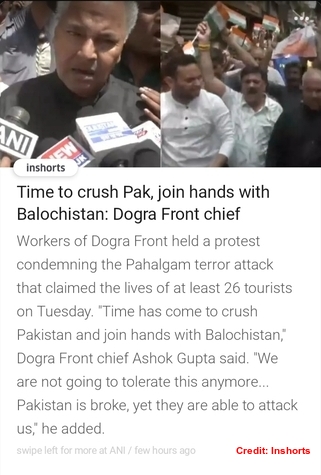
Meanwhile,


Leaders from across the globe condemn the terror attack
Boundless Ocean of Politics on Facebook
Boundless Ocean of Politics on Twitter
Boundless Ocean of Politics on Linkedin
Contact: kousdas@gmail.com

 ISMC
ISMC Boundless Ocean Of Politics