

Elephants, Too, May Suffer From Alzheimer’s
The human brain uses special neurons, called memory cells (or time cells), to organise memories of various events and experiences. The brain also has a special nerve cell, called a place cell, which helps human beings to recognise their location. Hence, one can identify each place separately.
There is another type of special nerve cell, called grid cell, in human brains that helps a person to determine how far or in which direction her/his destination is. Grid cells create a three-dimensional map of every place, like an image. The discovery of place cells and grid cells has unlocked the mystery of human navigation. In other words, human brains store a precise and detailed map of every place, making the process of navigation possible. Grid cells act much like the internal GPS of the brain. As the concepts of distance and speed associated with spatial knowledge are stored in the brain, one can recognise (and return to) her/his previous location after visiting a place. In other words, grid cells help a person to reach her/his destination.

Yet, people often forget the right path and fail to reach their destination. When one cannot return home or recognise a familiar path, it is considered an illness in medical terms. People, suffering from complex neuro-degenerative diseases (like Dementia or Alzheimer’s), often make such a mistake. A general decline in cognitive abilities affects a person’s ability to think, remember and applying logic (reason), disrupting the dynamics of the sense of direction.
The discovery of place, as well as grid, cells has provided a clearer understanding of Dementia and Alzheimer’s. In Alzheimer’s disease, damaged neurons (nerve cells) lose their ability to connect with one another, leading to impaired communication within the brain. Neuroscientists have found that Amyloid and Tau proteins in the brains of Alzheimer’s patients become tangled and stiff, damaging the neurons in the relevant areas of the brain.

Neuroscientists have also found that even longest-living animals, such as whales or dolphins, and domestic animals, like dogs and cows, suffer from Alzheimer’s disease. However, they believe that wild animals suffer from Alzheimer’s for a very short period of time. Interestingly, elephants are an exception. Perhaps, elephants do not lose their memory because of their ability to recall information for extended periods, making it seem like they “never forget” important details crucial for their survival in the wild. Elephants walk miles outside the forest area in search of a specific place or to gather food and water. Most importantly, they can remember the route for decades! Elephants are also quite good at identifying themselves and maintaining close bonds with members of their own group.
According to experts, the large brain size of elephants plays a crucial role in this regard. The brain of an elephant is about three times larger than a human brain and contains about three times more neurons! Researchers believe that elephants are immune to Alzheimer’s disease because of their large brains and sharp memory, although the cerebral cortex of an elephant brain has fewer neurons than a human’s cerebral cortex. In spite of the fact that the human brain is the most advanced and the human memory is also quite sharp, people often lose memory.
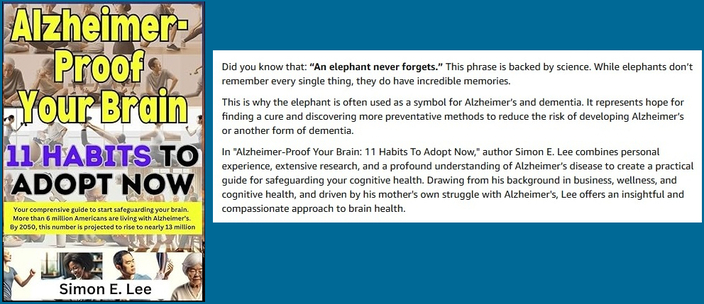
No one can claim that elephants are not at risk of memory loss. It is possible that elephants suffer from Alzheimer’s for a very short period of time. As per a report prepared by the Wildlife Conservation Society, a number of elephants disappear from forests every day across the globe. Most of them end up falling into the hands of poachers, resulting in the loss of their precious tusks, as well as lives. Many elephants get lost in towns and cannot return to the forest. Had there been a chance to examine the brain of such an elephant before its disappearance, the animal might have also been diagnosed with symptoms of Alzheimer’s. Deforestation and human encroachment into forests have increased the pressure on wildlife in recent times, prompting elephants and other animals to move into human settlements. They may suffer from Alzheimer’s because of this.
The presence or absence of Amyloid and Tau proteins in specific areas of the brain is considered a key indicator for diagnosing Alzheimer’s disease. This test is also done on elephants, but on captive or dead elephants, and not on wild elephants. It is necessary to monitor their behavioural changes in order to determine whether elephants could suffer from Alzheimer’s, although it is quite difficult to conduct this test on wild elephants.

Other diseases besides Alzheimer’s can also cause Amyloid and Tau proteins to build up in the brain. These diseases include Parkinson’s disease, Frontotemporal Dementia and Chronic Traumatic Encephalopathy. Hence, the absence of Amyloid and Tau does not necessarily mean the absence of Alzheimer’s. Ignorance about what is happening to wild elephants makes it impossible for researchers to come to a conclusion.
Boundless Ocean of Politics on Facebook
Boundless Ocean of Politics on Twitter
Boundless Ocean of Politics on Linkedin
Contact: kousdas@gmail.com

 ISMC
ISMC Boundless Ocean Of Politics