

AI Makes History Alive!
Dr Federica Nicolardi could not believe her eyes as she did not expect that 2,000-year-old secrets could be revealed with the help of Artificial Intelligence (AI).
Dr Nicolardi, a Papyrologist at the University of Naples Federico II, has deciphered numerous ancient writings on papyrus. She came to know about Vesuvius Challenge, one of the more than 800 scrolls known as the Herculaneum Papyri that were carbonised by the eruption of Mount Vesuvius in 79 BCE, a couple of years ago. In February 2024, three students won USD 700,000 for their successful attempt to read some passages from this ancient papyrus scroll with the help of AI.
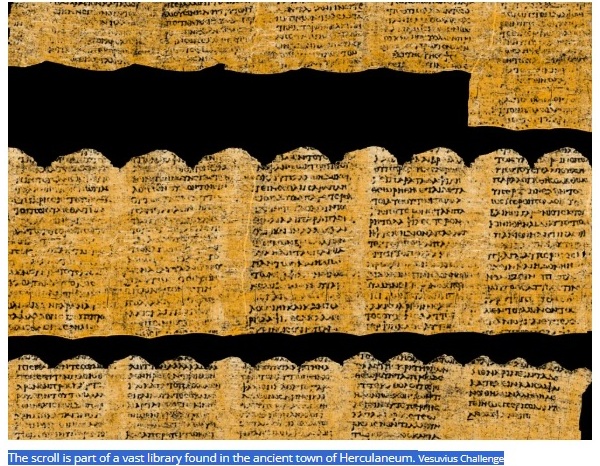
Dr Nicolardi has claimed that the text of the entire papyrus is now readable, thanks to Computed Tomography, a non-invasive medical imaging procedure that uses X-rays to create detailed pictures of the inside of the body. She has explained that one can read the entire papyrus text with the help of 3D mapping and AI-powered Machine Learning. The papyrologist, who recently read the lines written in Greek letters in five columns, stressed: “Unbelievable! The 2,000-year-old history is within our reach. This is a historic moment in the world of papyrology.” She added: “This is the start of a revolution in Herculaneum Papyrology and in Greek Philosophy in general. It is the only library to come to us from ancient Roman times.”
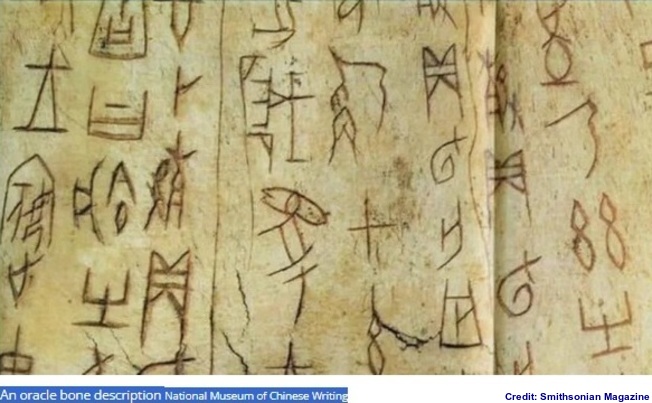
According to Dr Nicolardi, AI has opened up new horizons in deciphering everything… from ancient Greek and Latin scripts to Chinese oracle bone scripts, the oldest attested form of written Chinese carved on bull bones or tortoise shells dating to the late 2nd Millennium BCE. AI not only helps researchers to recover ancient inscriptions, but also to understand the meaning of the lost scripts or languages. Earlier, computers successfully analysed the ancient scripts by digitising them. However, AI has made a big difference through neural networks as it instructs computers to analyse data the same way the human brain works. The digitisation of data collected from the recovered ancient texts helps researchers to get an idea about the unknown scripts, as well as characters.

Experiments with a neural network-based model, called Pythia, have recently been conducted in London. Pythia is basically an ancient text restoration model that recovers missing characters from a damaged text input using deep neural networks. Data from 10,000 Greek inscriptions written between the 7th Century BCE and the 5th Century AD were fed into this model network. Interestingly, the technology successfully revealed meanings of those unknown inscriptions, although several letters or symbols were missing from the text.
The great advantage of technology is that it can deal with large, as well as complex, amounts of data. Thea Sommerschield, a Historian and Epigrapher at the University of Nottingham, has stated: “They are very complex to read, they are badly preserved, parts of them are missing. We are not really sure where they came from or what their dates are; there are interesting mixes of dialects.” However, she has claimed that the new Ithaca model, a deep neural network for the textual restoration, geographical attribution and chronological attribution of ancient Greek inscriptions, provided insight into the time and place of the unknown scripts. Sommerschield stressed that the Transformer model of machine learning would also open the way to understanding the complex linguistic patterns of ancient writings.
Robert Fowler, the Emeritus Professor of Greek at Bristol University and Chair of the Herculaneum Society, considers the recovery of texts from the blackened scrolls with the help of AI as a stunning feat. He said: “This is a complete game changer. There are hundreds of these scrolls waiting to be read.”
Experts believe that they are moving into a new era and so far, it has been an incredibly rewarding journey.
Boundless Ocean of Politics on Facebook
Boundless Ocean of Politics on Twitter
Boundless Ocean of Politics on Linkedin
Contact: kousdas@gmail.com

 ISMC
ISMC Boundless Ocean Of Politics