

‘Women Are Like Flowers’
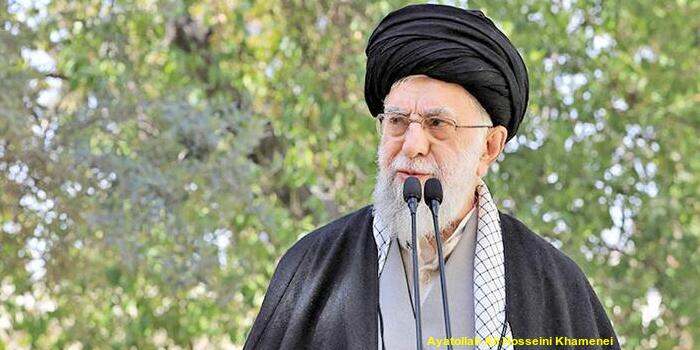
At a time when Iran is relentlessly cracking down on women fighting for their basic rights, Supreme leader Ayatollah Ali Hosseini Khamenei has said: “A woman is a delicate flower and not a housemaid. A woman should be treated like a flower in the home. A flower needs to be cared for. Its freshness and sweet scent should be benefitted from and used to perfume the air.“
The UN General Assembly (UNGA) had adopted the Convention on the Elimination of All Forms of Discrimination against Women (CEDAW) on December 18, 1979. On the occasion of its 45th anniversary, Khamenei posted one after the other on his X handle about the role of women in society in December 2024. As expected, his comments have triggered a fresh controversy across Iran. People recalled the death of 22-year-old Mahsa ‘Zhina’ Amini, as the demise of the Kurdish girl on September 16, 2022 in the custody of Iran’s Moral Police (after she was arrested for not following a strict Islamic dress code) led to a nationwide outrage. Immediately after Khamenei’s post, Israel posted an image of a young woman wearing a black hijab on its official X account. That single image was enough to humiliate the Islamic Republic as it was the picture of Amini!
The Anti-Hijab Movement that has been going on in Iran for years has put the country under huge pressure in the global arena. The movement became more destructive after Amini’s death. At that time, Tehran introduced more stringent Hijab Laws, announcing that women would have to face severe punishment for not wearing hijab in public. The Bill, passed by the Iranian Parliament in 2022, could lead to up to 15 years in prison and hefty fines for women and girls who violate the dress code. However, the move failed to suppress the movement.
Despite knowing what the consequences would be, Iranian singer Parastoo Ahmadi performed in an online concert in Western outfit without wearing a hijab in mid-December 2024. As expected, the singer and two of her band members were arrested. During the concert, she reportedly said: “I am Parastoo, a girl who wants to sing for the people I love. This is a right I could not ignore; singing for the land I love passionately. Here, in this part of our beloved Iran, where history and our myths intertwine, hear my voice in this imaginary concert and imagine this beautiful homeland.“
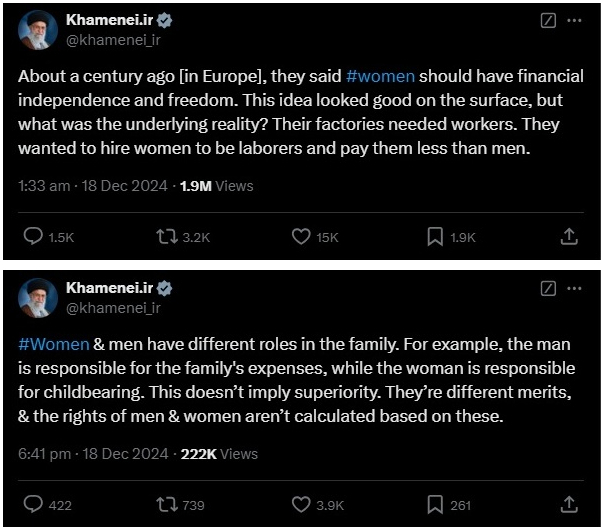
Meanwhile, Ayatollah Ali Khamenei expressed his objection to the participation of women in the workplace, too. On X, he wrote: “About a century ago (in Europe), they said #women should have financial independence and freedom. This idea looked good on the surface, but what was the underlying reality? Their factories needed workers. They wanted to hire women to be labourers and pay them less than men.” The Supreme Leader added: “#Women & men have different roles in the family. For example, the man is responsible for the family’s expenses, while the woman is responsible for childbearing. This doesn’t imply superiority. They’re different merits, & the rights of men & women aren’t calculated based on these.“
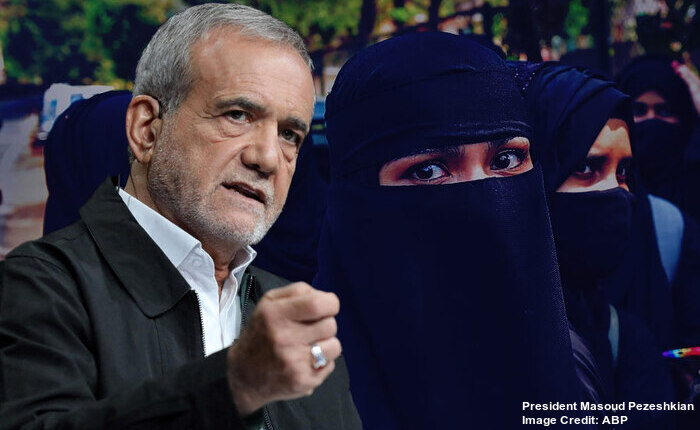
Interestingly, Iran has withdrawn a new controversial Hijab and Chastity Law that was due to come into force on December 13, 2024. President Masoud Pezeshkian called the legislation “ambiguous and in need of reform“. With this, the President signalled his intention to reassess its measures.
The proposed new law would introduce harsher punishments for women and girls for exposing their hair, forearms or lower legs in public. There were also provisions for severe punishment for violation of the rules. Currently, fines are levied for breaking the rules, while the maximum punishment is 15 years of imprisonment.
The Hijab Fatwa of the Orthodox Religious Regime in Tehran naturally caused a storm of controversy. Several Women’s Rights organisations, as well as the Amnesty International, heavily criticised the proposed law. Political analysts are of the opinion that President Pezeshkian, popularly known as a Reformist, is behind the proposed law. While campaigning for the Presidential Election in early 2024, the doctor-turned-politician had stressed that he was against strict restrictions related to the hijab. Discussions have started on whether the President opened the window of freedom for women while going against the will of the Supreme Religious Leader!
According to a section of political observers, Iran is now under multifaceted pressure in the current regional geopolitical landscape. The US-Israeli offensive has cornered Iran-backed Hamas, Hezbollah and the Houthis in Palestine, Lebanon and Yemen, respectively, in recent times. The fall of the Bashar al-Assad Regime in Syria on December 8, 2024 was also a setback for the Islamic Republic. In such a situation, it has become increasingly difficult for Tehran to show enough courage required to enact a strict Hijab Law.
Boundless Ocean of Politics on Facebook
Boundless Ocean of Politics on Twitter
Boundless Ocean of Politics on Linkedin
Contact: kousdas@gmail.com

 ISMC
ISMC Boundless Ocean Of Politics