

A Liberaliser Who Transformed Indian Economy
Dr Manmohan Singh (September 26, 1932 – December 26, 2024), who served as the 13th Prime Minister of India from 2004 to 2014, passed away on December 26, 2024 at the age of 92. The fourth longest-serving Prime Minister of India (after Pandit Jawaharlal Nehru, Indira Gandhi and Narendra Modi) was an eminent economist, sharp minded and also an extremely honest person with utmost integrity. He is popularly known as the chief architect of India’s most important economic reform programme. Economic reforms had taken place from 1991 to 1993 that put the Indian economy in the orbit of global markets. The significance of the reform programme can be understood from the way India’s economic growth rate increased in the post-reform phase.
Dr Singh’s economic policies also triggered the strong rise of Indians at the global stage. Today, many Indians are serving as directors of the top US and European organisations, and at the forefront of technological innovation, as well as policy-making. It has been possible mainly because of the impact of large-scale investment in higher education, science and technology in India, as well as the economic reforms in the early 1990s. Hence, history shall remember Dr Singh as one of the most important (Indian) political personalities of all time.
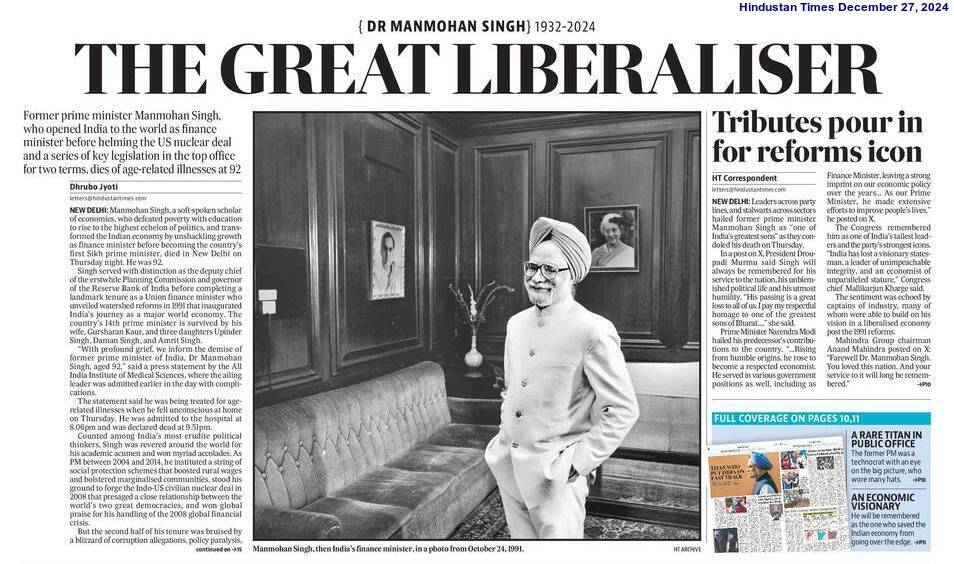
As a political figure, Dr Singh had always been exceptionally modest and soft-spoken. He was a man who never deviated from basic decency. Many have mistaken this particular characteristic of Dr Singh as his weakness! In fact, it was his self-confidence that made him humble. He did not need to speak louder as he was a person of strong character.
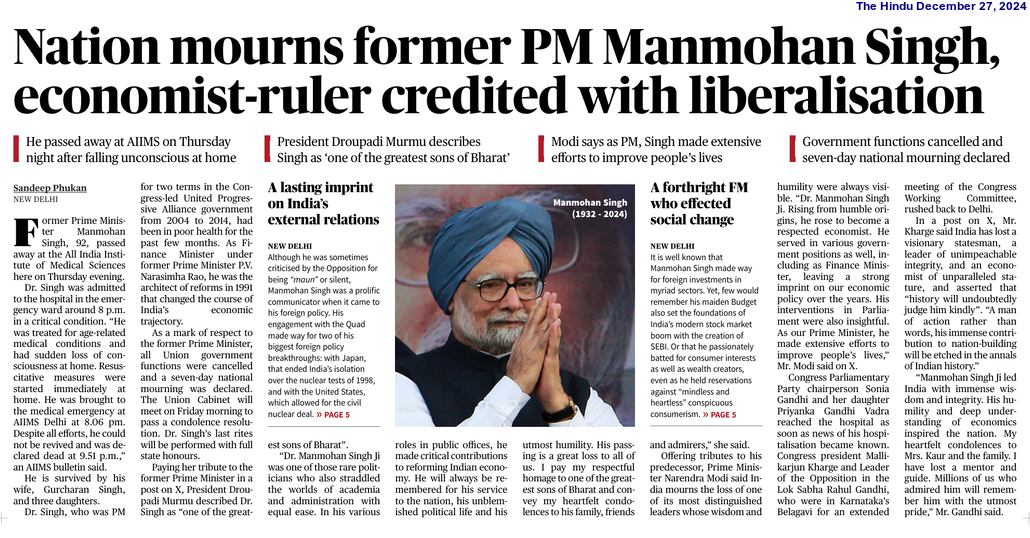
Dr Singh’s integrity, too, was unquestionable. He was deeply concerned about corruption and bureaucratic red tape. A handful of businessmen have always effectively controlled the government in Vladimir Putin‘s Russia and in many West Asian nations. Dr Singh wanted to ensure that it should not happen in India. At the same time, he was well aware of the fact that the process of controlling corruption was quite complex! He rightly realised that an anti-corruption drive could do more harm than good and create bureaucratic interference, undermining the normal business environment. Prime Minister Modi’s demonetisation programme in 2016 failed to wipe out corruption and to deal with black money holders, but badly damaged the Indian economy. However, Dr Singh had made an attempt to fight corruption in a different manner.
Dr Singh had the courage to accept any new ideas. Kaushik Basu, the former Chief Economic Adviser to the Government of India, had triggered a debate by proposing some legal reforms to stop the practice of bribery in 2011. Although Dr Singh did not agree at all with Basu’s proposals, he reportedly encouraged the economic adviser to bring new ideas to the table! It was because of this open-mindedness that many brilliant ideas eventually found their way to the policy level of the Government under his leadership (first as Finance Minister and later as Prime Minister), taking the Indian economy into a new orbit.
Until 1991, India’s foreign exchange reserves were extremely low, standing at USD 5.8 billion as of March (1991). At times, foreign exchange reserves would fall even further, creating great panic. The situation became such that India could no longer import even essential commodities from abroad! There were also a lot of austerity measures because of limited foreign exchange reserves. As per the rule, no one could take foreign currency out of the country in the early 1990s. At that period of time, one could not bring foreign currency with him while returning to India from abroad, if the person did not carry sufficient foreign currency while going abroad. It is because once entered India, the foreign currency could not be taken back!
As the Finance Minister, Dr Singh removed the ban on carrying foreign currency outside India. There was a possibility of a short-term risk due to this policy shift as Indians could take all their foreign currency out of the country. Therefore, India had to approach the International Monetary Fund (IMF) for security assurance. However, it appeared that exactly what was expected was happening in the long-run within a couple of years. When people realised that they could take enough foreign currency out of the country, the Indian diaspora started sending foreign currency to India from abroad. Currently, India is sitting on a foreign exchange reserve of around USD 705 billion (as of September 27, 2024)!
Dr Singh was not properly evaluated during his lifetime. When he took charge of the Indian Finance Ministry, the country’s gold reserve was being mortgaged, with zero foreign currency reserves. The Leftists repeatedly created obstacles during his first budget speech at the Parliament in such a situation. He only requested the Opposition members of the House to allow him to complete his speech. As Dr Singh read out his budget proposals that day, the entire nation realised that something new was coming to the Indian economy. Later, the entire world realised the same. No one can erase that history and Dr Singh shall remain in the memory of billions of Indians for his efforts to rescue (as well as boost) the Indian economy.
Boundless Ocean of Politics on Facebook
Boundless Ocean of Politics on Twitter
Boundless Ocean of Politics on Linkedin
Contact us: kousdas@gmail.com

 ISMC
ISMC Boundless Ocean Of Politics