

Exposing Problems Of Economics With Colonialism
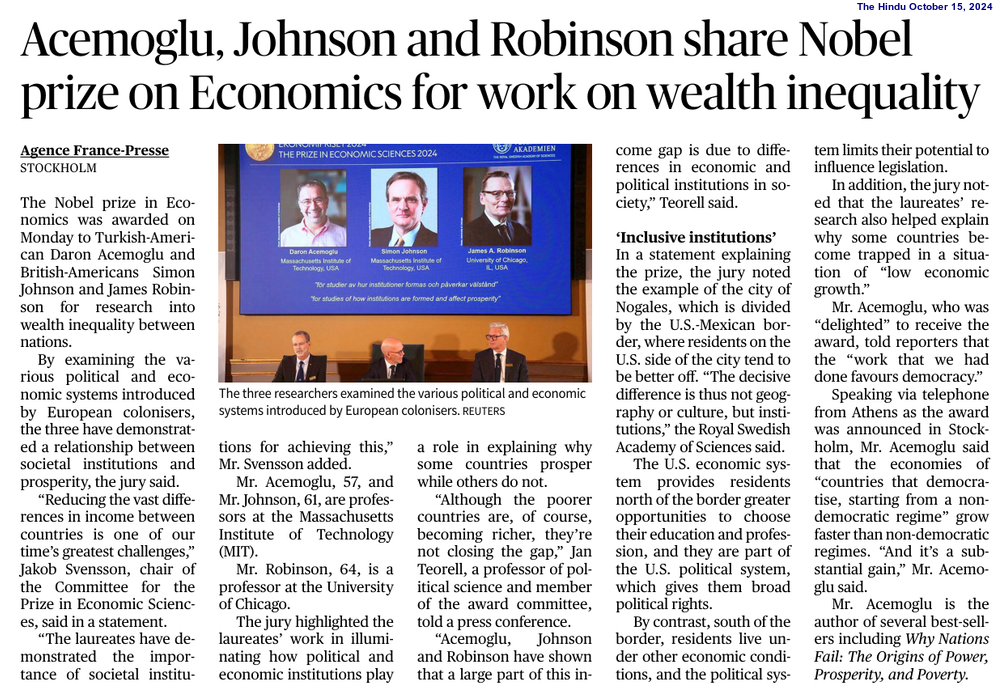
The Royal Swedish Academy announced the names of winners of 2024 Nobel Prize in Economics on October 14, stating that Kamer Daron Acemoğlu, a Turkish-American economist of Armenian descent, and British-American economists Simon H Johnson and James Alan Robinson would receive the prize this year “for studies of how institutions are formed and affect prosperity”. While Acemoğlu and Johnson are conducting research at the Massachusetts Institute of Technology (MIT), Robinson is a researcher at the University of Chicago.
The three laureates have long carried out research on how social institutions are formed and how they affect the overall economic prosperity of a country. In a statement, Jakob Svensson, the Chair of the Committee for the Prize in Economic Sciences, mentioned: “Reducing the vast differences in income between countries is one of our time’s greatest challenges. The laureates have demonstrated the importance of societal institutions for a country’s prosperity. Societies with a poor Rule of Law and institutions that exploit the population do not generate growth or change for the better.“

The Nobel Committee explained that when the Europeans had begun to colonise countries across the globe, the institutions of those societies also changed. It was the Europeans who had built a new political, as well as economic, system in those colonies for their own convenience. However, it has been found that the colonies that were rich have become poor; and those which were poor in the past have become prosperous!
What matters here is how wealth is distributed in a society and who enjoys the decision-making power. People often unite and fight against the ruler to seize power. It shows that the power of an organised society is stronger than that of a monopolistic decision-making authority. In order to avoid such a situation, the ruler promises various short-term economic reforms, resulting in no long-term change! Acemoğlu, Johnson and Robinson believe that inequality can be removed only by transfer of power or by establishing democracy. As the ruler does not hand over power to people in most of the cases, forceful overthrow of the regime becomes inevitable.
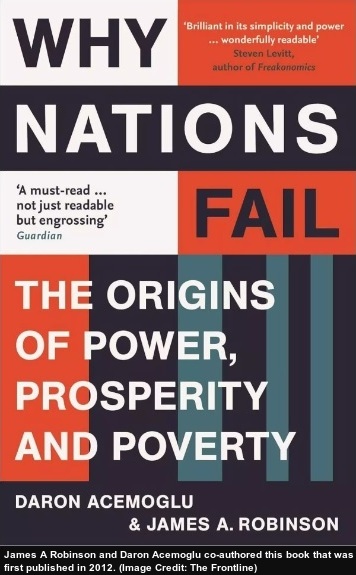
According to the three laureates, the colonial rulers had set up mainly two types of institutions in their former colonies… some to loot the wealth of their colonies and others which were constructive (mainly to establish the Representative Rule of Law). Acemoğlu, Johnson and Robinson have also explained how the Europeans decided which type of institution would be established in a colony through various indices. They have specifically mentioned the death rate among those Europeans who had arrived in various Asian, African and Latin American countries during the colonisation. Statistics show that the country where the death rate was higher at that time the poorer it is today!
In a country where it was difficult for the colonial masters to survive, it was quite natural for them to be more interested in plundering resources of that country than living there. Hence, the Europeans had established institutions just for looting national wealth in those colonies. They focused on creating constructive institutions only in those countries where they were able to live permanently. The Colonial Policy was adopted mainly to plunder as much wealth as possible, instead of creating constructive institutions, from those countries which were already populous and rich. The theory of the Nobel laureates helps one to realise how the richest economy in the world during the Pre-Colonial Period, like India, gradually sank into the darkness of poverty.
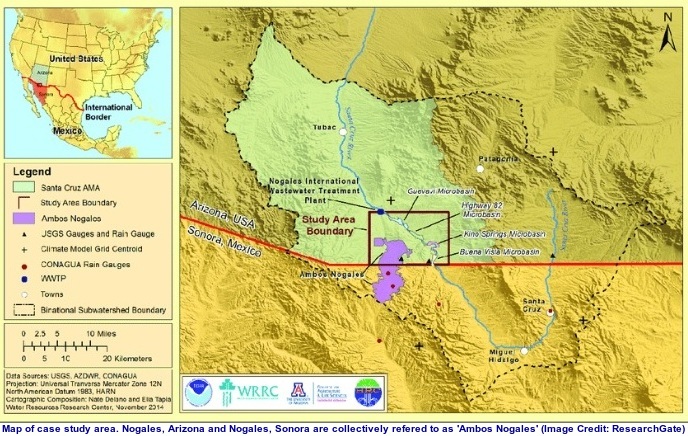
The three economists have further mentioned a city, called Nogales, to explain the importance of the institutions. While the northern part of this city is situated in Santa Cruz County, Arizona; the southern part is in Mexico. Hence, one can find a barbed wire in the middle of Nogales. Although there is no difference in climate and culture of the two parts of this city, the part belonging to the US is way ahead in all aspects of the part belonging to Mexico. It is needless to say that the economic status, literacy rate and political rights of the US citizens living in Nogales are far better.
The three Nobel laureates have claimed that the colonial masters created constructive institutions in the US, ensuring people’s right over their own earnings and wealth. The Right to Vote of at least a section of the people was also recognised. On the other hand, the Spanish colonists had established predatory institutions in Mexico! Interestingly, the geographic area of modern-day North America was less prosperous in the Pre-Colonial Era than the Aztec Civilisation. However, the colonial institutions reversed the entire scenario.
The question arises here: Is there any other choice apart from bearing the burden of colonisation? Well, Acemoğlu, Johnson and Robinson believe that there is indeed a way! According to the three laureates, the Government would have to focus on establishing new societal institutions. They have argued that only these institutions could increase Social Trust and ensure Civil Rights!
Boundless Ocean of Politics on Facebook
Boundless Ocean of Politics on Twitter
Boundless Ocean of Politics on Linkedin
Contact: kousdas@gmail.com

 ISMC
ISMC Boundless Ocean Of Politics