

On A Pyrrhic Victory…
It is being talked about that Ajay Rai may well be considered as the biggest winner in the recently-held 18th Indian Parliamentary Elections. It is also seen that defeats tend to overshadow the glory of victories and appear larger in the electoral process. Rai, the Indian National Congress (INC) Party candidate, lost to Prime Minister Narendra Modi by just 152,513 votes in the Varanasi constituency of the northern Indian Province of Uttar Pradesh. While Modi received 612,970 votes, Rai bagged 460,457 votes and Bahujan Samaj Party candidate Ather Jamal Lari finished third with 33,766 votes. In spite of the fact that he conceded a defeat, Rai humiliated his heavyweight opponent as Modi’s 2024 margin (of victory) is among the lowest ever for a sitting Prime Minister of India!

Arithmetically, the margin of 152,513 votes is a huge one. However, this figure is nothing for the mighty Narendra Modi who should have defeated his nearest rival by more than 750,000 votes! During the campaign, the PM’s Bharatiya Janata Party (BJP) projected Modi as a super hero, mentioning that ‘Modi hai to mumkin hai’ (If Modi is there as the Prime Minister, then everything is possible). The PM, himself, claimed that the BJP would get at least 300 seats and the ruling National Democratic Alliance (NDA) would win 400 in the 545-seat Lower House of the Indian Parliament. (Un)fortunately, the BJP won 240 seats, while the BJP-led NDA got 293 seats. As the BJP has failed to get an absolute majority (272 seats), Modi has formed a Coalition Government. Naturally, he got upset! Perhaps, PM Modi has realised that his party made a mistake ahead of the election by glorifying him as a divine personality.
During the election campaign, Jagat Prakash Nadda, the President of PM Modi’s BJP, reportedly said that the Indian Prime Minister was not only Narendra (the Leader of all human beings or King of men), but also Surendra (the Chief of gods)! Top BJP leaders made an attempt to convince the Indian population that no one heard the name of India before Modi became the Prime Minister in 2014! As if the sleeping India suddenly blinked and found that a lord arrived in front of them (decade ago)! It is the great fortune of the people of India that such a person has asked the Almighty for time till 2047 to take his country to the peak of development!
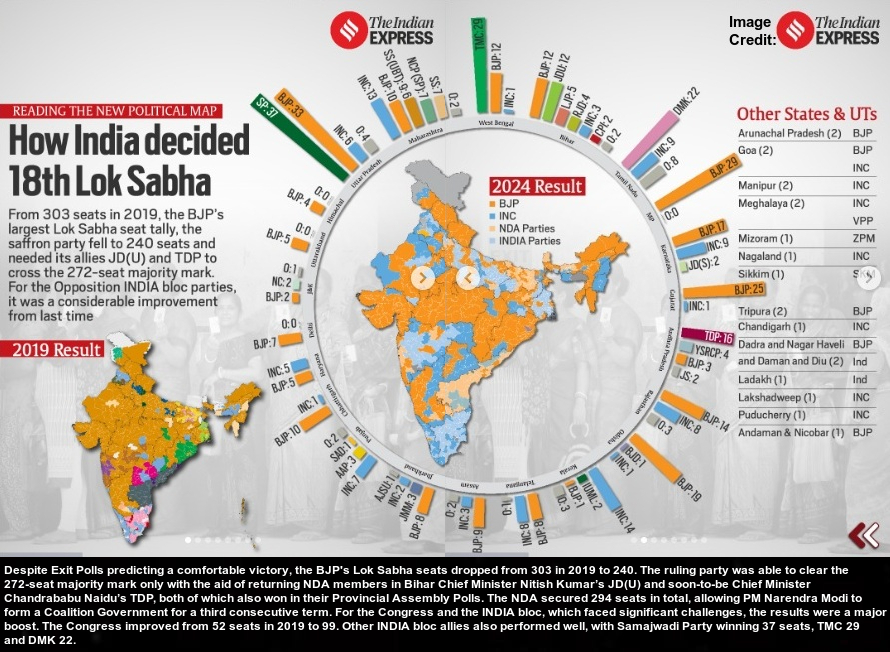
Ahead of the 2024 Parliamentary Elections, the Indian PM possibly thought that there was no divine personality like him in the Opposition camp. Out of a deep sense of responsibility towards the minorities, he took it upon himself to publicise the election manifesto of the main opposition Congress Party. He seemingly tried to ensure that the promises made by the opposition reached the masses, at the least. Who else could have set such an example of democratic values and courtesy without having confidence (in getting absolute majority).
However, the Indians have experienced a different Modi for the past decade. For the Indian PM, development means announcing big projects and satisfying the corporate houses. Since 2014, people have also witnessed the Politics of Intolerance, Hatred and Divisiveness nature in India. Unfortunately, the Prime Minister failed to read the minds of the electorate, assuming that the people of India are incompetent enough to judge his performance. Interestingly, the performance of Ajay Rai in the Varanasi constituency shows that the Indians are quite mature thinkers! Of course, India has elected Modi as the PM for the third consecutive time, the people of India have also sent a strong Opposition to the Parliament in order to maintain checks and balances. The frustration of Modi’s supporters is evident on social media, as they are yet to believe that the PM would have to lead a Coalition Government for the next five years.
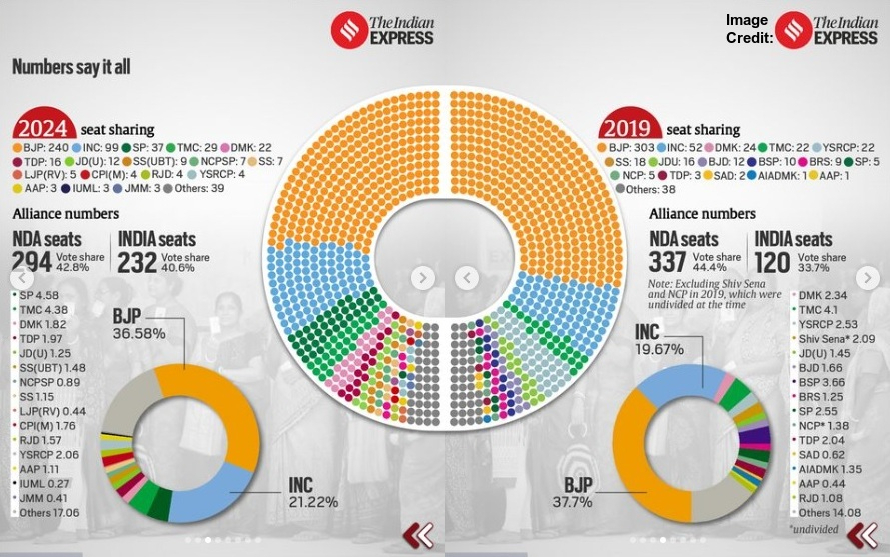
On the other hand, the success of the Opposition forces is glorious in itself as they fought the election only on the basis of mental strength! The outcome of the 18th Parliamentary Elections shows that the majority of Indians still want to be democratic citizens, and not just Modi’s subjects. Prime Minister Modi may be disappointed by this result, but it has brought a great hope as far as India’s self-esteem is concerned.
People’s Mandate In A Democracy
In a democracy, priority is given to the opinion of the majority which is considered as the opinion of the people. However, this is an over-simplified concept of majority. Majority is of course essential, as well as valuable, especially in the functioning of a Representative Democracy. However, those who come to power on the basis of majority votes in a Westminster-model of electoral system often do not enjoy the support of the maximum number of citizens! They only have a higher public support ratio compared to their competitors. Usually, the largest percentage of support (received by the winning camp) is accepted as the majority support for the sake of functioning of a government. However, there is no reason to consider this percentage as the opinion of the people. Instead, this is the opinion of a certain percentage of people.
Secondly, can those who vote in favour of the ruling party (or coalition) give any unanimous opinion? It is not at all possible (especially in a multi-party Democratic system). In other words, even if the maximum percentage of support is considered as the basis of the mandate, then also no specific, tangible and unambiguous majority can be traced in the source of that mandate.
One can consider the electoral success (of a party or a coalition) as the only meaning of mandate. In that case, those who receive more seats than others thanks to arithmetic equations in the conventional electoral system certainly enjoy the Right to Rule. However, many are not in favour of accepting the order of the ruling party or coalition as the final word in a democracy! According to these people, there is a need to be concerned with a larger ideology or philosophy.
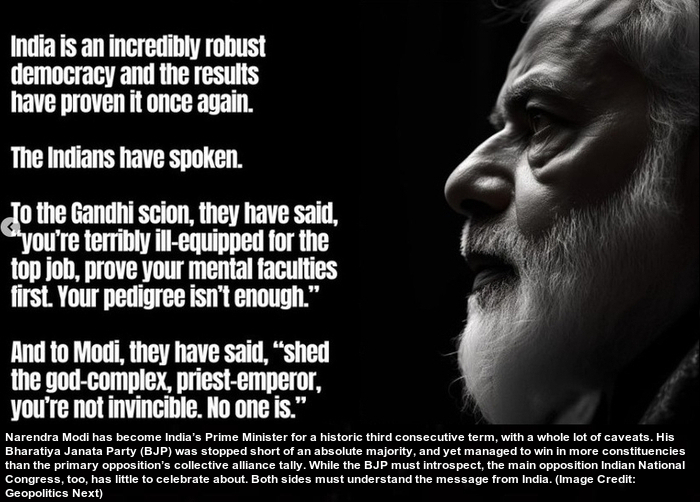
In a democracy, the concept of the people and their mandate is indeed important, fundamental and indispensable. However, it is quite impossible to trace the root of the mandate in simple arithmetic. Instead, it can be found in the depths of politics based on social reality. This sort of politics moves forward through inherent real conflicts. Interestingly, the phrase move forward, too, has no undisputed and predetermined meaning. The history of the 20th Century has clearly explained the consequences of Progress (or move on). In reality, people’s courage to stand up against the injustice and lawlessness triggered by the powerful ruler or to resist the misrule moves the society forward. People can ensure their rights over the Political System through this. Therefore, when an election establishes the people’s claim to their rights against the hegemony of the ruler and restores them from the possession of the people in power, then it can be called a mandate in a true sense.
This is why the 18th Parliamentary Election in India has proven to be a historic one. Prime Minister Modi’s (and his BJP’s) return to power for the third consecutive time with the help of coalition partners is just a footnote of that history! The historicity of this election lies in the fact that it has restored the real value of mandate. It is not possible for tyrants, dependent on mere arithmetical equations, to understand the importance of this value.
Boundless Ocean of Politics on Facebook
Boundless Ocean of Politics on Twitter
Boundless Ocean of Politics on Linkedin
Contact: kousdas@gmail.com

 ISMC
ISMC Boundless Ocean Of Politics