

Indian Himalayas Witness Profound Transformation
The climate is drastically changing in Asia due to Global Warming, with the temperature crossing 40 Degrees Celsius in the Bay of Bengal region in April 2024. The World Meteorological Organisation (WMO) has mentioned in a report that Asia witnessed the most environmental disasters in the world in 2023. India is no exception. According to the Indian Space Research Organisation (ISRO), hundreds of glaciers are melting rapidly in the Himalayan region. Hence, the size of various glacial lakes is constantly increasing in the Himalayas. Scientists are of the opinion that India is all set to witness a major disaster!
The size of one in four lakes larger than 10 hectares in the Himalayan region has been increasing since 1984. Now, the situation is getting worse. The ISRO scientists have warned that the glacial water may overflow both sides of these lakes, triggering the risk of flooding. After monitoring satellite maps of the Himalayan region for a long-term, scientists have found that melting glaciers formed around 2,431 lakes with an area of at least 10 hectares in 2016-17. Moreover, 676 glacial lakes, including 130 in India, have increased in size since 1984. The ISRO has revealed that of these 130 lakes, 65 are situated in the Indus River basin, seven are in the Ganges River basin and 58 are situated in the Brahmaputra River basin.
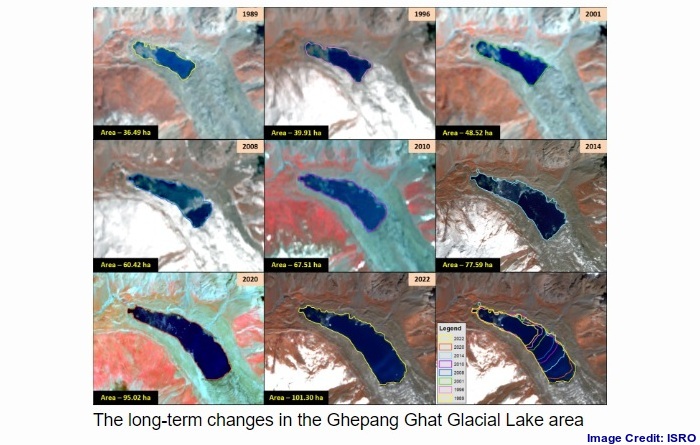
Of these 676 glacial lakes, 601 lakes (89%) have expanded more than twice, while 10 lakes have grown between 1.5 to two times and 65 lakes have increased 1.5 times. In terms of altitude, 314 lakes are situated between 4,000-5,000 metres above the sea level and 296 lakes are 5,000 metres above the sea level. In its report, the ISRO has mentioned: “Long-term changes in the Ghepang Ghat glacial lake (Indus River Basin) at an elevation of 4,068mt in (the northern Indian Province of) Himachal Pradesh, show a 178% increase in size from 36.49 to 101.30 hectares between 1989 and 2022. The rate of increase is about 1.96 hectares per year.“

Scientists are worried about this development. Renowned Glaciologist Anil V Kulkarni has stated: “Scientists, including our team, have already highlighted that Gepang Gaht lake has expanded at a major scale and can potentially affect the Manali-Leh Highway and population downstream. We have already recommended that Provincial Governments take precautionary action.” He further said that the Government of India should also focus on lakes beyond the country’s borders, stressing: “We need to negotiate and discuss these lakes with neighbouring countries.” Referring to the Lhonak lage GLOF in Sikkim as a case in point, the glaciologist said that the Indian Institute of Science (IISc) presented an assessment of current and future GLOF hazard for Gepang Gath Lake in 2023, factoring in the prospect of rock and/or ice avalanches cascading into the lake. The ISRO has claimed that the Himalayan region is a quite sensitive one. Along with huge glaciers, many places in this region are covered with snow. Hence, Climate Change has a serious impact here.
Studies have revealed that the rate of melting of glaciers has been increasing across the globe since the Industrial Revolution. At the same time, the volume of glaciers has been decreasing. The water (after melting of these glaciers) thus accumulated in many low-lying areas and formed lakes. In October 2023, Miriam Jackson, a Glaciologist at Kathmandu-based International Centre for Integrated Mountain Development, reportedly said: “As the climate warms, glaciers shrink in size and a lake may be formed, often at the side of the glacier (glacier-dammed lake) or at the front of the glacier, between the glacier and a moraine ridge (moraine-dammed glacier) or another type. As the climate continues to warm, these lakes may grow in size. There is a lot of evidence that there are more lakes than previously. This strongly implies there will be more GLOFs and GLOFs will be bigger (and more damaging).”

Meanwhile, the WMO has mentioned in its latest report that Asia witnessed the highest number of weather disasters in the world in 2023. The number of such disasters in Asia was 79 in 2023, claiming the lives of more than 2,000 people and affecting nearly nine million! The continent is warming faster than the average rise in global temperature.

The situation deteriorates in India, as well. Due to Climate Change, the Indians have suffered from severe heat in recent times. While some regions of the South Asian nation experienced drought, other regions witnessed heavy floods during the monsoon in 2023. At least 110 people lost their lives in April-June 2023 in India due to the heatwave, which continued till the spring!
Boundless Ocean of Politics on Facebook
Boundless Ocean of Politics on Twitter
Boundless Ocean of Politics on Linkedin
Contact: kousdas@gmail.com

 ISMC
ISMC Boundless Ocean Of Politics