

Experts Race To Save USD 15bln Structure
Japan’s Kansai International Airport became operational 29 years ago… in September 1994. It is the nearest international airport to busy cities, like Osaka, Kyoto and Kobe. The airport is located on two artificial islands, 38km southwest of Osaka Railway Station. Incidentally, the two artificial islands on which the airport has been built are gradually sinking under the sea. Also, this airport is slowly moving away from the mainland.

In the 1960s, the Government of Japan decided to build an airport near Kobe and Osaka in an attempt to boost trade in the Kansai area and Tokyo. The Government planned to rebuild and expand the Itami International Airport in Osaka. As there were a number of tall buildings in Itami and Toyonaka, the Government failed to find vacant land for the expansion of the airport. Even the local residents opposed the project, claiming that expansion of the airport would increase noise pollution. Then, the Government decided to build a new airport in Kobe. However, the local administration in Kobe rejected the proposal. Finally, the Government planned to build two artificial islands on the sea and construct the airport on those islands.
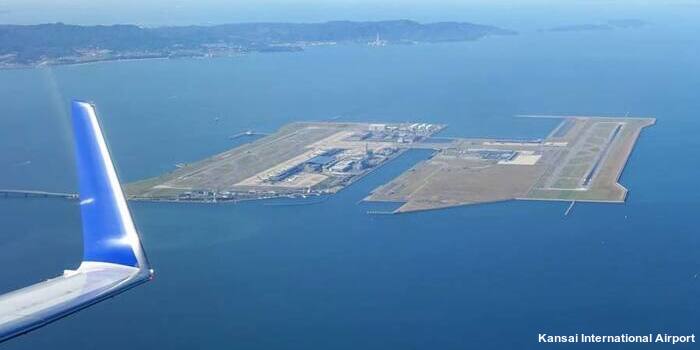
Experts have claimed that more than 38ft of these two artificial islands have already sunk and another 13ft could sink by 2056. Japan had spent USD 15 billion to build this airport. Hence, it became the most expensive civil works project in modern history after 20 years of planning and three years of construction. First, the concerned authorities constructed a sea wall, made of rock and 48,000 tetrapods, in 1987. Then, three mountains were excavated for 21 million cubic metres and 180 million cubic metres of rocks that were used to construct the first island. Over three years, more than 10,000 workers, using 80 ships, took 10 million man-hours to complete the 30-40mt (100-130ft) layer of earth over the sea floor and inside the sea wall. Later, 2.2 million pipes of a diameter of 16inch each were laid on the islands. Mud and sand were mixed with soil on those pipes in order to strengthen the base of the islands. Initially, the land on the two artificial islands was like a wet sponge. After the land became completely dry, the construction works of the airport began.
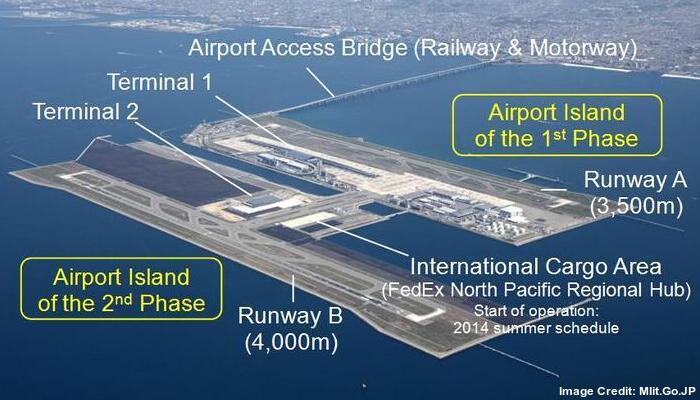
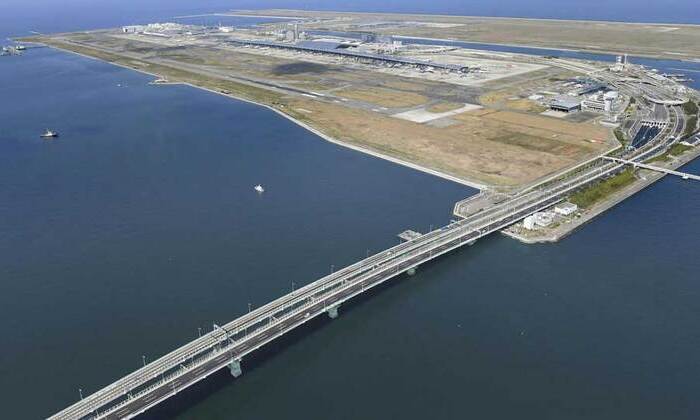
The Kansai International Airport is built on 2,600 acres of land on the two artificial islands. The airport has two parts. While one has been built on 1,260 acres of land, the other on 1,340 acres of land. In 1990, the two artificial islands were connected by two bridges. Later, another 3km-long bridge was built to connect the islands to the mainland at Rinku Town at a cost of USD 1 billion. The airport became fully operational four years after the construction of this bridge.
An earthquake rocked Japan on January 17, 1995, claiming 6,434 lives on the island of Honshu. However, the Kansai International Airport was not damaged. According to local media, not a single glass of the airport was even cracked. A typhoon hit the airport on September 22, 1998. This time also, the wind gust of 216km per hour could not damage the airport.

Another typhoon hit the Kansai International Airport on September 4, 2018. This time, water seeped into the engines of some aircraft and many passengers were stuck inside the airport. A tanker also hit the bridge connecting the airport with the mainland, and some parts of the bridge collapsed. Flight services from the airport were completely suspended for a couple of days, as the Government of Japan allowed only some domestic flights to take off and land. The Kansai International Airport became fully operational a month after the typhoon. The repair works of the bridge was completed by April 8, 2019. In 2016, 25.2 million passengers used the airport, making it the 30th busiest airport in Asia and third busiest in Japan.

Meanwhile, Japan is worried about the constant sinking of these two artificial islands. The islands had been predicted to sink 5.7mt (or 18ft 8inch) by the most optimistic estimate as the weight of the material used for construction compressed the seabed silts. However, the island had sunk 8.2mt (or 26ft 11inch) by 1999, almost 50% more than predicted. Interestingly, the sink rate fell from 50cm (or 20 inch) per year during 1994 to 7cm (or 3 inch) per year in 2008.
Experts have warned the Government that the airport would go under the sea in a few decades. Maybe Japan will take effective measures in addressing this issue, by that time.
Boundless Ocean of Politics on Facebook
Boundless Ocean of Politics on Twitter
Boundless Ocean of Politics on Linkedin
Contact: kousdas@gmail.com

 ISMC
ISMC Boundless Ocean Of Politics