

After Germany, Farmers’ Protests Rock France, Belgium
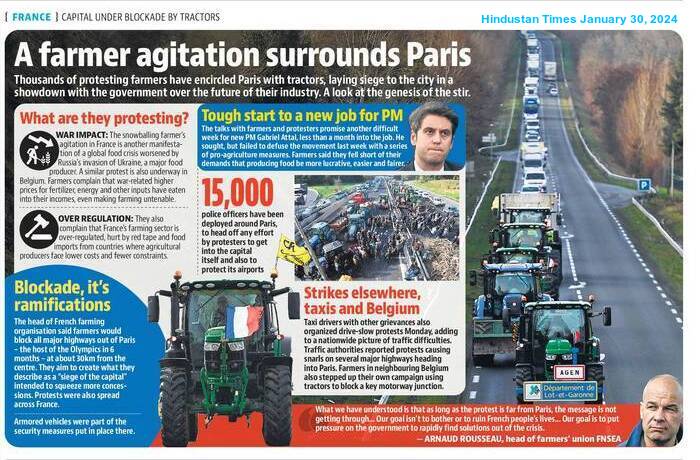
Paris was under siege on January 29, 2024, as farmers blocked the major access points to the French capital with tractors and bales of hay, while many planned to stay until the EU Summit held in Brussels on February 1. This spectacular action followed days of protest actions throughout the Western European country. Newly appointed Prime Minister of France Gabriel Nissim Attal de Couriss did offer them a few concessions, such as bureaucratic simplifications, emergency aid, a freeze on the price of farm fuel, as well as measures against price dumping by the major supermarket chains. However, the farmers were demanding nothing less than an in-depth reform of the EU Agricultural Policy, which is deliberately oriented to downsizing the farm sector. Fishermen, too, joined the demonstrations early on, as did taxi drivers in some cities, as well as certain categories of truck drivers.
The mobilisation is having a snowball effect throughout France. Teachers’ unions called for strikes and other actions in the first week of February, demanding pay raises and a stop to the layoffs. The CGT trade union of the Paris Public Transportation System (RATP) announced a strike as of February 5, while workers at the electricity giant EDF went on strike on January 30.
Coming back to the farmers, the Solidarité et Progrès movement, headed by Jacques Cheminade, joined the protests in many places and distributed a Letter to the Farmers, blasting the current economic system that condemns our agriculture to a deliberate euthanasia in the name of making financial profit.
Beyond the immediate demands made by the farmers’ unions, S&P proposes other measures that need to be taken, such as curbing the power of agro-holdings, banning speculation on food and drink, organising a moratorium on farm debts and their reorganisation.
Our farmers, the Letter goes on, “need a fair parity price that allows them to live decently, and to finance their investments, without being strangled by their lenders”. It is also important for “the farmers of the world not to confront one another in a financial Wild West controlled by corrupt sheriffs”.
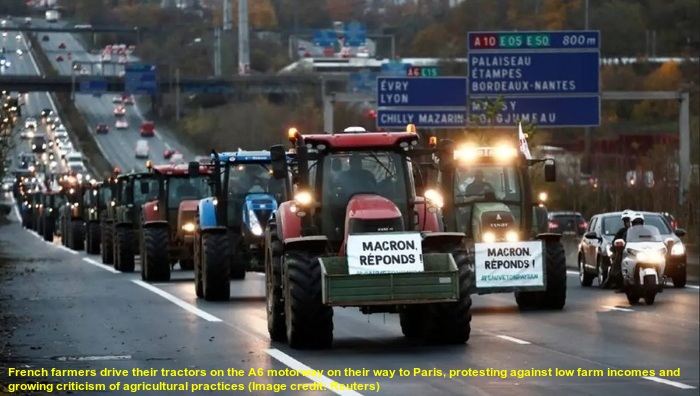
Damien Brunelle, a farmer of cereals and other crops in the Aisne region northeast of Paris, told Reuters: “Everything we warned of 30 years ago is coming true. Our countryside is emptying. Everything we buy has gone up. But we’re not getting the same revenue.” He claimed that the Ukraine War triggered a hike in prices. According to Brunelle, he received EUR 400 (USD 430) per tonne for the wheat he grew. In other words, a tonne of wheat now brings him less than half of the amount or EUR 190. “We are obliged to make a show of strength and have clashes to be heard,” added Brunelle. For his part, Stphanie Flament, a farmer of cereals and beets east of Paris, stressed: “We are worried because they do not have the same regulations as us. It will be cheaper for the consumer, so where will consumers or companies turn to process flour and so on? To products that cost less.“
In neighbouring Belgium, thousands of tractors took to the streets, hitting in particular the main highway access to Brussels. The actions were expected to culminate in a rally in the capital as the EU Heads of State and Government gathered there.
In Germany as well, protests are going on in more decentralised forms, as farmers begin to see themselves as the avantgarde of a broader revolt of the mittelstand, from which several branches endorsed and joined past actions, including truck and taxi drivers, bakers and shop owners. At a regional meeting in the city of Stollberg in Saxony, activists of the LSV organisation, together with local mayors, agreed on a petition for which they would gather signatures. It called for the protection of the transport sector, abolition of disproportionate taxation for all small and medium sized enterprises, and highlighting the role of farming and the productive sector in school curricula.
This article was first published in Executive Intelligence Review (EIR) Strategic Alert weekly newsletter (Volume 38, No. 5) on February 1, 2024.
Boundless Ocean of Politics on Facebook
Boundless Ocean of Politics on Twitter
Boundless Ocean of Politics on Linkedin
Contact: kousdas@gmail.com

 ISMC
ISMC Boundless Ocean Of Politics