

World’s Oldest Human Construction
Archaeologists have claimed that human beings used to live in Greece’s Theopetra Cave 50,000 years ago! The cave is situated near the Meteora, a rock formation in the regional unit of Trikala, in Thessaly. The results of the radiocarbon sample test of this cave recently surprised the researchers, as they found the oldest human construction on the Earth inside Theopetra Cave. Radiocarbon samples show that the cave was inhabited 50,000 years ago. Even evidence of human existence has been found in this cave 130,000 years ago!

According to archaeologists, the cave was inhabited from the Middle Stone Age to the Neolithic or New Stone Age. A lot of new information about ancient Greece has emerged because of this discovery. After excavating the Theopetra Cave, archaeologists discovered graves, weapons made of stone, vessels and animal bones. They also found traces of constructions made by human beings inside the cave. Archaeologists believe that it is the world’s oldest human construction. They are of the opinion that Neanderthals (primitive humans) used to live in this cave. Neanderthals were quite different from modern humans, as their forehead was very high and nose was elongated. They lived in Eurasia 430,000 years ago.
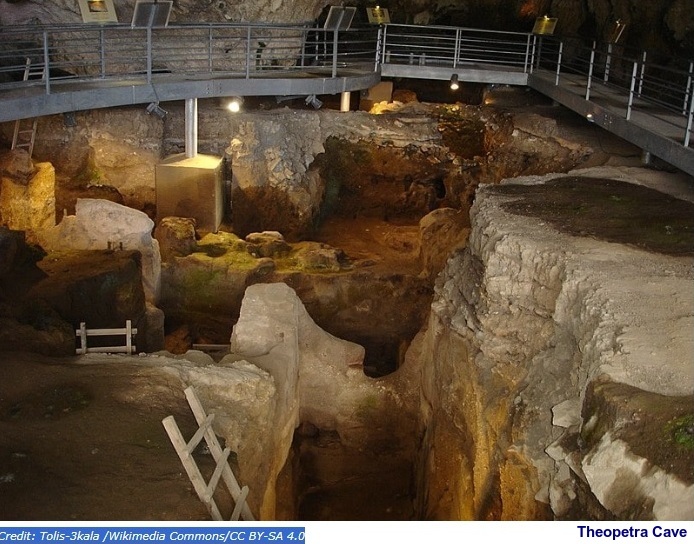
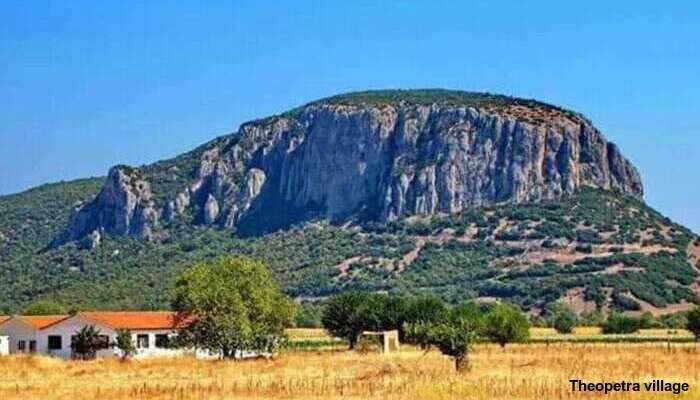
After radiocarbon testing of Theopetra, archaeologists claimed that it was the oldest man-made cave in the world. However, the Neanderthals did not make this cave. They probably started living in a small area inside the cave. Later, modern humans increased the extent of this cave by cutting the mountain. The cave is located on the northeastern slope of the limestone cliffs of Meteora. One can find the cave at the foot of a 100mt (330ft) tall limestone cliff that looms over Theopetra village. The Lethaios River, a tributary of the Pineios River, flows nearby. The view is quite beautiful. Geologists have opined that the limestone hill was formed between 137 and 65 million years ago, during the Upper Cretaceous geological period.
The large entrance of the cave, which covers an area of about 500sqmt (5,380sqft), allows a great deal of light to enter into the interior. This is why people started living in this cave millions of years ago. Excavation of the Theopetra Cave began in 1987, and the work went on till 2007. Later, important historical materials were recovered from the cave. Archaeologists have claimed that local herders used the cave as a temporary shelter for their animals. They often tied sheep and cows inside the cave and left the place. That is how the cave first came to the attention of archaeologists. Then, they started excavation works.

Archaeologists came to know that people used to live inside this cave about a million years ago, and stayed there for ages. They gradually abandoned the cave due to Climate Change. After examining archaeological layers of the cave, researchers have found that there had been hot and cold spells during the cave’s occupation. The population of this cave seemed to fluctuate over the years, relative to these changes in climate.
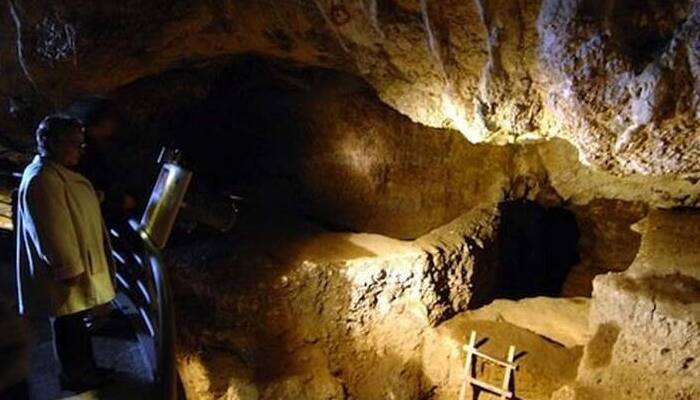
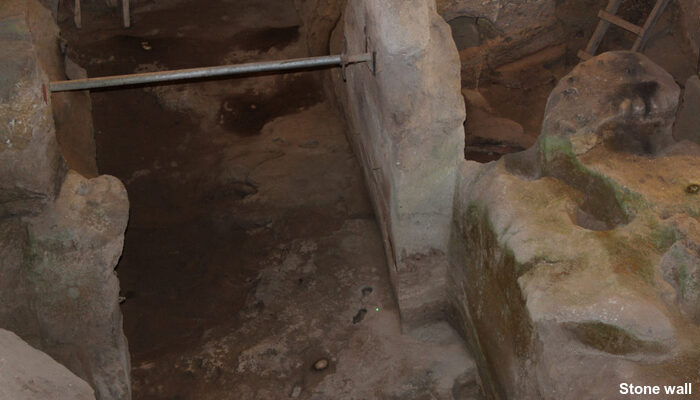
The Greek Reporter reported on September 17, 2023 that the cave is roughly quadrilateral in shape, with small niches on its periphery. Meanwhile, archaeologists have also discovered a stone wall, considered as the oldest human construction, inside the Theopetra Cave. They have opined that the wall once partially closed off the entrance of the cave. Using a relatively new method of dating known as Optically Stimulated Luminescence, they have now been able to date this wall to around 23,000 years old. The age of the wall has prompted researchers to assume that it had been built by the cave’s inhabitants to protect them from the cold.
Archaeologists also discovered hominid footprints imprinted onto the soft earthen floor of the cave. They speculated that these were made by several Neanderthal children, aged between two and four years old. Those children had lived inside the cave during the Middle Palaeolithic period.

The Greek Reporter further reported that one of the most important finds inside Theopetra Cave was the remains of an 18-year-old woman. She lived in Greece 7,000 years ago. Scientists managed to reconstruct the teenager’s face after years of intensive work, as she was given the name of Avgi (Dawn). Professor Manolis Papagrigorakis of Athens University has claimed that Avgi used to live in Theopetra Cave during the Mesolithic era (7,000 BC). Professor Papagrigorakis, an orthodontist, used Avgi’s teeth as a base for the total reconstruction of her face. Avgi, discovered by archaeologist Aikaterini Kyparissi-Apostolika, is displayed at the Acropolis Museum in Athens.

The cave was opened to visitors in 2009, and closed in 2010 when the oldest wall was discovered. Later, the concerned authorities allowed visitors to enter the cave. However, it was closed yet again in 2016 due to fears of a landslide. Now, it is reopened to visitors.
Boundless Ocean of Politics on Facebook
Boundless Ocean of Politics on Twitter
Boundless Ocean of Politics on Linkedin
Contact: kousdas@gmail.com

 ISMC
ISMC Boundless Ocean Of Politics