

Moonstruck
When the erstwhile Soviet Union launched the Earth’s first artificial satellite Sputnik I, the US called the development the Shock of the Century. Indeed, the successful launch came as a shock to the US, as Washington DC used to believe that it would accomplish this scientific advancement first. It was the era of the Cold War, and the competition between the two World Powers was at its peak. The Cold War divided the world into two camps, Capitalists and Socialists. The US remained alert for Soviet attacks those days. Hence, people in the US were worried about which American cities would fall under the orbit of Sputnik I, as those cities would be under Soviet surveillance.
Interestingly, the launch of Sputnik I triggered the fall of the Republican Party in the 1961 Presidential Election. The Democrats came to power, and John Fitzgerald Kennedy (May 29, 1917 – November 22, 1963) became the US President. President Kennedy announced in 1962 that the US would send astronomers to the Moon by the end of the 1960s. The US’ dream came true on July 20, 1969, as Neil Armstrong and Buzz Aldrin landed the Apollo Lunar Module Eagle on the Moon. Upon their arrival, Commander Armstrong famously said: “That’s one small step for man, one giant leap for mankind.” NASA, the US space agency, carefully prepared this quote that deserves to be appreciated.
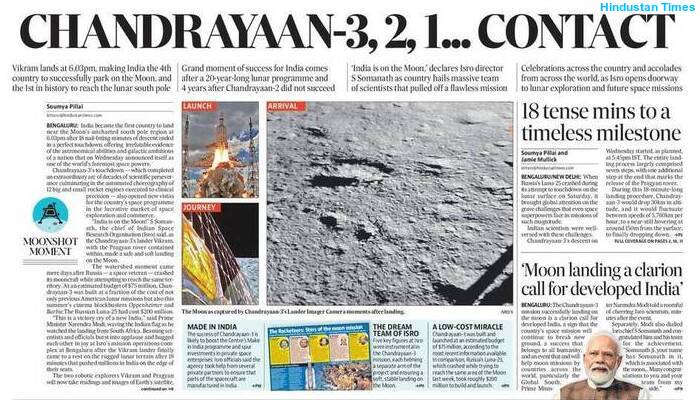
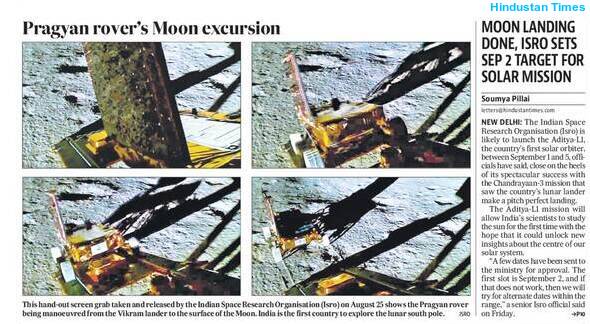
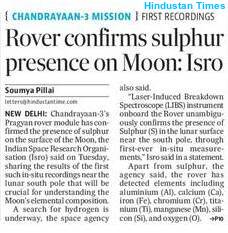
The same is applicable in the case of Chandrayaan-3, the third Indian lunar exploration mission under the Indian Space Research Organisation‘s (ISRO) Chandrayaan programme. Chandrayaan-3 consists of a lander, named Vikram, and a rover, named Pragyan, which landed on the Moon on August 23, 2023. The ISRO immediately declared that the successful landing of Chandrayaan-3 would be useful in India’s upcoming Sun, Mars and Venus missions.

NASA Chief Clarence William Nelson and European Space Agency (ESA) Chief Josef Aschbacher congratulated their ISRO counterpart Sreedhara Panicker Somanath for India’s historic achievement, stressing that the current Indian mission would support future, manned lunar missions. Their message has made it clear that India is not a country to be ignored anymore as far as space research is concerned. India has become the fourth country (after Russia, the US and China) to land a vehicle on the Moon, and the only nation to do so at the lunar South Pole.
In a way, scientific research is a competition between different countries, scientists and laboratories. There is a similarity between the Luna-25 spacecraft sent by Moscow and India’s Chandrayan-3, as both of them are part of a bigger competition. While ISRO launched Chandrayaan-3 on July 14 (2023), Roscosmos lifted off Luna-25 on August 10 (2023), atop a Soyuz-2.1b rocket from the Vostochny Cosmodrome in Russia’s far eastern Amur Region. It entered lunar orbit on August 16. Unfortunately, the lander crashed on the Moon’s surface after a failed orbital manoeuvre on August 19. It may be noted that the failed Russian lunar lander mission also planned to land near the crater Boguslawsky at the lunar South Pole. Failure in space missions is no big deal. The first vehicle of the Apollo Programme, which successfully landed the 11th lunar module, had failed in 1967. All three US astronauts perished in that failed US mission.

The 1986 Challenger crash was another shocking event in the history of space research. On January 28, 1986, the Space Shuttle Challenger broke apart 73 seconds into its flight, killing all seven crew members on board. The spacecraft disintegrated 46,000ft (14km) above the Atlantic Ocean, off the coast of Cape Canaveral, Florida, at 11:39am (local time). It was the first fatal accident involving a US spacecraft while in flight. Nobel laureate scientist Richard Phillips Feynman was one of the members of the committee that was formed to investigate the accident. The fault he found was a surprising one, as the scientist claimed that the accident took place due to a component failure because of extreme cold. NASA scientists did not think about this possibility. Hence, it can be surmised that space projects can fail due to various reasons.

Chandrayaan-2, too, was a failed mission. The second lunar exploration mission, developed by the ISRO, consisted of a lunar orbiter, and also included the Vikram lander and the Pragyan rover. The spacecraft was launched from the second launch pad at the Satish Dhawan Space Centre in the southern Indian Province of Andhra Pradesh on July 22, 2019. The craft reached the lunar orbit on August 20, 2019 and began orbital positioning manoeuvres for the landing of the Vikram lander. The lander and the rover were scheduled to land on the near side of the Moon, in the South Polar region, on September 6, 2019. However, the lander crashed when it deviated from its intended trajectory while attempting to land on the Moon. As per a Failure Analysis Report submitted to ISRO, a software glitch caused the crash.
ISRO Chief Somanath recently revealed that it took Indian scientists a year to understand why Chandrayaan-2 crashed on the lunar surface. They took another three years to make preparations for launching Chandrayaan-3. There is nothing wrong with making mistakes. However, it is important to learn from them.

This is the time for ISRO scientists to rejoice, as they have scripted history with the successful Chandrayaan-3 mission.
Boundless Ocean of Politics on Facebook
Boundless Ocean of Politics on Twitter
Boundless Ocean of Politics on Linkedin
Contact: kousdas@gmail.com

 ISMC
ISMC Boundless Ocean Of Politics