

De-Orbiting The ISS…
Another eight years… then, the global community might have to bid adieu to their known address in space! The International Space Station (ISS), the human habitable satellite orbiting the Earth, has a lifespan of up to 2031. Scientists are not at all worried about the final few years of the ISS’ life. Instead, they are of the opinion that the final phase of the ISS’ lifespan is going to be more exciting.
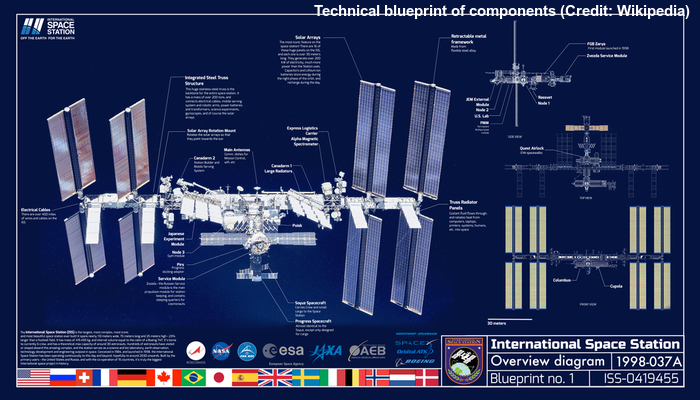
The project to build a space research centre had begun way back in 1998. It was basically a collective venture. Russia was the first to send the Zarya module, also known as the Functional Cargo Block (FGB). It was the first module of the ISS to have been launched. The FGB provided electrical power, storage, propulsion, and guidance to the ISS during the initial stage of assembly. Later, dozens of countries gradually took part in this venture, as they built a home in space.

Interestingly, this space mission was considered as a symbol of friendship between Russia and the US after the collapse of the erstwhile Soviet Union and end of the decades-long Cold War. Wendy Whitman Cobb, an expert at the US Air Force School of Advanced Air and Space Studies, said that it was a truly remarkable event after the Cold War.
The centre, weighing 400 tonnes, is about the size of a football stadium, as it revolves around the Earth at a speed of 18,000 miles per hour. The ISS has been described as the most expensive single item ever constructed. As of 2010, the total cost was USD 150 billion. Furthermore, maintaining ISS altitude uses about 7.5 tonnes of chemical fuel per annum at an annual cost of about USD 210 million. The centre started functioning in November 2000, and a group of astronauts reached there in a rare first that month. Since then, some astronauts have always been there in the ISS. As components of the space station are getting older, scientists have decided to de-orbit it in 2031 and to bring the ISS back to the Earth. Later, it would be buried in the sea.
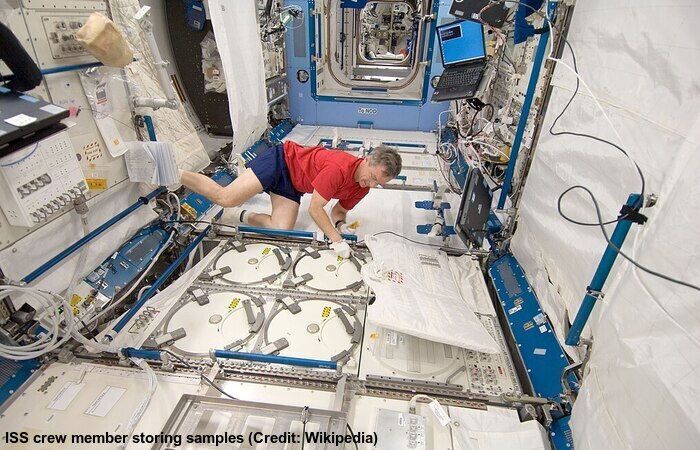
Thousands of scientific researches have been carried out on the ISS over the past 23 years. The same will continue in the years to come. While one segment of this centre belongs to the US, the other to Russia. Apart from these two, there are modules of Europe and Japan. Notable among the researches going on at the ISS are works on Alzheimer’s and Parkinson’s, apart from the study of the state of matter. In addition, vegetables, like lettuce and radish, were experimentally grown in the zero gravity of space at the ISS.
Frank Viscount De Winne, a Belgian Air Component officer and a European Space Agency (ESA) astronaut, visited the ISS twice (in 2002 and also in 2009). De Winne stressed that the experience of living and working on the space station was amazing. “Advancement of human civilisation… opportunity to do such a thing does not come again and again,” he added. For his part, British Cosmologist and Astrophysicist Lord Martin John Rees stated that Robotic Missions, like the Mars Mission or the James Webb Space Telescope, were good. However, sending human beings into space is expensive. He explained that the amount of money invested in such a mission would have no return. Still, building a space station was an achievement, stressed Rees.
In a sense, the ISS is still a symbol of harmony (between Russia and the US). In the context of the Russia-Ukraine War, no one sees any hope of a repeat of this sort of joint venture in the near future. However, scientists are planning to build a successor of the ISS. They have decided to construct a new commercial space station, and companies, like SpaceX and Boeing, have also shown interest. This time, the main aim is not only conducting scientific research, but also entertaining tourists. Space tourists would get an opportunity to spend their vacation at the new commercial space station.
Boundless Ocean of Politics on Facebook
Boundless Ocean of Politics on Twitter
Boundless Ocean of Politics on Linkedin
Contact: kousdas@gmail.com

 ISMC
ISMC Boundless Ocean Of Politics