

Greenland’s Dilemma
Greenland is at the centre of an escalating, high-stakes geopolitical tug of war between Denmark and the US. The world’s largest non-continental island is an autonomous territory of the Kingdom of Denmark. It may be noted that Denmark ruled the Self-Government Act, Greenland from the early 18th Century until 1979, when Home Rule began. In 2009, Greenland approved the Self-Government Act in a referendum that allowed the island nation to assume additional areas of responsibility. However, Greenland has been trying to become independent for a long time and the trend has intensified in the last couple of decades. Meanwhile, the aggressive foreign policy of US President Donald John Trump has prompted Nuuk to think about whether it wants independence right now. As it would be quite difficult for a country with a population of just 57,700 to counter US aggression, Greenland has decided to remain an autonomous territory of a European nation.
As President Trump has decided to establish US dominance in the Western Hemisphere, political observers believe that he has brought back the Monroe Doctrine. James Monroe (April 28, 1758 – July 4, 1831), the fifth President of the US, had declared on December 2, 1823 that the Western Hemisphere was closed to further European colonisation and that any attempt by European powers to interfere in the political affairs of American nations would be considered a hostile act against the US. President Trump’s 2025 National Security Strategy, popularly known as the Donroe Doctrine (the Trump Corollary to the Monroe Doctrine), has added several islands to the list of Western countries whose geographical locations are important to the US’ security, and one of them is Greenland.
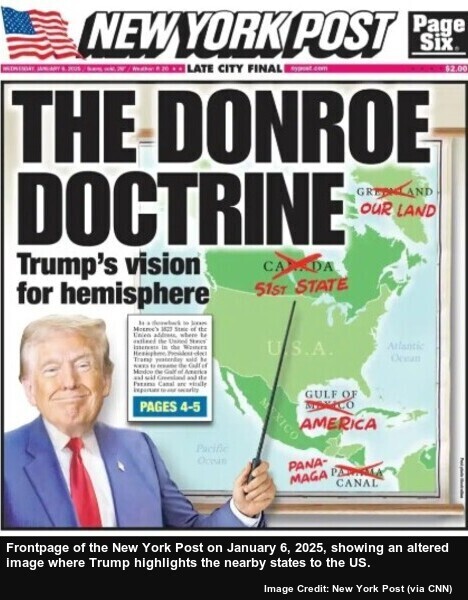
The US President’s intention to annex Greenland has brought global attention to the ice-covered island, as well as its push for independence. As expected, the European countries, which do not want President Trump to easily usurp autonomous Greenland, have expressed solidarity with Denmark. Meanwhile, the US President has claimed that he would never allow China or Russia to take over Greenland. In such a scenario, it has become important for Greenland and Denmark to join hands against the US. At the same time, Greenland would have to remain an autonomous territory of the Kingdom of Denmark. Then, it would be difficult for President Trump to annex Greenland.
The US President has further claimed that Greenland is a part of North America as it is situated in the northern tip of the Western Hemisphere. Hence, it is at the centre of the US’ security interests. However, Denmark has firmly ruled out selling Greenland, with Prime Minister Mette Frederiksen calling the idea “absurd” and affirming that the island is “not for sale“. Greenland, too, has refused to become a part of the US.
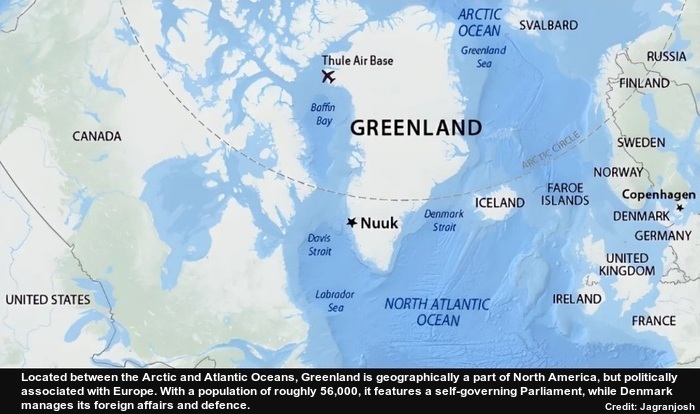
Approximately 88-89% of Greenland’s population is Greenlandic Inuit (often calling themselves Kalaallit), making it an overwhelmingly indigenous society. The remaining population is primarily of Danish or European descent. Colonial rule officially began in Greenland in 1721 with the arrival of Norwegian Lutheran missionary Hans Poulsen Egede (January 31, 1686 – November 5, 1758), who established a mission and trading post (later Nuuk) to convert the indigenous Inuit to Christianity and reconnect with believed-to-be-lost Norse settlers. His efforts marked the beginning of a 250-year Danish-Norwegian colonial period. Egede had the support of the Danish-Norwegian royal families. Following Napoleon‘s defeat, Denmark’s King Frederick VI signed the Treaty of Kiel on January 14, 1814, ceding Norway to the King of Sweden in order to avoid total occupation. This ended the 400-year Danish-Norwegian union, although Norway’s dependencies of Iceland, Greenland and the Faroe Islands remained with Denmark.
Greenland gained considerable independence on June 21, 2009, with the Act on Greenland Self-Government coming into force. Often described as self-rule or a self-government arrangement, the Act granted the island a significant expansion of autonomy in various areas, except foreign policy, defence and economy. Greenland also established a legal pathway toward independence on the basis of the 2009 Self-Government Act, although Nuuk has not yet held the final, binding referendum required to declare it.
While all major political parties support independence from Denmark, they are divided on the timing and approach. The 2025 elections showed a preference for a gradual transition, with the winning Democrats favouring a cautious approach. Other political outfits, like the Naleraq Party, decided to push for immediate independence. An opinion poll conducted by Verian for the Danish daily Berlingske and the Greenlandic media Sermitsiaq in January 2025 found that a significant majority of Greenlanders (84%) wanted their country to be independent from Denmark, up from 67% in 2019.
Inuit in Greenland accuse Denmark of systemic racism mainly because of a colonial legacy, despite receiving adequate financial support. Inuit also accuse Denmark of implanting Intrauterine Devices (IUDs) in thousands of women and girls to control their population during the Spiral Campaign. It may be noted that Denmark provides a significant annual block grant to Greenland, typically cited around USD 600 million to nearly USD 700 million, which supports the economy of self-governing territory, representing over 20% of its GDP. This funding ensures that Greenlanders, as part of the Danish realm, have access to a welfare system that includes social security, free healthcare and education.
Amidst the dispute between Denmark and Greenland over various issues, President Trump has reconciled them. As Europe seeks peaceful ways to counter the US President’s aggressive foreign policy, Greenland navigates a complex geopolitical landscape, balancing its long-term ambition for independence from Denmark against increased pressure and economic interest from the US.
Meanwhile,
Boundless Ocean of Politics on Facebook
Boundless Ocean of Politics on Twitter
Boundless Ocean of Politics on Linkedin
Contact us: kousdas@gmail.com

 ISMC
ISMC Boundless Ocean Of Politics