

Digital Violence Against Women On The Rise
On November 25, 1960, three sisters – Patria Mirabal, Minerva Mirabal and María Mirabal – were assassinated by Dictator Rafael Leónidas Trujillo Molina‘s (nicknamed El Jefe; October 24, 1891 – May 30, 1961) Secret Police in the Dominican Republic, a crime initially disguised as a car accident. Their deaths (read murder) sparked national outrage and they were posthumously celebrated as martyrs, as well as symbols of resistance against tyranny and gender inequality. As the Mirabal sisters were fighting against the authoritarian rule of Trujillo, the dictator got them killed. Women’s Rights activists have been observing a day against violence on the death anniversary of the three sisters since 1981 and the UN General Assembly designated November 25 as the International Day for the Elimination of Violence against Women on December 17, 1999.

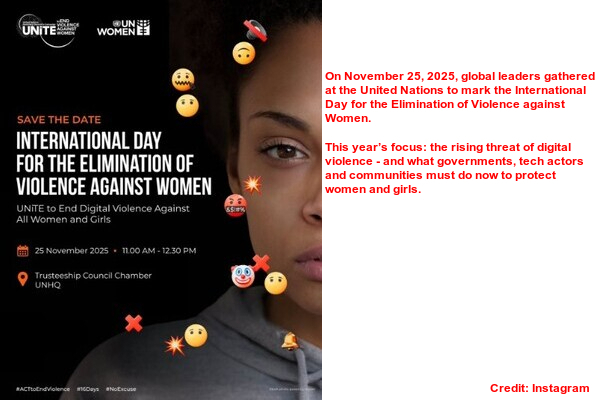
On this day, governments, non-governmental organisations (NGOs) and international bodies focus on spreading public awareness so that society can be freed from gender discrimination and every woman can live a healthy life with respect and the Human Rights she deserves. Digital violence has recently been recognised as the latest form of gender-based violence that uses Information and Communication Technologies (ICTs) to inflict harm, disproportionately targeting women and girls. It is not merely an online issue, but a continuation of offline abuse, with severe psychological, social, economic and even physical consequences.
Technological advancement has undoubtedly led to significant improvements in various aspects of civilisation, bringing progress in healthcare, communication, education and economic opportunity. At the same time, technological improvement has also increased the vulnerability of women. Although there are different types of digital violence, the purpose is the same… to observe, follow, harass and abuse girls. Digital violence can lead women, even girls, to such a hellish state that they become isolated in society and often commit suicide. Even nude photos of women are clicked without their permission, using digital methods. Then, the trolling and intimidation begin.
Online sexual harassment has become a common, pervasive and growing global issue. A section of tech-savvy people makes an attempt to assassinate characters of women through hate speech, apart from distorting their images, audio and video clips with the help of artificial intelligence. Technological advancement has also made it easier for these people to spread misogynistic messages.
While the scientific mindset was intended to be a force for challenging oppressive systems, like feudalism and patriarchy; it has ironically been misused to perpetuate gender stereotypes and defame women. Technology is pushing women into hell, instead of providing them with safety. Teenage and young girls, especially those who want to create their own identity, female politicians, social activists, Human Rights activists, journalists and immigrants are constantly exposed to digital violence. A 2018 survey carried out by the Inter-Parliamentary Union (IPU) and the Parliamentary Assembly of the Council of Europe (PACE) found that 58% of female Members of Parliament (MPs) in Europe had been the target of online sexist attacks on social networks. Radicalists have taken over much of the digital world, while self-appointed online (social media) leaders have started issuing diktats for women.
The World Health Organisation (WHO) has confirmed that approximately one in three women worldwide – about 840 million – have experienced physical or sexual violence in their lifetime. According to a global survey, nearly 38% of women have experienced online violence and 85% have witnessed it. Women are the majority of performers in the commercial adult film industry and a lack of explicit consent communication is common within the narratives of those films. India is no exception. Reports suggest that 98% of cybercrimes in the South Asian country are committed against women.
Social scientists are of the opinion that the governments, NGOs, Women’s Rights Organisations and Human Rights Organisations need to sensitise people about digital violence against women. Simultaneously, all countries should enact stricter laws against digital violence and implement them in a proper manner. Furthermore, it is crucial to teach children about the digital world and its dangers from a school level, starting as early as preschool, to equip them with necessary safety and critical thinking skills.
It is also important to define the word man in a way that is inclusive of all humans (men and women) and challenges philosophical viewpoints that treat women as commodities. The problem is that the supply-demand models do not always guarantee an equilibrium point, especially in such a complex, as well as sensitive, issue. Still, efforts to make the online world safer for women are essential.
Meanwhile,




Boundless Ocean of Politics on Facebook
Boundless Ocean of Politics on Twitter
Boundless Ocean of Politics on Linkedin
Contact us: kousdas@gmail.com

 ISMC
ISMC Boundless Ocean Of Politics