

Study: Early Britons Came From West Africa
A team of archaeologists and geneticists has shaken up the popular belief about the ancestors of the Britons, claiming that some of them had come from West Africa!
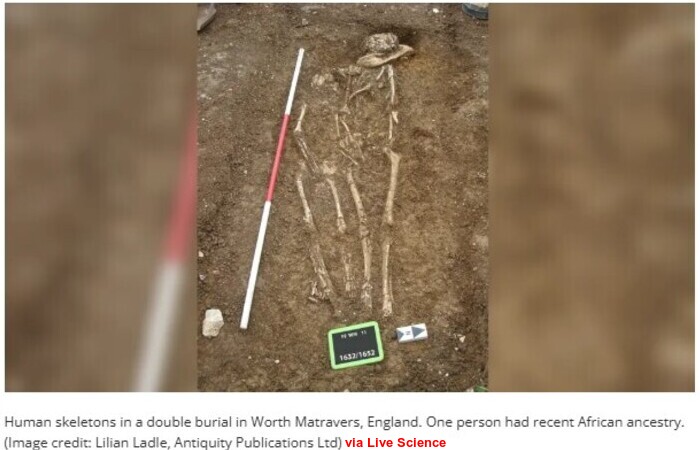
Reports suggest that two 7th Century skeletons, an adolescent girl from Kent and a young man from Dorset, have recently been recovered and their DNA analysis have revealed that they had grandparents from sub-Saharan Africa. The findings, published in Antiquity journal in August 2025, provide genetic evidence of long-distance human connections and diverse ancestry in early medieval Britain, contradicting previous assumptions of a more homogenous population. According to researchers, these two skeletons were buried around the 7th Century, during the early Anglo-Saxon Period following the fall of the Roman Empire.
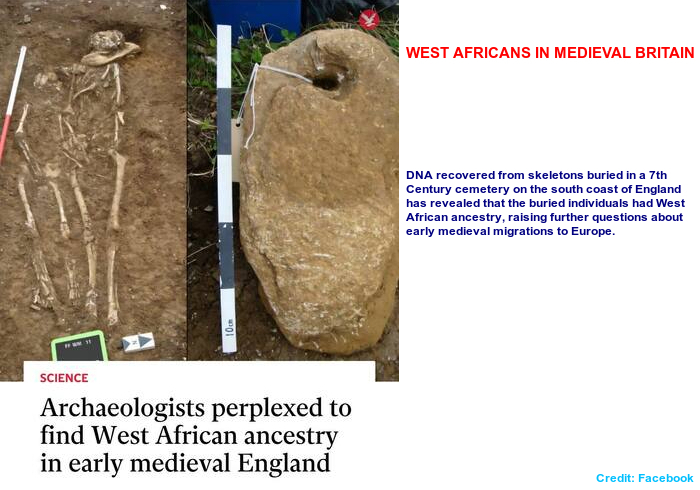
After analysing the two skeletons, researchers have come to the conclusion that their ancestors had arrived in Britain from West Africa. Dr Duncan Sayer, the Professor of Archaeology at the University of Central Lancashire and a member of the team, has mentioned in a paper that “both individuals thus show genetically and geographically mixed descent” as they had an estimated 20% to 40% ancestry characteristic of sub-Saharan Africa, likely in the grandparent generation. Dr Sayer and his colleagues are of the opinion that descendants of the Africans had arrived in Britain long before the British people colonised countries in Africa and Asia.
Naturally, the question arises as to how the ancestors of these skeletons came from Africa. Scientists have opined that some people in ancient Britain had African ancestry and also there was cultural exchange between the two continents long before the post-medieval colonial period. The latest study indicates that early medieval Britain was more diverse than previously believed. Dr Sayer stressed that the finding was “fascinating” because a number of children were buried in very different places, but had similar DNA. Dr Ceiridwen J Edwards from the University of Huddersfield, another member of the team, stated that “a diverse population with far-flung connections who were, nonetheless, fully integrated into the fabric of daily life“.
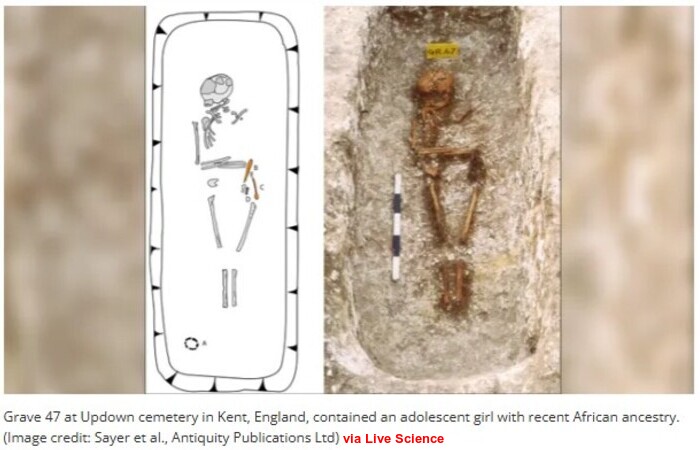
Interestingly, researchers have also found a knife, a spoon, a bone comb near the left hip of the girl buried in Kent and a decorated pot from Frankish Gaul at her feet. And, all these items are actually from Africa, indicating that cultural exchange between the Africans and the Britons was quite common. DNA analysis has further revealed that the adolescent girl had biological relatives in the same cemetery. However, the Worth Matravers young man was buried in a double grave in Dorset with an older man he was not biologically related to.
Meanwhile, German scientist Dr Joscha Gretzinger has claimed that the young girl, who died at about 10 or 11 years of age and was buried in Kent, had 33% West African ancestry. Perhaps, she married someone whose ancestors were not African. Hence, she got integrated with the English community, he added.
As per the common belief, the ancestors of the English people primarily originated from Germanic tribes, like the Anglo-Saxons, who migrated from continental Europe and settled in Britain after the Romans withdrew in the 5th Century. English ancestors also originated from the Celtic tribes who originally inhabited the island. The Anglo-Saxons, composed of Angles, Saxons and Jutes, migrated from what is now Denmark and northern Germany, while Celtic peoples were already present. Over time, these groups, along with later Viking settlers, mixed to form the English people and language. However, the latest study challenges the common belief, claiming that the people of medieval England were of mixed descent, with a complex ancestry.
The DNA analysis has revealed that the two skeletons had similar DNA to groups living in West Africa right now, such as the Yoruba, Mende, Mandenka and Esan groups. Dr Gretzinger has explained that there might have been a significant migration from Africa to Britain in the 6th Century soon after the Byzantine reconquest took place in North Africa. The young girl and the man (whose skeletons have been found in Britain) were the successors of those migrants.
Boundless Ocean of Politics on Facebook
Boundless Ocean of Politics on Twitter
Boundless Ocean of Politics on Linkedin
Contact us: kousdas@gmail.com

 ISMC
ISMC Boundless Ocean Of Politics