

Not Perpetual Enemies…
Once, former British Prime Minister Henry John Temple (also known as Lord Palmerston or 3rd Viscount Palmerston; October 20, 1784 – October 18, 1865) famously said: “There are no eternal friends or perpetual enemies, but only eternal and perpetual interests.” This is the core principle of contemporary global geopolitics.
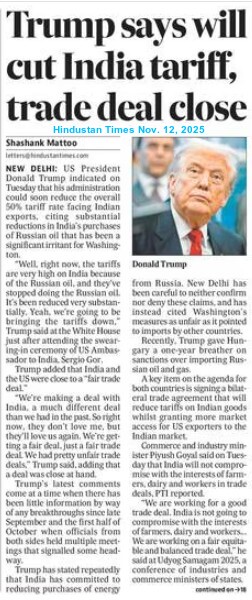
US President Donald John Trump‘s recent stance toward China reflects this principle. President Trump and his Chinese counterpart Xi Jinping made an attempt to stabilise bilateral relations during their meeting on the sidelines of the Asia-Pacific Economic Cooperation (APEC) Summit in Busan, South Korea on October 31 – November 1, 2025. After their “amazing” meeting, the US President claimed that Beijing agreed to purchase tremendous amounts of soybean from Washington DC, apart from expanding bilateral agricultural trade. He also announced that the US would reduce tariffs on Chinese goods from 57% to 47%.
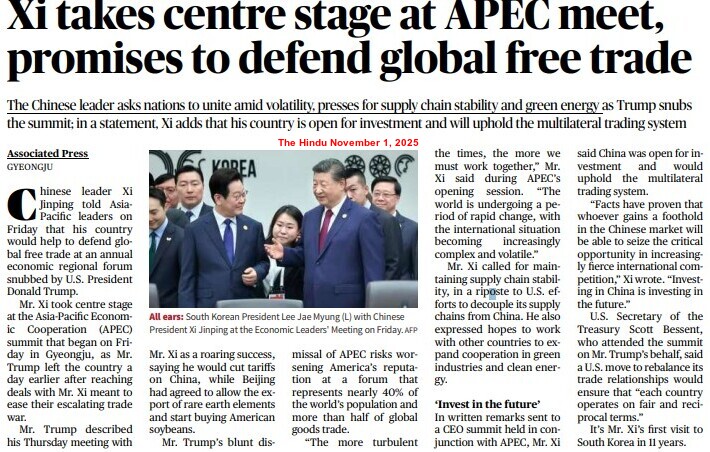
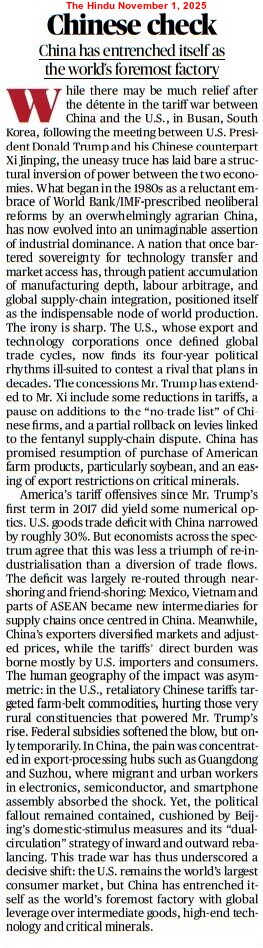
The US and China have long been engaged in economic, as well as ideological, warfare. Their actions over the past few decades, particularly concerning trade and technology, have strongly reinforced the prevailing view among a section of analysts and policymakers that the rivalry between these two counties is structural and likely a permanent one. However, internal priorities have prompted the two major global powers to reassess their relationship in recent times. It may be noted that the current US Administration faces a politically divided domestic environment and economic pressures that demand stability in global markets.
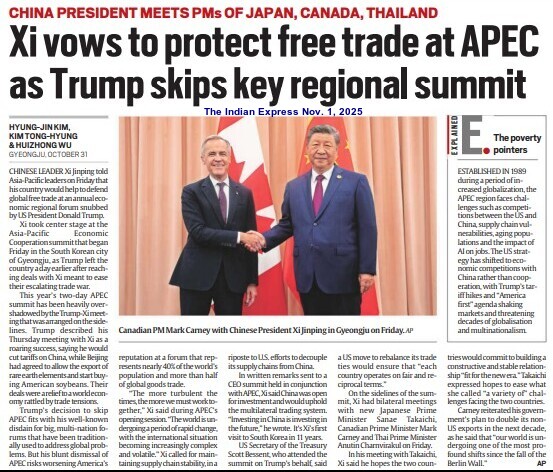
On the other hand, the Trump-Xi meeting in Busan was a strategic one for Beijing. President Xi is actively working to stabilise the Chinese economy amidst significant internal challenges, specifically sluggish economic growth, rising unemployment and high debt levels. His meeting with President Trump has served as a platform for bolstering (trade) ties with the US. Beijing can now test the limits of this new balance by putting its neighbours under diplomatic pressure or through new diplomatic initiatives in Asia.
The Trump-Xi meeting has also triggered a series of changes in the regional equation across Asia. It remains to be seen how India’s equation with both China and the US will evolve. Previously, India’s diplomatic position was determined by its relations with these two countries and they pushed the South Asian nation towards strategic isolation in some cases. The reassessment of the US-China relationship does raise concerns in India that is actively pursuing a policy of strategic autonomy and multi-alignment to navigate the complex geopolitical landscape and to maximise its own national interests.

New Delhi has rightly realised that it cannot remain inactive in the emerging situation. Instead, India must join the constantly changing geopolitical arena as an active player. The structural rivalry between the US and China is likely to continue, in spite of the recent reassessment of relations. Hence, India would have to take cautious steps in order to avoid the risk of overdependence on a foreign country. In the current geopolitical context in Asia, careful calibration of foreign policy, including increasing its strategic capabilities, has become imperative for India.
Meanwhile,







Boundless Ocean of Politics on Facebook
Boundless Ocean of Politics on Twitter
Boundless Ocean of Politics on Linkedin
Contact us: kousdas@gmail.com

 ISMC
ISMC Boundless Ocean Of Politics