

Celebrating The Power Of Art In Troubled Times
The Royal Swedish Academy of Sciences honoured Hungarian author László Krasznahorkai with the Nobel Prize in Literature for the year 2025 on October 9 “for his compelling and visionary oeuvre that, in the midst of apocalyptic terror, reaffirms the power of art”.
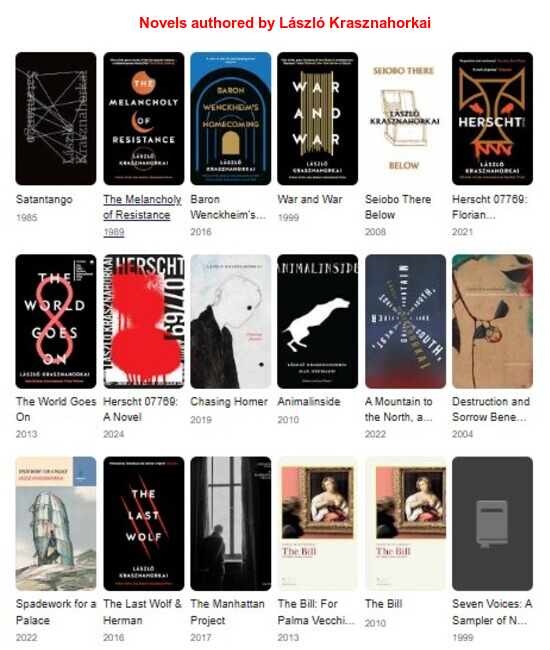
Krasznahorkai was born into a middle-class Jewish family in Gyula on January 5, 1954 when Hungary was under Communist Rule. He moved to erstwhile West Berlin in 1986 and initially drew inspiration from his experiences living under Communism and also from his travels to different places. The German critics consider his 2021 novel Herscht 07769, written in German, as a great German literary creation. The novel is set in the German state of Thuringia.
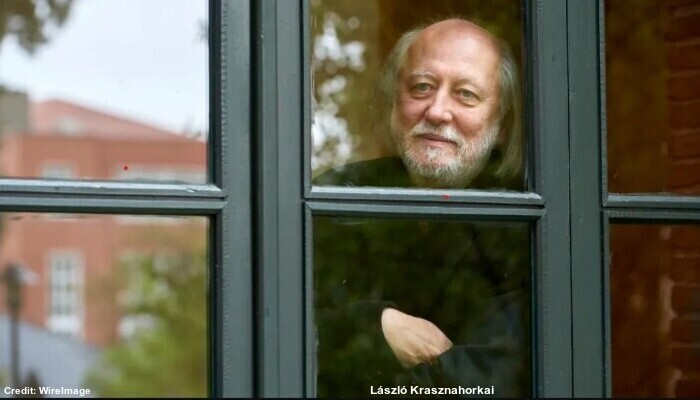
Meanwhile, the author returned to writing about Hungary in his 2024 novel Zsömle Odavan (Zsomle is Waiting). The main character of this novel is 91-year-old Uncle Józsi Kada who believes that he is a descendant of King Béla IV and Genghis Khan, with a legitimate claim to the Hungarian throne. Despite wanting to disappear from the world, he is found by a group of monarchist and extremist followers. The novel is a satirical tragicomedy about Kada’s attempts to evade his newfound followers and the absurdity of their political ambitions.
Krasznahorkai was in Frankfurt when the Royal Swedish Academy of Sciences announced his name as the winner of the Nobel Prize in Literature for the year 2025. He received the news over the phone. Later, the 71-year-old author told Swedish radio: “I’m very happy, I’m calm and very nervous altogether.” Krasznahorkai shall receive the prize in Stockholm on December 10, 2025.
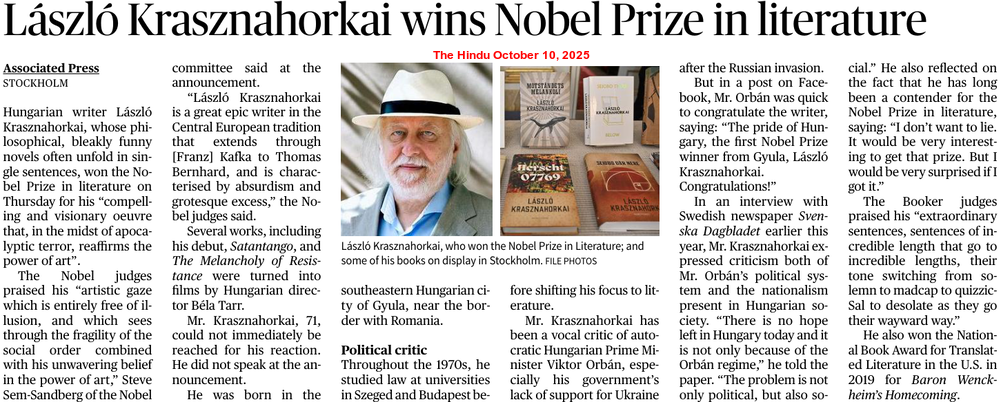
Krasznahorkai, popularly known for his difficult and demanding novels and often labelled postmodern for his attempt to explore dystopian, as well as melancholic, themes, has authored five novels and numerous short stories. In 2015, he won the Man Booker International Prize for his entire body of work rather than a specific novel. His debut novel, Sátántangó (Satantango or Satan’s Tango), was published in 1985. In a statement, the Swedish Nobel Committee has described this postmodern novel as a “stunning literary achievement” about the end of the world. It may be noted that several of his works, including Sátántangó and Az ellenállás melankóliája (The Melancholy of Resistance; 1989), were turned into films by Hungarian Director Bela Tarr. Háború és háború (War and War; 1999) is another famous novel written by him.

Krasznahorkai is the second Hungarian winner of the Nobel Prize in Literature, following Imre Kertész (November 9, 1929 – March 31, 2016) in 2002. The Swedish Nobel Committee has described Krasznahorkai as a “great epic writer in the Central European tradition that extends through Franz Kafka to Thomas Bernhard, and is characterised by absurdism and grotesque excess”. Once, the author described his own style of writing as “reality examined to the point of madness”.
The Nobel Prize in Literature has been awarded since 1901, with the first recipient being the French poet, René François Armand ‘Sully’ Prudhomme. So far, 122 people have received this prize and only 18 of them are women. Usually, literary critics cannot predict the name of the person who receives the Nobel Prize, even after much speculation. However, Krasznahorkai was among those whose names were being discussed as potential recipients in 2025. Apart from him, other much-discussed personalities were Japanese novelist Haruki Murakami, controversial Indian-origin author Sir Ahmed Salman Rushdie and Amitav Ghosh, the celebrated Indian English-language writer.
Boundless Ocean of Politics on Facebook
Boundless Ocean of Politics on Twitter
Boundless Ocean of Politics on Linkedin
Contact us: kousdas@gmail.com

 ISMC
ISMC Boundless Ocean Of Politics