

Evidence Of Bizarre Human Culture Found
Archaeologists began excavations around a cave in order to get new information about primitive humans. However, they experienced a horrifying scene while digging the area. Some human skeletons, broken into pieces, were buried there. The age and characteristics of those skeletons shocked the archaeologists.
The Archaeology Department of the Government of Spain has claimed that a little child, belonging to a now extinct human species, was decapitated and processed for food around 850,000 years ago! Archaeologists have speculated that the children became victims of cannibalism.
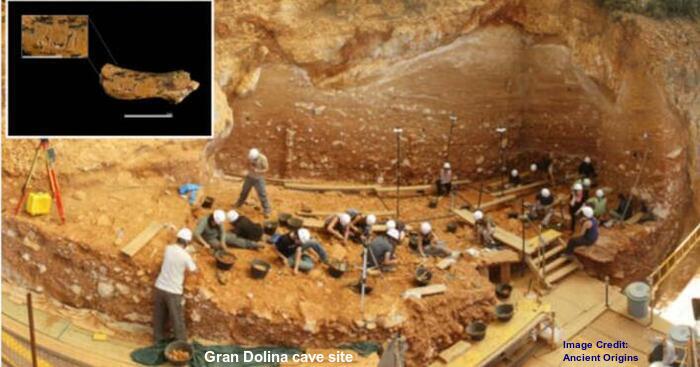
Researchers discovered a set of 10 skeletons while excavating at the Gran Dolina cave site in Atapuerca, northern Spain in the fourth week of July 2025. Those skeletons belonged to Homo antecessor, a species of archaic human, which went extinct around 770,000 years ago. Researchers also discovered defleshing cuts and intentional fractures, typically found on the bones of animals that were eaten, in the newly uncovered skeletons. The skeletons suggest that the victims were deliberately beheaded.
The specimen, a tiny vertebra, belonged to a two- to four-year-old member of the archaic human species. It carries clear evidence of precision cutting, while other bones found at the site exhibit marks characteristic of defleshing and intentional fracturing. All these are typical indicators of flesh being removed for food.
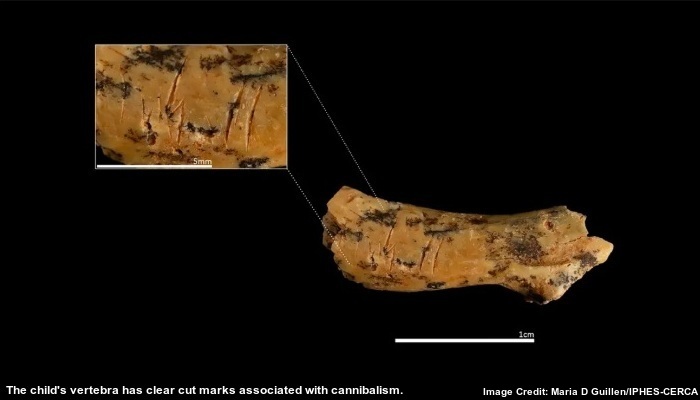
Dr Palmira Saladié, the Co-director of the Gran Dolina excavation, has mentioned in a statement: “This case is particularly striking, not only because of the child’s age, but also due to the precision of the cut marks. It is direct evidence that the child was processed like any other prey.” She stressed: “The preservation of the fossil surfaces is extraordinary. The cut marks on the bones do not appear in isolation. Human bite marks have been identified on the bones – this is the most reliable evidence that the bodies found at the site were indeed consumed.“
According to Dr Saladié, the skeletons are estimated to be 850,000 years old. She believes that primitive people used to consume flesh of their own species as food. She is of the opinion that Homo antecessor might have resorted to cannibalism in order to expand their dominance in certain areas (territorial control). It may be noted that this particular species of human lived in Western Europe during the Lower Palaeolithic Era, around 1.2 million to 800,000 years ago.
Watch: Interview With ‘Cannibalism’ Author
Archaeologists also recovered a hyena latrine with over 1,300 coprolites (fossilised poop) which were plopped on the level just above where the human remains, including the child’s vertebrae, were discovered. The overlaying evidence would help researchers to reconstruct who or what occupied the cave at different times. In other words, they shall get a better understanding of the history of interspecies competition in such an environment.
Interestingly, it is not the first time when researchers have identified such behaviour at this site. Nearly three decades ago, the same archaeological level revealed the first known case of human cannibalism in the world. Although cannibalism is well documented in early humans, it is unusual to find evidence of a child being eaten. Hence, the latest discovery could mark the earliest evidence of the practice found to date after verification. Dr Saladié said: “What we are documenting now is the continuity of that behaviour: the treatment of the dead was not exceptional, but repeated.”
The archaeologists are quite convinced that there is likely more to be discovered at the site, especially in relation to human bones. “Every year we uncover new evidence that forces us to rethink how they lived, how they died, and how the dead were treated nearly a million years ago,” stated Dr Saladié.
Boundless Ocean of Politics on Facebook
Boundless Ocean of Politics on Twitter
Boundless Ocean of Politics on Linkedin
Contact us: kousdas@gmail.com

 ISMC
ISMC Boundless Ocean Of Politics