

3,500-Year-Old City Unveiled In Peru
The Vedic Period began in India after the decline of the Indus Valley Civilisation about 3,500 years ago (around BCE 1500-600). Queen Hatshepsut of the 18th Dynasty of the New Kingdom was the ruler of Egypt at that period of time (specifically from approximately BCE 1479 to 1458). Latin America, too, emerged as a trade hub during this period, as a number of ancient civilisations developed there.
Archaeologists recently excavated a 3,500-year-old city, named Peñico, in northern Barranca Province of Peru. It is believed to have been a significant trading hub, connecting coastal, Andean and Amazonian cultures. The strategic location and well-preserved structures of Peñico offer valuable insights into the Caral-Supe Civilisation, which predates the Inca Empire. The ancient city is located approximately 200km north of Lima. According to researchers, the city was built about 600mt above sea level between BCE 1,800 and BCE 1,500.
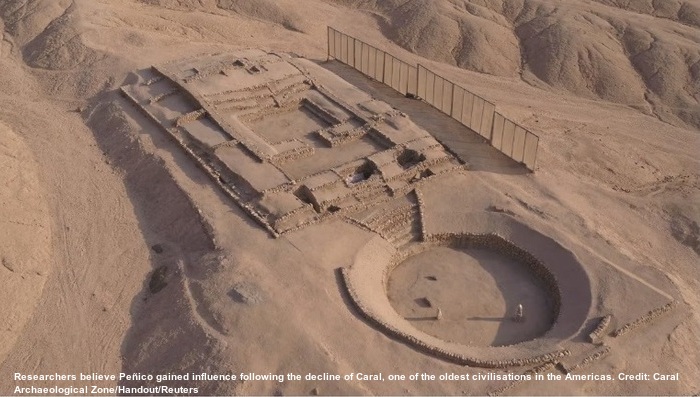
Interestingly, the Caral-Supe Civilisation, considered the oldest in the Americas, is estimated to have developed around 5,000 years ago in that particular region. Although various civilisations developed one after another across West Asia at that time, the Caral-Supe Civilisation developed independently as it had no connection with Indian, Egyptian or the Sumerian Civilisations. Dr Ruth Martha Shady Solís, who previously excavated the ancient city of Caral, led the research and excavation of Peñico. She stressed that Peñico was built after the Caral-Supe Civilisation faced an existential crisis because of climate change. The Peruvian anthropologist claimed that archaeologists uncovered 18 structures, including temples and residential complexes, along with ceremonial objects, clay sculptures and necklaces made from beads and seashells, during eight-year-long excavations in that area.

Speaking at a press conference on July 3, 2025, Dr Shady stressed: “This urban centre developed following the cultural tradition of the Caral. Due to its strategic location, it connected settlements on the coast and in the Supe and Huaura Mountains, as well as those living in the Andean-Amazonian territory and the high Andean region.” She added: “Its prestige may have been tied to its role in the trade of hematite, a red pigment with symbolic meaning in Andean cosmology.” Drone footage of the area shows a circular structure on a hillside terrace at the centre of the city, surrounded by the remains of stone and mud buildings. There are various sculptures carved on its walls. Researchers also found an image of a Pututu, a conch shell trumpet, on a wall of a building, known as B2, located in the central plaza of Peñico. This building is considered one of the most important structures in Peñico, while the pututu was a significant symbol in Andean society, used for rituals, calling meetings and announcing important events.
Experts are of the opinion that the ruins of Peñico are similar to those of the city of Caral. When the Egyptians were building the pyramids in northern Africa, the Caral-Supe or Norte Chico Civilisation emerged across a vast region in South America. Unfortunately, the oldest civilisation in both the Andean region and the Americas gradually disappeared due to climate change. Dr Shady believes that Peñico shall help researchers to understand what happened to the Caral Civilisation after the destruction of the city of Caral. For his part, Marco Machacue, a researcher and archaeologist at the Peruvian Ministry of Culture, has stated that the newly discovered 3,500-year-old city of Peñico is significant because it represents a continuation of the Caral society.
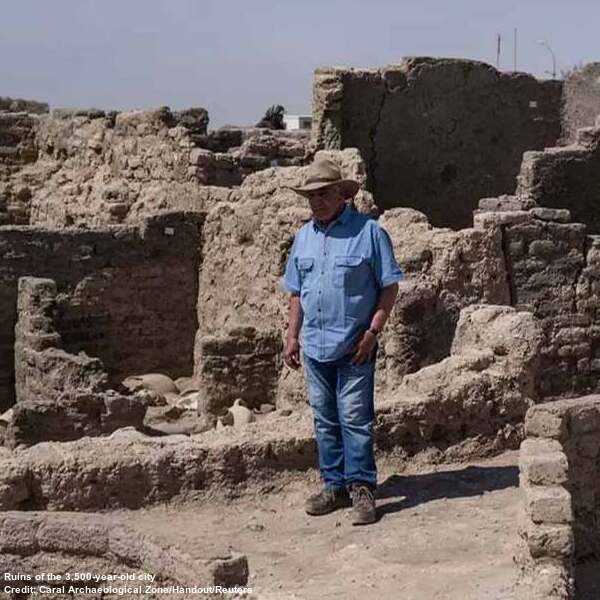
Traces of ancient Mayan, Aztec and Inca Civilisations are scattered throughout South America. The ancient civilisations of Machu Picchu, Pisac, Cusco and the Nazca Lines in Peru are famous among them which attract millions of tourists from different parts of the world every year. Now, Peñico has been added to that long list.
Latest Release: Tegart’s War: A Story of Empire, Rebellion and Terror by Stuart Logie
Available on Amazon, Amazon India and Kindle
Boundless Ocean of Politics on Facebook
Boundless Ocean of Politics on Twitter
Boundless Ocean of Politics on Linkedin
Contact us: kousdas@gmail.com

 ISMC
ISMC Boundless Ocean Of Politics