

Study: Boys Aren’t Better Than Girls At Math
Many believe that boys are better than girls at mathematics. However, a new study has challenged this age-old notion, revealing that there are no significant differences in mathematical abilities between boys and girls. In other words, understanding of the subject does not depend on gender. According to the study, childhood brains are equally good or bad at math, regardless of the gender of a child.
Elizabeth Shilin Spelke, an American Cognitive Psychologist at the Department of Psychology of Harvard University and Director of the Laboratory for Developmental Studies, made a similar claim a couple of decades ago, stressing that “gender is not a determining factor in math comprehension“. Her research showed that there were no inherent differences in aptitude for science and math between boys and girls. Otherwise, it would have been evident in childhood. She argued that observed differences in these fields were likely due to social and environmental factors rather than biological ones. Professor Spelke’s work emphasised that both male and female infants and children possess the same foundational cognitive abilities necessary for math and science. The study was published in the American Psychologist journal in 2005.

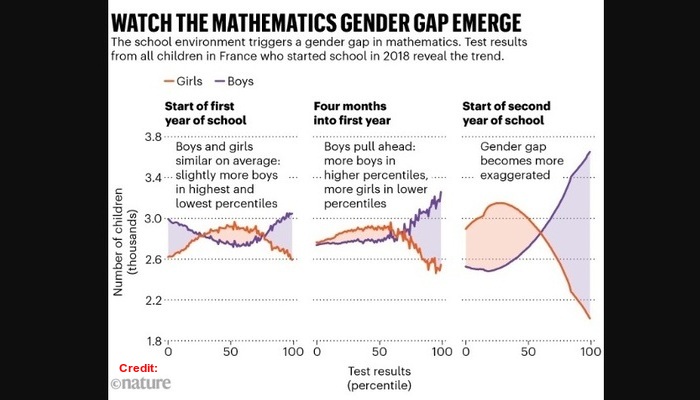
Dr Spelke and some European researchers recently published a new paper in the multidisciplinary science journal Nature. This time, they have presented stronger arguments in favour of the previous findings. Nearly seven years ago, the Government of France launched a survey on the mathematical skills of nearly 2.5 million school children. The latest study is based on the information obtained from that survey.
According to the 2018 study, there is no significant difference in mathematical skills between boys and girls at the pre-primary level. However, it has been noticed that a significant gap emerges within four months after enrolling in school, with boys pulling ahead. Researchers have also found that boys’ interest in math increases rapidly, thereafter. As time passes, the boys advance further in math than the girls. Hence, one may think that boys are naturally born better at math. Dr Spelke has argued that if it is so, then the difference should have been apparent from infancy or early childhood. However, the long-term study of 2.5 million children has shown that both boys and girls are equally skilled in math at the pre-primary level.
In 2003, Professor Paola Sapienza of the Kellogg School of Management at Northwestern University and her colleagues conducted a similar study on more than 270,000 adolescents in 40 countries. They found that when girls enjoyed equal opportunities with boys in education and other social spheres, there was no so-called gender disparity in their scores in mathematics. The researchers came to the conclusion that the way a child performs in math does not depend on gender, but on her/his socio-economic status. Interestingly, this disparity does not exist in countries where boys and girls enjoy equal opportunities. In fact, girls have outperformed boys in math (and also in science) in some of those countries.
There is no statistical or scientific evidence to support the notion that boys and girls differ in mathematical ability during childhood. Also, there is no major disparity in the socio-economic status of a boy and a girl in a country, like France. The question arises here: Why do girls fall behind in maths over time? There is disagreement as to whether this difference is due to social reasons (the way girls are raised from childhood) or there is a long social history behind it. The family, as well as society, creates discrimination between boys and girls from the very beginning. It can have an impact on the mathematical skills of a child. However, that is not the topic of discussion for now.

Dr Spelke and other researchers just wanted to know whether girls are inherently worse at math than boys because of their gender and whether there is any difference in their brains that creates a difference in understanding mathematics. The latest study has ruled out any such possibility.
Latest Release: Tegart’s War: A Story of Empire, Rebellion and Terror by Stuart Logie
Available on Amazon, Amazon India and Kindle

Boundless Ocean of Politics on Facebook
Boundless Ocean of Politics on Twitter
Boundless Ocean of Politics on Linkedin
Contact us: kousdas@gmail.com

 ISMC
ISMC Boundless Ocean Of Politics