

Spark Of Rebellion Igniting Chinese Army
Chinese President Xi Jinping has started taking actions against some high-ranking officials of the People’s Liberation Army (PLA) in the pretext of fighting corruption. The president recently dismissed two top officials and a nuclear scientist of the PLA. Hence, there is a growing fear of a military coup in China. However, the Xi Administration has rejected such a claim, stressing that the three officials were arrested for diverting large sums of money from the government treasury. One of the individuals facing criminal charges is believed to have a close relationship with President Xi.
As per a report published by the Hong Kong-based South China Morning Post, President Xi announced the dismissal of the three accused – Miao Hua, Li Hanjun and Liu Shipeng – on June 27, 2025. Miao is an Admiral of the PLA Navy who served as the Director of the Political Work Department of the Central Military Commission (CMC) of the Communist Party of China (CPC) from October 2017 to June 2025. This commission plays quite an important role in shaping the ideology of the Chinese military. Political analysts often refer to the six-member CMC as the most powerful institution of China. It may be noted that President Xi, as the Chairperson of the CPC, enjoys full control over the CMC. Significantly, Miao was expelled from the National People’s Congress (NPC or the Chinese Parliament) in April for his involvement in corruption and also for breaching discipline.

The Xi Administration, through its ongoing anti-corruption campaign within the PLA, has been investigating Admiral Miao, one of the youngest commanders of the PLA, for corruption and breaches of discipline since November 2024. The investigation is part of a broader effort to address corruption and ensure loyalty within the military.
China has never had such a high-ranking CMC official dismissed since the 1960s. A section of analysts believes that removing Miao has a different significance. Since becoming the General Secretary of the CPC on November 15, 2012, Xi has removed a number of CMC members on corruption charges. According to the British media outlet The Guardian, Miao is the eighth person on that list. The CCP has increased the power of the CMC since the leadership of Mao Zedong (December 26, 1893 – September 9, 1976). However, there were no allegations of corruption against CMC members at that period of time. The scenario changed after Xi became the General Secretary of the Communist Party, raising suspicions. Analysts are of the opinion that the Chinese President has gradually emerged as an autocratic ruler.
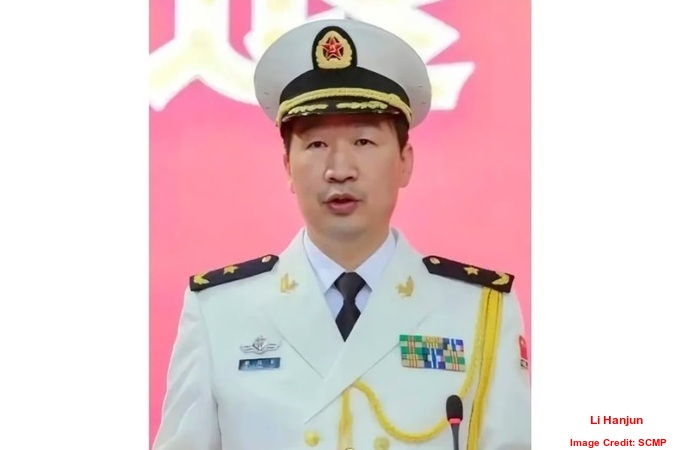
Vice Admiral Li Hanjun, the Chief of Staff of the PLA Navy, and Liu Shipeng, the Deputy Chief Engineer at state-owned China National Nuclear Corporation (CNNC), have also been caught in the sweeping crackdown in the military and expelled from the NPC. Xinhua reported that the NPC voted to dismiss the three officials. As President Xi had the support of the majority in the Parliament, he had no problem in making a final decision on their dismissal. Li served as Deputy Director of the CMC’s Training and Administrative Department before becoming the Navy Chief. He also served as the chief of the CMC’s Office for Reform and Organisational Structure for more than a year. Li was promoted to Vice Admiral in 2014 when he was appointed the Commander of the naval base in Fujian Province. Li also served as the Director (of Training) of the Naval Command College at that time. Soon, he was promoted to President of the school.
On the other hand, Liu, as the Deputy Chief Engineer at CNNC, used to monitor all aspects of his country’s civilian and military nuclear programmes. He was also the Secretary of the Communist Party and Chairman of the CNNC’s 404 base in Gansu. The Asian Giant established its first and biggest nuclear research centre on an area of more than 1,000sqkm in Gansu in 1954. The centre was instrumental in developing (China’s) first atomic bomb in 1964 and first hydrogen bomb in 1967. The 404 Base played an important role in these two successful ventures and Liu was named an Outstanding entrepreneur of Gansu in 2023.
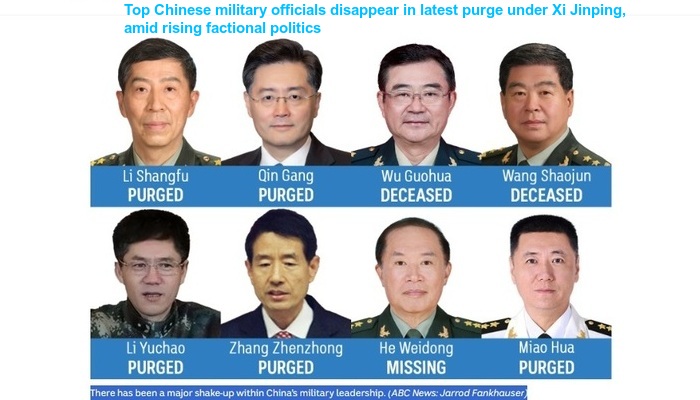
The Chinese President has overseen the dismissal or investigation of a dozen of senior military officers, defence industry executives and two former Defence Ministers in the past couple of years. Analysts have opined that President Xi, through such moves, is seeking to gain full control over the PLA and the CPC, apart from consolidating party control over the Armed Forces. Xi, who wants to make China one of the world’s best military powers, has consistently emphasised the need for the PLA to demonstrate absolute loyalty to the Communist Party and to him personally.
Among the high-profile appointees of the President, former Foreign Minister Qin Gang had a tragic end as he disappeared from public view in June 2023 and was removed from the post of Minister of Foreign Affairs on July 25, 2023. Reports suggest that a corruption investigation was underway against Qin who emerged as the fiercest rival of Xi within the party. Some believe that President Xi secretly eliminated the former minister. In November 2024, the Xi Administration launched an investigation of former Defence Minister Admiral Dong Jun due to suspicion of corruption. Later, the Chinese Foreign Ministry dismissed media reports that Dong was under investigation for corruption, terming them as “groundless” and “shadow chasing“. At the same time, Beijing made it clear that it was determined to make the PLA completely free of corruption.
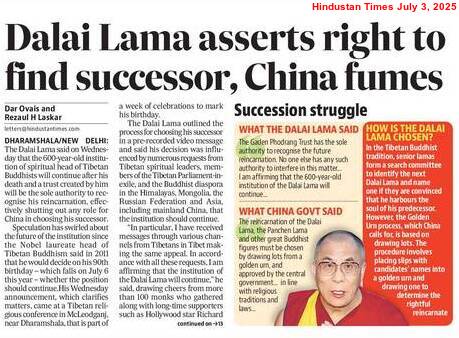
The People’s Liberation Army Rocket Force (PLARF) is responsible for China’s nuclear arsenal, alongside its conventional missile capabilities. This branch of the PLA manages and controls land-based ballistic, hypersonic and cruise missiles (both nuclear and conventional), apart from playing a crucial role in China’s strategic deterrence and broader military posture. The PLARF is cited as having the highest number of corruption allegations. According to defence experts, it is highly dangerous as there is a possibility of handing over nuclear weapons to the enemy in exchange for bribes.
Experts believe that President Xi’s anti-corruption campaign would ultimately weaken the PLA from within by creating an atmosphere of suspicion among Army officers. As a result, China may have to pay a heavy price during a war or to experience a rebellion.
Boundless Ocean of Politics on Facebook
Boundless Ocean of Politics on Twitter
Boundless Ocean of Politics on Linkedin
Contact us: kousdas@gmail.com

 ISMC
ISMC Boundless Ocean Of Politics