

People From 12 Countries Face US Travel Ban
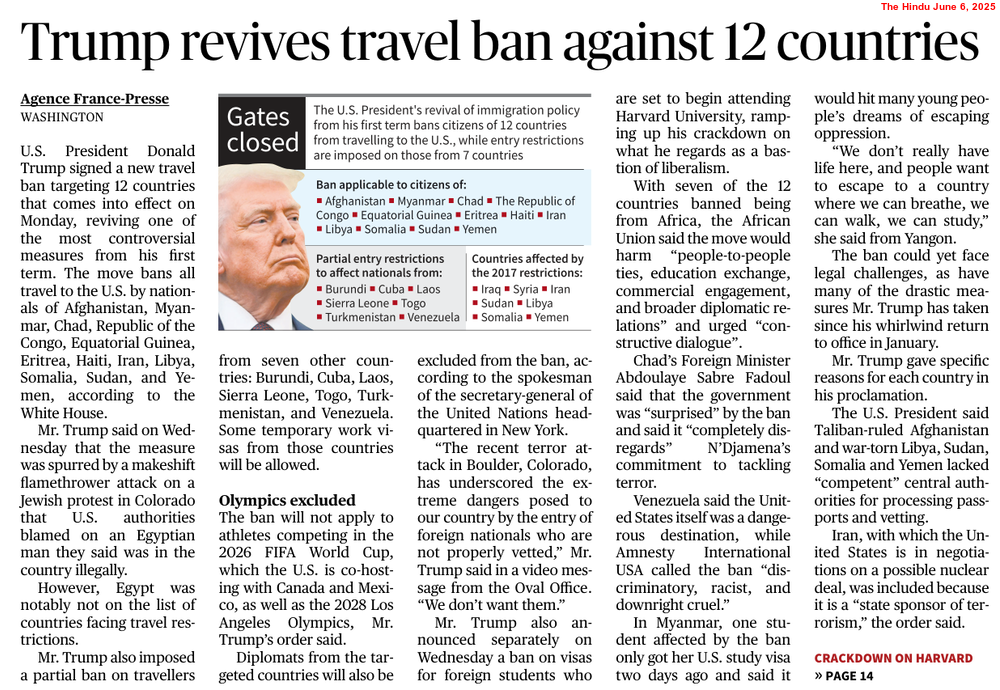
President Donald John Trump has decided to close the doors of the US to citizens of 12 countries for the sake of national security. He has also imposed partial restrictions on entry to the US on people of some other countries. However, some people from those 12 countries may enter the US.
It may be noted that the US, Canada and Mexico would jointly host the 2026 FIFA World Cup. Later, the 2028 Summer Olympics would take place in Los Angeles. Members of the participating countries would be able to travel to the US during these two sporting events as the Trump Administration has confirmed that it would not apply the restrictions applicable to citizens of those 12 countries.
Earlier, the US granted special immigrant visas to some minorities facing religious and ethnic persecution in Iran. The fresh ban would not be applicable to them either. Hence, they can stay in the US for now. Afghan citizens with special US visas could also be able to stay there. The new ban would not be applicable to those who have been legally recognised as permanent residents in the US. Reports suggest that people with dual citizenship can also enjoy exemptions. Furthermore, the State Department can grant exemptions to the entry of some specific individuals to the US.
President Trump has announced that residents of Afghanistan, Myanmar, Chad, Republic of Congo, Equatorial Guinea, Eritrea, Haiti, Iran, Libya, Somalia, Sudan and Yemen would not be able to enter the US from June 9, 2025. Partial restrictions have been imposed on citizens of Burundi, Cuba, Laos, Sierra Leone, Togo, Turkmenistan and Venezuela.
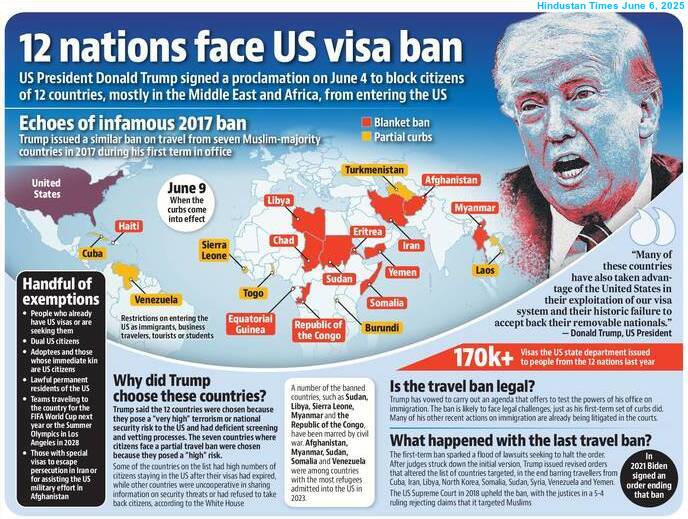
According to sources close to the White House, many countries that face US sanctions support terrorist activities. For example, the US has mentioned Afghanistan, Iran and Cuba. Citizens of Chad, Eritrea and some other countries are allegedly staying or trying to stay in the US even after the expiry of their visas. The President has claimed that the move would prevent the entry of Islamist terrorists to his country.
Meanwhile, the Democrats have strongly criticised President Trump’s decision, stressing that the move would further isolate the US internationally. Human Rights organisations, too, have expressed serious concern over Trump’s decision, with Amnesty International describing the travel ban as “discriminatory and violent“. Incidentally, Trump had imposed a travel ban on people of seven Muslim-majority countries, including Iran, Libya, Somalia, during his first term as the US President in 2017. Later, he included two non-Islamic states – North Korea and Venezuela – to that list. Although the US Supreme Court upheld the travel ban in 2018, the Joe Biden Administration lifted the ban later.
Boundless Ocean of Politics on Facebook
Boundless Ocean of Politics on Twitter
Boundless Ocean of Politics on Linkedin
Contact us: kousdas@gmail.com

 ISMC
ISMC Boundless Ocean Of Politics