

World Pays Tribute To ‘Man With The Golden Arm’
The global community paid a rich tribute to James Christopher Harrison (December 27, 1936 – February 17, 2025), an Australian blood donor known as the Man with the Golden Arm for his prolific history of donations, after his demise in February 2025. He donated blood and plasma a record 1,173 times from the age of 18 to 81, as his blood contained rare antibodies that saved millions of babies from Rh disease. The Government of Australia awarded Harrison a national honour in recognition of his contributions.
Harrison, born in New South Wales, underwent major chest surgery that required the transfusion of a large amount of donated blood at the age of 14 in 1951. In spite of his fear of needles, he started donating blood after reaching the required age of 18 in 1954. Decades later, doctors discovered that Harrison’s blood contained unusually strong and persistent antibodies against the D Rh group antigen. Hence, doctors processed his blood, containing a high level of anti-D antibodies, to create immunoglobulin-based products used to prevent Haemolytic Disease of the Newborn (HDN). The processed products were given to Rh(D) negative mothers of unknown or Rh(D) positive babies during (and after) their pregnancy in order to prevent the creation of antibodies in the blood of the Rh(D) positive child. This piece of information encouraged Harrison to donate his blood at an interval of two weeks on a regular basis. He made his final blood donation on May 11, 2018 at the age of 81.
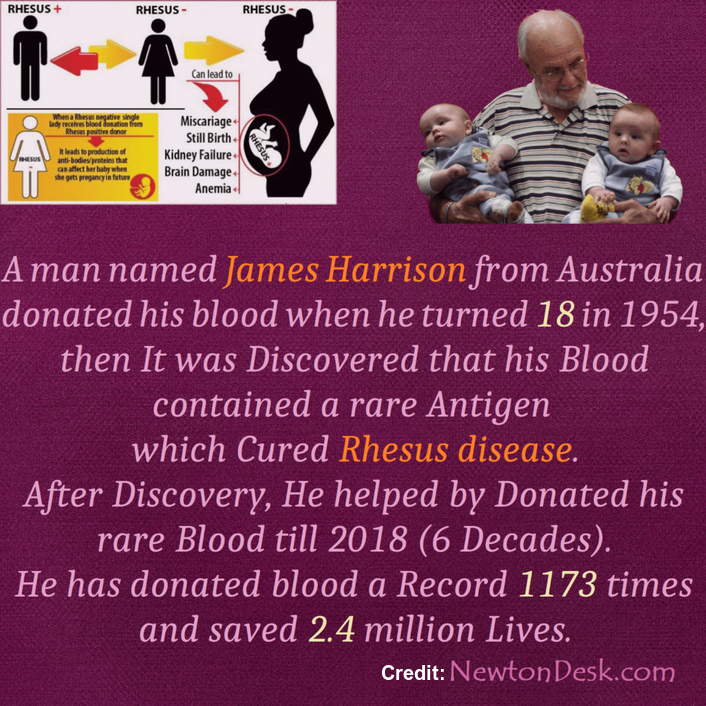
Medical researchers have explained the importance of the anti-D injection, stressing that if the blood type of a mother is Rh negative and her first child is Rh positive, then the second child would suffer from a serious blood disease, called Hemolysis, in the womb. Hemolysis is basically the breakdown or destruction of red blood cells (Erythrocytes), either within the bloodstream (intravascular) or outside of it (extravascular), leading to the release of their contents. According to researchers, when a baby is born (or in some other way), some of the baby’s blood enters into the mother’s body. In case of a mother with Rh negative, she does not have the antigen in her red blood cells. The blood of such mothers fails to recognise the Rh positive blood antigen of their child. Hence, the mother’s body produces a lot of antibodies to combat the unfamiliar antigen. Although there are no complications during the birth of the first child, the problem arises when the mother conceives for the second time, with antibodies accumulated in her body destroying red blood cells of the foetus. Often, it leads to foetal demise. Else, a baby is born with serious physical defects.
Interestingly, anti-D injection can save children from this sort of complication. Usually, anti-D immunoglobulin injections are given to Rh negative mothers within 72 hours of the birth of their first child. It covers the Rh antigen originating from the baby’s body. Therefore, the immune system of the mother does not detect the presence of unfamiliar antigens and also does not produce antibodies to protect the system from such antigens. Hence, the mother faces no problem during her second pregnancy.
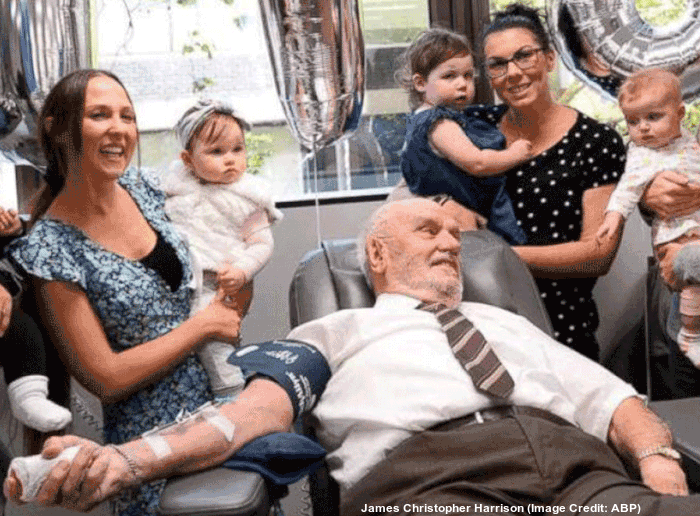
Harrison’s daughter Tracey and granddaughter-in-law Rebecca received anti-D injections made from his plasma during their pregnancy. Jarrod, the grandson of Harrison, confirmed that injections containing his grandfather’s donations were used on her mother when she was pregnant with his brother Scott and again on his wife, stating: “It’s pretty cool that part of him went into mum and got me a brother, then protected my kids (and) his great-grandkids.“
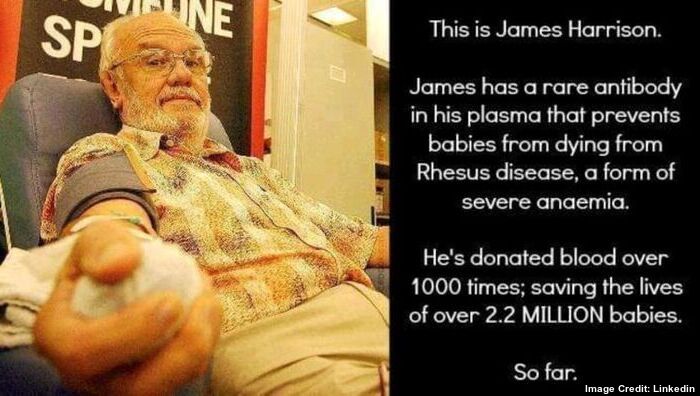
For Harrison, blood donation was part of social service. He was against using donated blood for commercial purposes. Hence, he strongly criticised the Australian Government‘s plan to open up plasma donation to foreign corporations in 2007, saying that the trade would discourage volunteer donations. According to the Australian Red Cross Society, about three million doses of anti-D injections were produced from Harrison’s donated plasma, benefitting nearly 2.4 million Australian women. After donating blood for the one last time in 2018, Harrison stated: “I hope it’s a record that somebody breaks, because it will mean they are dedicated to the cause.” He passed away in his sleep at the Peninsula Villages nursing home in Umina Beach on February 17, 2025 at the age of 88.
Researchers are now trying to artificially create a mixture of monoclonal antibodies, manufactured in bioreactors by hybridomas, which matches what is naturally produced in the bodies of donors, like Harrison. This initiative is popularly known as James in a Jar!
Boundless Ocean of Politics on Facebook
Boundless Ocean of Politics on Twitter
Boundless Ocean of Politics on Linkedin
Contact: kousdas@gmail.com

 ISMC
ISMC
