

A Slightly New Dinosaur Extinction Theory
As per the most widely accepted theory, dinosaurs, the giant prehistoric creatures, had gone extinct after an asteroid, between 10-15km in diameter, hit the Earth at an angle of 60 degrees and a velocity of 20km per second 66 million years ago! However, scientists recently found enough evidence that could change this popular theory for the extinction of dinosaurs!
According to scientists, more than one asteroid, and not just one, had hit the Earth, triggering the extinction of dinosaurs and some other creatures. Today, one can find their fossils only. A couple of months ago, researchers mapped an underwater crater off the coast of Guinea, named Nadir Crater, spanning over 8km. They claimed that the 400mt-wide crater was created by an asteroid! After detecting the crater through seismic scans, scientists came to the conclusion that the asteroid believed to have caused the extinction of dinosaurs was a contemporary of the one that had created the Nadir Crater. Therefore, not one, but at least two asteroids, had hit the Earth and an entire species had gone extinct. If this claim is proven, then the previous theory of dinosaur extinction may be reconsidered!
Dr Uisdean Nicholson from Heriot-Watt University, Edinburgh first discovered the Nadir Crater in 2022. However, a cloud of uncertainty hung over how it was really formed. Dr Nicholson claimed that the Nadir Crater was created after an asteroid of a diameter of 0.4km hit the Earth. This asteroid was smaller than the one, which created the Chicxulub Crater in Mexico and is blamed for the extinction of the dinosaurs from the Earth.
A section of palaeontologists is of the opinion that a huge explosion was caused by the impact of the collision between a large asteroid and the Earth. As a result, there was an environmental change that had led to the extinction of dinosaurs, among others. Palaeontologists have claimed that an asteroid with a width of 12km hit the Yucatán Peninsula that separates the Gulf of Mexico from the Caribbean Sea! As the asteroid crashed into the Earth at a high speed, a crater estimated to be 200km in diameter and several kilometres in depth was created. The event also triggered a Tsunami!
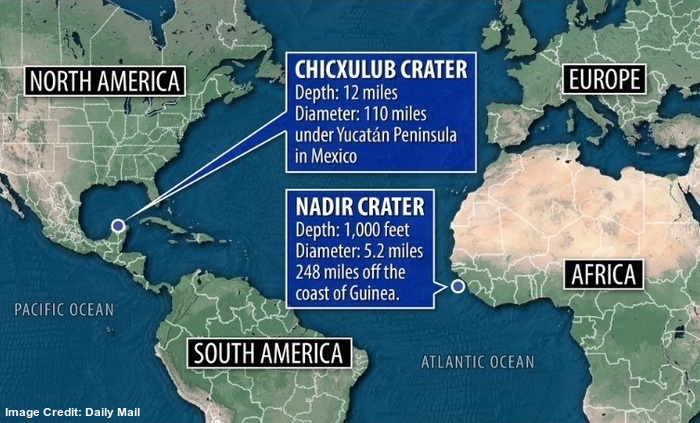
After examining a large part of the crater that is submerged underwater, palaeontologists have found the presence of Gypsum in it. Gypsum is a soft mineral that is made of Calcium Sulphate Dihydrate. Palaeontologists have opined that sulphur might have mixed with the water in the ocean due to the collision between the asteroid and the Earth. As sulphur entered the atmosphere, the temperature of most places on the Earth dropped below zero degree Celsius, making it difficult for dinosaurs to survive. The team of researchers led by Dr Nicholson believes that the asteroid which created the Nadir Crater hit the Earth at a speed of more than 72,000km per hour! It ultimately led to landslides and changes at the bottom of the ocean, apart from triggering a Tsunami in the Atlantic Ocean. The tidal height is estimated to be over 400mt!
Watch: New Findings
Researchers further claimed that the second asteroid, although smaller in size than the one which created the Chicxulub Crater, had a greater impact. New research suggests that the combined impact of two asteroids had caused the extinction of 75% of species, including the dinosaurs. After the extinction of the dinosaurs, the Age of Mammals began on the Earth.
Boundless Ocean of Politics on Facebook
Boundless Ocean of Politics on Twitter
Boundless Ocean of Politics on Linkedin
Contact: kousdas@gmail.com

 ISMC
ISMC Boundless Ocean Of Politics