

Vast Ancient Mayan City Discovered In Mexico
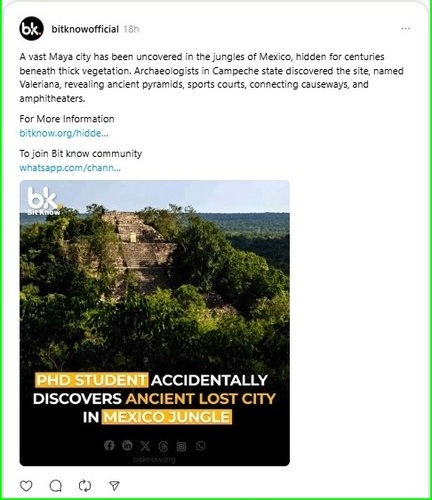
The possibility of the existence of an entire city covered under a thick blanket of dense forest has been at the level of conjecture for many centuries. Luke Auld-Thomas, a PhD candidate at Tulane University in New Orleans, Louisiana, recently discovered the ruins of a huge city of the ancient Mayan Civilisation in southern Mexico, somewhat unexpectedly. Although the researcher is excited, he is also concerned about the real cause of the destruction of the city that has been named Valeriana after a lake situated near the forest.
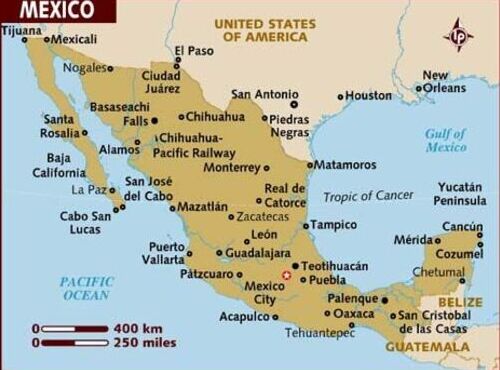
Auld-Thomas and other archaeologists have claimed that they also found pyramids in this ancient Mayan city near Campeche, a Mexican port city on the Gulf of Mexico. The pyramids resemble those at Chichén Itzá in the Mexican Province of Yucatán, and Tikal, an ancient citadel in the rainforests of northern Guatemala. The newly discovered ancient Mayan city has many other structures, including temples, playgrounds and water bodies, too.
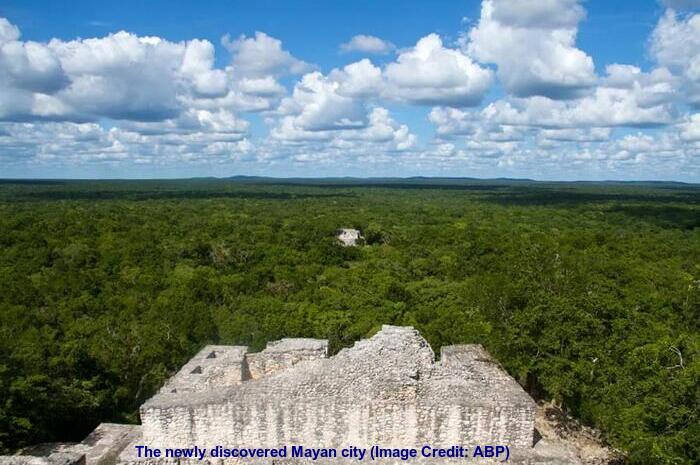
From the information available so far, it is estimated that the ancient city was inhabited by 30,000-50,000 people. The figure is several times more than the number of people currently living in that region! Therefore, it can be assumed that the importance of Valeriana was huge to the Mayan people. Researchers are of the opinion that the Mayan people did not live in different isolated villages, but in a big city with adequate infrastructure.
As per the latest research paper published in the Antiquity journal on October 29, 2024, the newly found site covers about 16.6sqkm, an area about one-and-a-half times the size of Washington DC. The densely packed area contains nearly 6,674 structures!
According to Auld-Thomas, the ancient city, which was inhabited about 1,500 years ago, is now buried under the dense forest. It was not possible for researchers to discover such a huge area in the past mainly because of the lack of advanced technology. However, the modern drone mapping technology, known as Light Detection and Ranging Equipment (LiDAR), has made it possible! LiDAR is basically a remote sensing technique that uses a laser to measure distances and create three dimensional models of the Earth’s surface. LiDAR systems are made up of a laser, scanner and GPS receiver, which work by sending out pulses of light and measuring the time it takes for the light to reflect back. The time of flight is used to calculate the distance between the laser and the surface.

Meanwhile, Marcello Canuto, a Professor of Anthropology at Tulane University, has stressed that Valeriana probably collapsed between 800 AD and 1,000 AD for a complex set of reasons, including Climate Change! NBC News quoted him as saying: “The growing consensus is that climate variability was a major factor causing stresses, adaptations and reactions, leading to more systemic unrest.” Professor Canuto further said that the ancient city was densely populated. Hence, the inhabitants could not survive climate-related problems after a certain period of time.
Professor Canuto has claimed that the discovery emphasises the requirement for more field research, alongside the large efforts to map the region using drones. “It would be wonderful over the next 10-20 years. We should have double the amount of ground covered in LiDAR,” he added.
The research paper published in the Antiquity reads: “We argue that the Alianza data demonstrate a range of ancient settlement densities comparable to those documented by site-focused archaeological surveys in the region, from nearly vacant rural landscapes to dense urban areas. The discovery of Valeriana highlights the fact that there are still major gaps in our knowledge of the existence or absence of large sites within as-yet unmapped areas of the Maya Lowlands.“
Boundless Ocean of Politics on Facebook
Boundless Ocean of Politics on Twitter
Boundless Ocean of Politics on Linkedin
Contact: kousdas@gmail.com

 ISMC
ISMC Boundless Ocean Of Politics