

A Major Threat To The Entire Ecosystem!
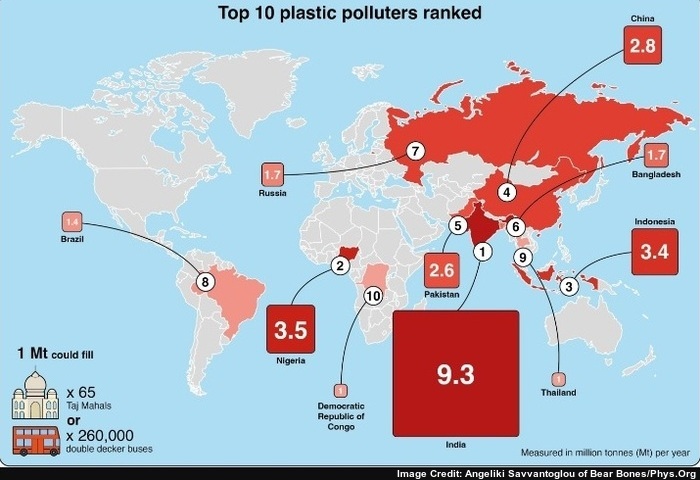
Well, occupying the top position turns out a matter of shame, at times! The issue of plastic pollution is a fine example of this. As per a study recently published in Nature, India is the largest plastic emitter in the world! The report has claimed that the South Asian nation releases 9.3 million tonnes of plastic waste into the environment each year and it can fill up an area equivalent to 604 Taj Mahals!
After analysing waste management practices across more than 50,000 cities, researchers at the University of Leeds in the UK have found that the world generates 57 million tonnes of plastic waste every year. Interestingly, most of this huge amount of plastic waste is generated by countries in the Global South. India is followed by Nigeria, Indonesia, China and Pakistan in the list. In the past, China was the world’s most plastic polluting country. However, the Asian Giant has replaced India to secure the fourth position by improving access to waste collection facilities in recent times.
With the help of advanced technology, researchers have shown that over two-thirds of the world’s plastic pollution stems from uncollected waste, with 1.2 billion people (15% of the global population) living without access to waste collection services. India implemented Plastic Waste Management Amendment Policy (2021) in 2022, imposing a ban on the production, sale and use of 19 types of single-use plastics. However, the move has failed to improve the situation.
Researchers at the University of Leeds have claimed that “nearly 53% of India’s plastic waste emissions come from 255 million people whose waste is uncollected”. They have mentioned: “Most of the remaining emissions are as a result of open burning on dumpsites in which fires are reported to be common.” In actuality, India burns roughly 5.8 million tonnes (mt) of plastic each year and releases another 3.5mt of plastics into the environment (land, air and water) as debris. Although India claims to have a national waste collection coverage of around 95%, the study has found evidence that official statistics do not include rural areas, open burning of uncollected waste and waste recycled by the informal sector. Hence, it has become quite difficult to get the real picture of plastic pollution in India!
Information about uncollected waste is important to understand the nature of plastic pollution. If waste collection is not done in a proper manner, people tend to pile the waste in open places or burn it. Burning of waste, like plastic, does reduce it, but the pollutant particles produced due to open burning are particularly harmful to the human body. The study has revealed that more plastic waste is burned than is emitted as debris (physical particles larger than 5mm) worldwide, and it may have a significant impact on human health and ecosystems.
There is a huge gap between official declarations and reality in India as far as plastic waste is concerned. While marking the World Environment Day on June 5, 2018, Prime Minister Narendra Modi announced that India would phase out single-use plastics by 2022. India implemented the Plastic Waste Management Amendment Policy (2021) in 2022. Unfortunately, the use of single-use plastics has not decreased at all (even after the implementation of that policy)!

According to researcher Costas Velis, setting to fire in the open is the predominant form of plastic pollution in the Global South. Sub-Saharan Africa is an exception, as uncontrolled debris comprised a larger share of the pollution pie in this region, unlike in the Global North. In the Global North, plastic pollution predominantly comprised of uncontrolled debris. The researcher believes that it is simply a symptom of inadequate or completely absent waste management systems and a lack of public infrastructure for the same. Velis told AP: “We should not put the blame, any blame, on the Global South… (or) praise ourselves about what we do in the Global North in any way.” He stressed that people’s ability to dispose of waste depends mainly on their government’s power to provide the necessary services.
Meanwhile, experts are of the opinion that different types of non-recyclable plastics are being used in India due to the lack of suitable alternatives. Furthermore, the country does not have a robust waste collection system. Hence, one can easily imagine the level of plastic pollution in India.
In such a scenario, India occupying the top position in the plastic emitters’ list is a clear sign of warning!
Boundless Ocean of Politics on Facebook
Boundless Ocean of Politics on Twitter
Boundless Ocean of Politics on Linkedin
Contact: kousdas@gmail.com

 ISMC
ISMC Boundless Ocean Of Politics