

Twenty Love Poems & A Song Of Despair!
A collection of Twenty Love Poems and A Desperate Song (Veinte poemas de amor y una canción desesperada) recently turned 100, as Pablo Neruda (born Ricardo Eliécer Neftalí Reyes Basoalto; July 12, 1904 – September 23, 1973) published his second work in 1924! The Chilean poet, diplomat and politician, who won the 1971 Nobel Prize in Literature, penned those verses before he was 20 years of age! The controversial eroticism of the verses, especially considering the author’s young age, triggered a sensation across the globe, and the editor of a magazine reportedly refused to print the very first poem of this book that began with the line… “Body of a woman, white hills, white thighs, when you surrender, you stretch out like the world.“
Surprisingly, the publication was well received by the young people soon after its release! In fact, the lonely moments of the Post-First World War period prompted the global community to look for a space full of love, intimacy and peace. In young Neruda’s works, the readers discovered a strong sense of love and desire, and not the abstract ideal (of love)!

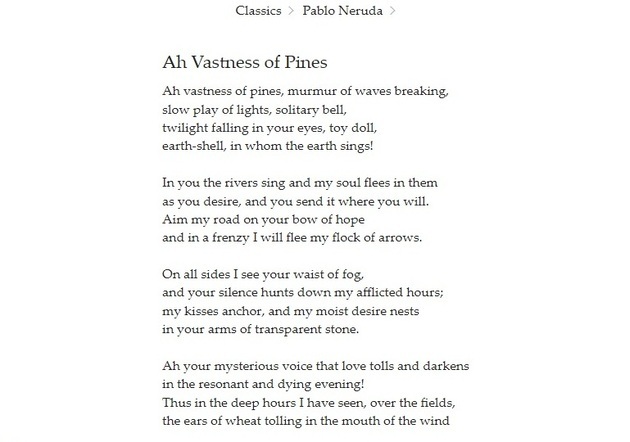
It was a different time altogether. James Joyce‘s modernist novel Ulysses, T S Eliot‘s The Waste Land and Peruvian poet César Vallejo‘s Trilce were published in 1922. Federico García Lorca‘s Romancero gitano (or Gypsy Ballads) would be published in 1928. In the midst of these, Neruda uttered the love with his eyes, ears, nose, tongue and fingertips, as one could find the vastness of pines, the sound of bells and waves on the shore in his beloved person through his exclaimed works. He wrote: “In you the rivers sing and my soul flees in them…” (Ah Vastness of Pines) Hence, Neruda’s verses on love and eternal oblivion still thrill the readers!
A wave of change rocked Chile in the 1930s. The new Constitution reduced the power of the church, while democratic ideas began to gain importance in the Latin American country. Such reforms were naturally directed towards Europe, especially France. However, Neruda turned his back on the colonial masters of the past. Instead, he stressed on Chile’s wealth, beautiful mountains, the majesty of the forests and the girls of the soil. His verses helped his countrymen to discover the unique characteristics of Chile.
Although Neruda was honoured with the Nobel Prize in Literature a couple of years before his demise, he strove to find the future world through his works from the very beginning of his literary journey! He ventured the Far East, to the great Indian poet and philosopher Rabindranath Tagore, in search of emotion and expression. Tagore’s Manaspratima (a poem written at the end of the 19th Century) influenced Neruda to write: “And now you’re mine. Rest with your dream in my dream. Love and pain and work should all sleep, now.” (Sonnet Lxxxi) One can find sensitivity, as well as keen intelligence, in his verses. Neruda successfully matched the essence of greatness in everyday life with his superb skill. In a sense, Twenty Love Poems and A Desperate Song is a wonderful amalgamation of various feelings, like love, separation, hope and despair. He wrote: “I like you when you’re silent, for you seem as if you’re gone, and you hear me from afar, and my voice doesn’t touch you.” (I like you when you’re silent)
Along with it’s being so popular, the context of this book, too, is much-discussed. In his verses, young Neruda expressed love for his fiancées (Albertina Rosa, Teresa Basques and Maria Parodi and there might be a fourth one), with none of them did his relationship last! However, his works have immortalised all of them. Neruda captured the rain-soaked hills and forests of his childhood towns of Temuco and Puerto Saavedra in this publication, as well. In his autobiography, Neruda mentioned that he portrayed the passion of his youth and the unforgettable nature of southern Chile in Twenty Love Poems and A Desperate Song.

It can be said that Neruda’s own style of writing also originated from this book! While delivering a speech in 1964, the poet stressed that he had made a desperate attempt to overcome the influence of his contemporary Uruguayan poet Obra Inédita de Carlos Sabat Ercasty (November 4, 1887 – August 4, 1982).
It is obvious that the world of Spanish Literature would organise various events to mark the centenary of the publication of a book that changed the journey of such a poet! Articles on this book have been published in almost all the newspapers and literary magazines in each and every Latin American country. While a new centenary edition of this book has been published from Chile, the Chilean Embassy in Panama marked the World Poetry Day (celebrated on March 21 every year) in 2024 by reciting poems from Twenty Love Poems and A Desperate Song.
It seems that the loneliness, love and hope as described by Neruda could inspire the global community to stop bloodbath in different parts of the world and to ensure peace in the 21st Century.
Boundless Ocean of Politics on Facebook
Boundless Ocean of Politics on Twitter
Boundless Ocean of Politics on Linkedin
Contact: kousdas@gmail.com

 ISMC
ISMC Boundless Ocean Of Politics