

Human Resource Management In Colonial India
In her latest publication ‘Human Resource Management in the Days of John Company: 1790-1850‘, Dr Sharmistha De has discussed how the British East India Company became an administrative entity in Colonial India. Based on archival documents, she has made an attempt to explain how the Company was run and how it interacted with its employees. The author has not only discussed various parts of this Proto-Empire, but has also tried to explain how the East India Company built a complex civil regime and how it became a blueprint for the Governments of Independent India.
Earlier, Philip J Stern, an Assistant Professor of History of the British Empire at Duke University, and others directed their focus to the 17th Century while trying to trace the roots of colonialism in India. It may be noted that the East India Company had started functioning institutionally, like a Government, through its employees and agencies in the 17th Century! According to Dr De, it is unbelievable that Professor Stern considers the rise of the East India Company as an inherent process of the imperialist regime. She feels that the Company had unwittingly acted as an instrument of history by creating a large and complex administrative system in India… a system far in advance of the Monarchical Government of Britain itself!

In the first four chapters, Dr De, the Assistant Archivist of State Archives of (eastern Indian Province of) West Bengal since 1994, has shown how the Company built such a huge governance structure with cost control and public welfare in mind. The British joint-stock company, founded in 1600 and dissolved in 1874, reduced the administrative expenditure by appointing the minimum number of employees. According to the author, this policy had an impact on the two pillars of governance: the Judiciary and the Revenue System. The author has also shown that despite these limitations, the Colonial Government was able to make huge improvements especially in education and health sectors, even more so than the Government of Great Britain! The Company utilised the Indian caste system and other social hierarchies to ensure the steady supply of a stratified labour force. Dr De has elaborated on how the Colonial Government had a unique experience in trying to establish a regime through this system.
In the first chapter, she has discussed how the civil service system developed from the time of Warren Hastings (December 6, 1732 – August 22, 1818), the first Governor of the Presidency of Fort William (Bengal), to how it was structured under Lord Charles Cornwallis (December 31, 1738 – October 5, 1805), a British Army Officer, Whig politician and colonial administrator. The subsequent chapter has shown how the senior Company administrators often clashed with the local officials by analysing various letters and petitions of that period of time. While the senior administrators used to concentrate on cost cutting measures, the local officials (who were the de facto controllers of the workforce) wanted to maintain a high standard of governance. It is evident from their requests for additional posts or financial assistance as per the local needs. The author has beautifully illustrated the division between the two levels of administrators. This division was deeply rooted in the conflicting directives of the British Government. On one hand, the Government asked the Company to reduce the debt, and on the other, it asked the Company to take new initiatives in order to increase the margin of profit!

In the third chapter, Dr De has explained how the Company increased its influence and connections by adopting a kind of Liberal Authoritarianism in the fields of geography, botany, health, education, communication, urbanisation, information-gathering, etc. The next chapter has highlighted how the Company created a racial division between European and native employees. However, this division was often violated because of mutual proximity. Also, it was destroyed with appropriate action or punishment to smoothly run the administration. The author believes that the moral value of working independently as a prerequisite for civic virtue came from the spirit of the Scottish Enlightenment. It further led to the separation of native and European employees, and also of the merchants and the administrators. The Company not only scrutinised the moral aspects of its employees, but also their dress code, lifestyle, behaviour and work standards. In the final two chapters, the author has narrated how modern rules, regarding leaves and pensions, were introduced during this period. In fact, the rules followed in Colonial India were far better than those followed in Britain!
However, the holiday rules that allowed European workers to enjoy vacations were different from the Company rules made for its Indian employees in 1857. The rules were complex, but liberal; as the Company made an attempt to strike a balance between the demands of the workers and the expectations of the administrators. The Sixth Chapter contains a detailed discussion of the pension policy of the Company. Initially, only the Army personnel and contractual employees used to receive pension. Later, the Company introduced a pension system for the lower-level employees. Citing examples, the author has shown how the Pension Policy created a space for negotiation and dialogue between employers and employees in Colonial India. It seems that the Company introduced the pension system in order to ensure the moral support of the Indians to the Company’s rule in the South Asian country.
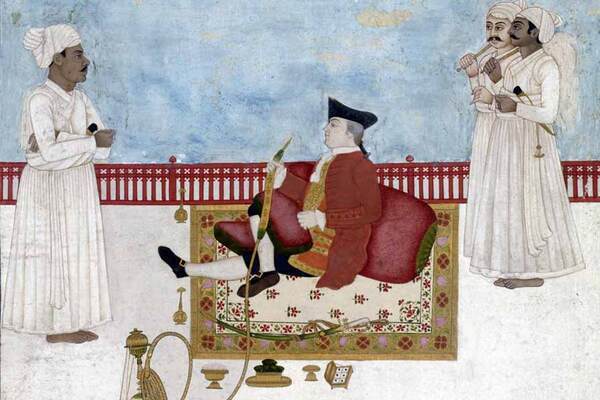
Dr De has made a thorough use of archival documents to support her argument that the innovative policies introduced by the Company were humane and modern compared to contemporary British Government policies. In fact, those policies also formed the foundation of various policies of Independent India in 1947!
It would have been better had the author discussed two aspects more clearly… Whether Dr De accepts Professor Stern’s views that there is no gap or hiatus in the march of the East India Company’s Empire from the early modern to the modern state system and how John Company (the British East India Company was informally known as John Company) continued Human Resource Management in spite of negotiating claims and dissatisfaction of native employees. Otherwise, the author has done a great job by departing from the anti-colonial historiography to present a political, as well as intellectual, history of the East India Company on the basis of documentary evidence! Her work shall certainly lead to a new way to explore history.
Boundless Ocean of Politics on Facebook
Boundless Ocean of Politics on Twitter
Boundless Ocean of Politics on Linkedin
Contact: kousdas@gmail.com

 ISMC
ISMC Boundless Ocean Of Politics