

Frescoes Revealed At Pompeii: Stunning!
The high black-walled dining hall had been buried under solidified lava and thick ash for 1,945 years! During recent excavations, dazzling frescoes emerged at the Roman city of Pompeii. The magnificent works of unknown artists of 2,000 years ago would leave one stunned. The Italian Ministry of Culture issued a statement on April 10, 2024, mentioning that one of the frescoes depicts the Greek mythological figures of Helen and Paris of Troy that was discovered inside the imposing banquet hall with elegant black walls.
Pompeii is a vast archaeological site in southern Italy’s Campania region, near the coast of the Bay of Naples. Once a thriving and sophisticated Roman city, Pompeii was buried under metres of ash and pumice after the catastrophic eruption of Mount Vesuvius in AD 79. The preserved site features excavated ruins of streets and houses that visitors from different parts of the globe can freely explore. Currently, this ancient Roman city attracts around 2.5 million visitors every year.
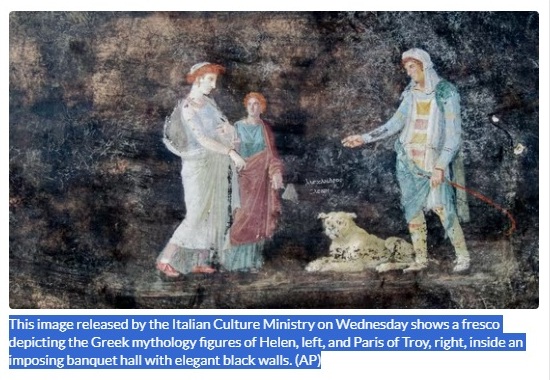
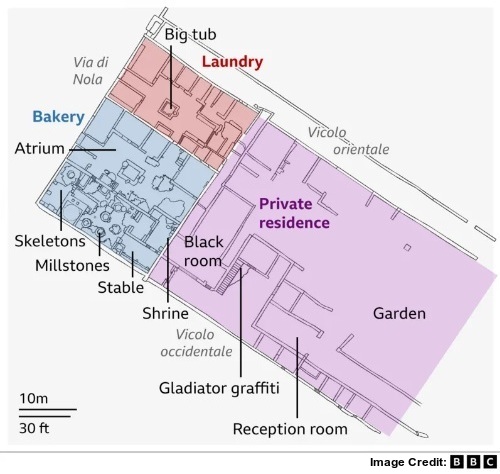
Although excavation works have been going on in Pompeii and its surrounding area for more than 200 years, one-third of the site is still covered in ash and lava. Excavating a similar area, archaeologists discovered a hall, about 15mt long and 6mt wide, a few weeks ago. Archaeologists are of the opinion that it is a banquet room. More than 100,000 small white tiles were used to build the mosaic floor of this hall. However, the colour of the walls is black. On those black walls, unknown artists had created the frescoes, using bright colours, like orange, green, blue and yellow, nearly 2,000 years ago! The frescoes depict various scenes from Greek mythology. The concerned authorities of Pompeii Archaeological Park have stressed that the quality of the frescoes and mosaics from the time of Emperor Augustus and the choice of characters suggest it was used for banquets.
Archaeologists have so far uncovered two frescoes by removing lava and ash. One image depicts Apollo, the Greek God of the Sun and Music, proposing to Princess Cassandra (or Kassandra as described in Greek mythology). She was a Trojan priestess dedicated to Apollo and fated by him to utter true prophecies, but never to be believed. The second fresco depicts Helen, the queen of Sparta, and Paris, the Prince of Troy. Standing next to Helen is probably her attendant, while a tiger sits at Paris’ feet. Helen allegedly left her husband and family to live with Paris in Troy. Then, the Greeks invaded Troy. Finally, Troy fell after a decade-long war. Homer (born 8th Century BC) immortalised the battle and the events related to it in his two epics.
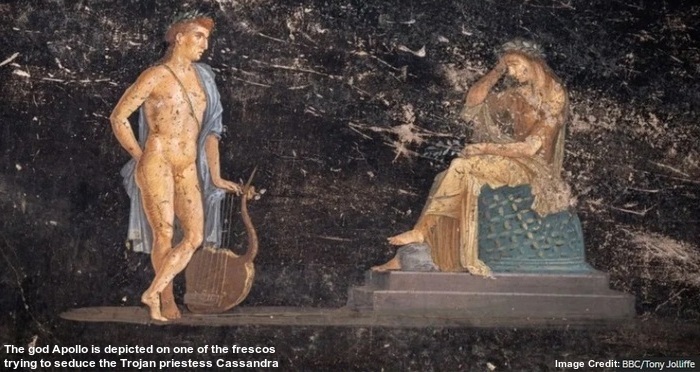
The two frescoes, based on Greek mythology, were painted on the wall of a hall in Pompeii nearly nine centuries after Homer. These artworks have prompted historians to rethink about the ancient Roman city. Park Director Dr Gabriel Zuchtriegel has said that people have long thought of Pompeii as an important port city. However, the recent discovery shows another entity of this ancient city, he added. According to Dr Zuchtriegel, there is no doubt that Pompeii was one of the centres of art and culture of the Roman Empire.

Dr Zuchtriegel has stressed: “The walls were painted black to prevent the smoke from the oil lamps being seen on the walls. People would meet to dine after sunset, and the flickering light of the lamps had the effect of making the images appear animated, especially after a few glasses of good Campanian wine.” He has claimed that the main task of archaeologists is to preserve the frescoes in a proper manner. Archaeologists have already injected a plaster glue in their rear in order to prevent them coming away from the walls. It will help the frescos to stay in position. Meanwhile, the masonry is being shored up with scaffolding and temporary roofing is going over the top.
Currently, Chief Restorer Dr Roberta Prisco is trying to stop an arch from collapsing. She said: “The responsibility is enormous. We have a passion and a deep love for what we are doing, because what we are uncovering and protecting is for the joy also of the generations that come after us.“
So far, no one, except some media persons, has been allowed to enter the hall. However, Dr Zuchtriegel wants to open the hall for tourists in the near future. He believes that visitors shall be impressed by these sparkling frescoes on the black wall. “We want no one to be deprived of that feeling of love and wonder,” he told the press.
Boundless Ocean of Politics on Facebook
Boundless Ocean of Politics on Twitter
Boundless Ocean of Politics on Linkedin
Contact: kousdas@gmail.com

 ISMC
ISMC Boundless Ocean Of Politics