

Secrets Of 2000-Year-Old Scorched Scrolls Revealed
Researchers recently recovered the contents of an extensively damaged ancient scroll with the help of Artificial Intelligence (AI). It is believed that the ancient scrolls survived the eruption of Mount Vesuvius.
Youssef Nader, an Egyptian bio-robotics Ph.D. student in Berlin, Luke Farritor, a 21-year-old SpaceX intern from Nebraska, and Julian Schilliger, a Swiss robotics student at ETH Zürich, made a huge effort to decipher the 2,000-year-old decaying documents. In the first week of February 2024, they won the Vesuvius Challenge for their remarkable effort. It may be noted that the Vesuvius Challenge is an international machine learning and computer vision competition launched in March 2023. The competition is aimed at resurrecting a collection of charred ancient Roman scrolls from the ashes of history.

In an article published on February 7 (2024), Forbes mentioned that the three researchers used 3D mapping and AI techniques to uncover layers of those documents that looked like pieces of charcoal. Then, they read the documents after digitally scanning them. Nader, Farritor and Schilliger are of the opinion that Philodemus of Gadara (BCE 110 – BCE 30 BCE), an Epicurean Philosopher and Epigrammatist, had written the newly recovered documents. Philodemus had studied in the Epicurean school at Athens when it was led by Zeno of Sidon (BCE 150 – BCE 75). Later in BCE 70, the philosopher moved to Italy. The three researchers have claimed that Philodemus penned down his views on the influence of beauty, music and food on human life in those documents.
In the 18th Century, a farmer discovered the documents while digging a well near a Roman villa in Herculaneum, an ancient Roman town that is located in the modern-day commune of Ercolano, Campania, Italy. Although the documents had been buried under the rubble of a volcano for 2,000 years, they remained more or less intact. Forbes also mentioned in the article that Nader, Farritor and Schilliger managed to read “a part of one scroll from a collection of charred, rolled-up documents carbonised by the intense heat from the volcanic eruption that famously buried the Roman towns of Pompeii and Herculaneum in BCE 79”.
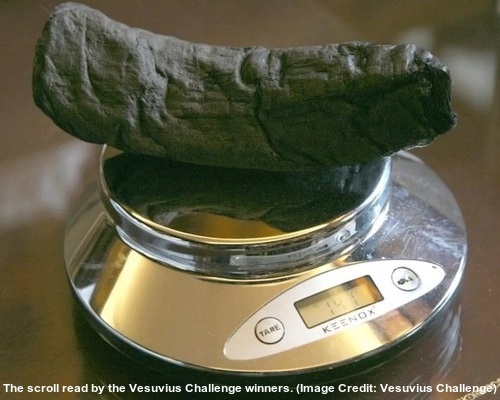
As the scrolls are in a highly fragile state, the three researchers realised that trying to unroll the precious documents would only damage them even further. Hence, they used modern tools to analyse high-resolution Computed Tomography (CT) scans of four scrolls at the Diamond Light Source Particle Accelerator near Oxford, England.
Talking to the media, Brent Seales, a Professor of Computer Science at the University of Kentucky and a co-founder of the Vesuvius Challenge, stressed: “The significance of reading this scroll is that it demonstrates that all of them have the potential to be read.” He said: “The reason we wrap gifts at the holidays is to enhance the wonderful pleasure and surprise of receiving a gift. These literary gifts from antiquity can now be opened, and must be, if we are to discover exactly what stories they tell.” Commenting on the scrolls’ content, Professor Seales stated: “We have so little of what was actually written,” adding that every new work that could be read “moves the needle substantially on the corpus of known classical material.”

Meanwhile, Nat Friedman, the former CEO of software and coding platform GitHub and the current adviser to Midjourney, has claimed that more scrolls could be found in that area. On his X (formerly Twitter) handle, he wrote: “Our hope is that the success of the Vesuvius Challenge catalyses the excavation of the villa, that the main library is discovered, and that whatever we find there, rewrites history and inspires all of us.”
Boundless Ocean of Politics on Facebook
Boundless Ocean of Politics on Twitter
Boundless Ocean of Politics on Linkedin
Contact: kousdas@gmail.com

 ISMC
ISMC Boundless Ocean Of Politics