

Viewed Through The Lens Of Traumatic Events
The crisis is huge, but the scope is limited. Hence, it is better to begin from the end. In the Epilogue of a 2023 publication, the author mentioned that the edifice of development which we are so proud of was created by uprooting millions of indigenous people from their soils. Similarly, our religion encourages slavery. He further mentioned that security, universities, freedom of speech, etc., were all exceptions. According to the author, the problem with authoritarianism is that it wants to take control of everything.
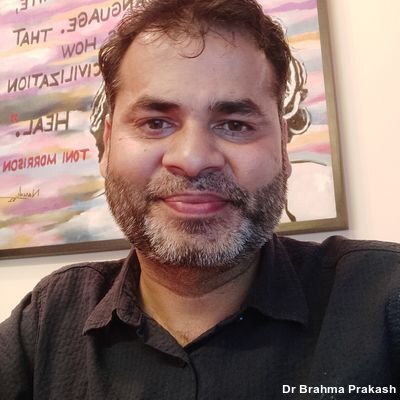
In his book ‘Body on the Barricades: Life, Art and Resistance in Contemporary India‘, Dr Brahma Prakash, a Professor of School of Arts and Aesthetics at the New Delhi-based Jawaharlal Nehru University (JNU), has explained how an authoritarian system suffocates a society through various rules and regulations. The Frontline magazine has stated that Dr Prakash’s publication is all about “thinking of life and freedom from the points of confinement. It is about the act of breathing from the point of breathlessness“. All the eight chapters (or essays) of this 210-page book concentrate on building a Politics of Resistance against the suffocating aggression and the barricades installed by the State.

The metaphor of Suffocation or Breathlessness is the essence of this book. Breathlessness means a number of things. Dr Prakash has stressed: “Breathlessness is a general condition of life.” (pp. 13) It includes “breath in the toxic, putrid sewers of caste-based society; grasping the last shred of life facing a riotous lynch mob; gulping and holding breath down in the fervent hope that the hate speech on street corners and television screens will not escalate to physical maiming and death; the chokehold“.
It seems that two incidents have influenced the author to narrate the suffocating condition. People across the globe experienced physical and social suffocation during the COVID-19 Pandemic in 2020-21. Dr Prakash has also recalled the final words of George Perry Floyd Jr (October 14, 1973 – May 25, 2020). On May 25, 2020, the 46-year-old Afro-American cried: “I can’t breathe.” He said so when he was murdered in Minneapolis by Derek Chauvin, a 44-year-old White Police Officer. Floyd was arrested after a store clerk alleged that he made a purchase using a counterfeit USD 20 bill. Chauvin reportedly knelt on Floyd’s neck for over nine minutes while Floyd was handcuffed and lying face-down in a street. Two other Police Officers, J Alexander Kueng and Thomas Lane, assisted Chauvin in restraining Floyd. Lane had pointed a gun at Floyd’s head before he was handcuffed. A fourth Police Officer, Tou Thao, prevented bystanders from intervening.
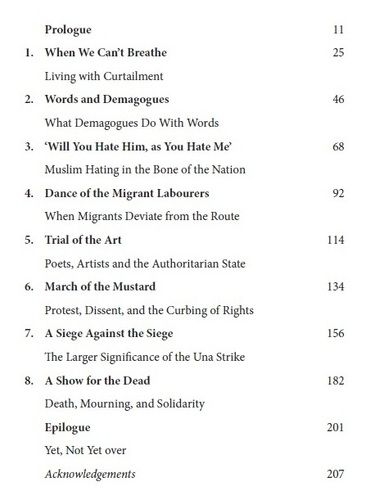
Dr Prakash is of the opinion that one would have to be aware of various unfreedoms or non-freedoms in order to get rid of the feeling of suffocation. The first chapter of the book deals with those unfreedoms. Based on this discussion, the author has mentioned in the second chapter that Superheroes talk only about themselves, do not listen to others, and do not let others talk, thus creating a suffocating atmosphere. In the fifth chapter, he has described the strength of independent-minded novelists and poets who are telling the truth, ignoring all sorts of threats in the era of authoritarianism.
Meanwhile, Dr Prakash has also discussed the restricted life of the minority communities in India in the first three chapters. According to the author, although the minorities are living a suffocating life, they are unable to speak the truth. The topic of the fourth chapter is the experiences of migrant workers especially during the COVID-19 Pandemic. The ruler’s hegemonic project of tying down the bodies and movements of migrant workers made their lives miserable. Workers had no other option, but to ignore the decree of the authoritarian power in order to survive and to return home. While on their way to home, some workers received injuries, while others perished. These incidents portrayed the image of a brutal inhumanity. Dr Prakash has reminded his readers: “For the migrant worker, the city may be cruel and indifferent, but the village is a life sentence that you escape. A life sentence is not life, and fugitives cannot be nostalgic… Yet, there is the soil and the language. Yes, I love my village, but if you asked me to live there, I would not.” (pp. 103)

The author has arrived at the conclusion on a relatively positive note, stating that protest or resistance is the only way to counter authoritarianism. Dr Prakash has presented his arguments in favour of resistance in chapters six and seven. He has described the recent peasant movement in India, the long history of province-wide protests against the oppression of lower caste people in Gujarat’s Una municipality area, and also the history of poignant use of art, poetry, drama and music in various movements in the South Asian country. In the final chapter, the author has penned the extreme form of suppression. He has described how the authoritarian ruler took away the Right to Express Sorrow from the oppressed people in the northern Indian town of Hathras and other parts of the country.
According to Dr Prakash, barricades are symbols of the power of an authoritarian regime (and its proxies). Authoritarian rulers often use barricades to prohibit the outsiders from enjoying their Basic Rights, prompting them to shift constantly. At the same time, barricades provide the logic of classification, separation and segregation, weaponising thought, speech and action in the process. He has stressed that the ultimate resolution of the body should be to cross the barbed wires erected by the ruler. It seemingly comes to a situation where it is extremely difficult for a person even to breathe, yet one still manages to survive. “Breathlessness… is the point to think through the symptomatic condition,” added Dr Prakash. (pp. 16). His narration takes the readers to Michel Foucault‘s concept of Biopolitics or Biopower or Body Politic, which is currently under the siege of Right-Wing Neo-Liberal politicians.
“We are not making an exit. This is not the end. We are only taking a pause. We will meet again at the barricades, in words, for life and freedom. A popular saying goes that the barricade closes streets, but opens ways,” concluded the author. This publication has not only enfolded literary and poetic challenges to the oppressions of authority and power (read institutional power), but has also posed an analytical challenge to the barricades of life and existence in an authoritarian world.
Boundless Ocean of Politics on Facebook
Boundless Ocean of Politics on Twitter
Boundless Ocean of Politics on Linkedin
Contact: kousdas@gmail.com

 ISMC
ISMC Boundless Ocean Of Politics