

French Love-Letters Finally Opened After 265 Years
One small letter has been sealed in an envelope for the past 265 years. A lady had written this private and personal letter to her sailor husband. “I could spend the night writing to you … I am your forever faithful wife. Good night, my dear friend. It is midnight. I think it is time for me to rest,” she mentioned in the letter.
Professor Renaud Morieux, from the University of Cambridge’s History Faculty and Pembroke College, recently discovered at least 100 such sealed letters written in 1757-58. Those letters were written to the sailors of a French warship by their parents, siblings, fiancées, wives, children or family members. Unfortunately, the letters never reached the addressees. The letter mentioned above was written by Marie Dubosc to her husband, the first Lieutenant of the Galatée, a French warship, in 1758. She had no idea about the location of her husband Louis Chambrelan or that his ship had been captured by the British Navy. Louis neither received Marie’s letter, nor met her again. Marie died the following year in Le Havre before the release of Louis who remarried in 1761 after his safe return to France.

In another such letter, Anne Le Cerf had written to her husband: “I cannot wait to possess you.” Anne’s husband Jean Topsent was a Non-Commissioned Officer on the Galatée. According to Professor Morieux, Anne most probably meant embrace, but also “to make love to you”. She had even signed “Your obedient wife Nanette.” The professor is of the opinion that Nanette was the nickname given to her affectionately by her husband. Jean, imprisoned somewhere in England, never received Nanette’s letter.
Professor Morieux, who took several months to decode those and 102 other letters written with wild spelling, no punctuation or capitalisation, has said that the letters were written just after the beginning of the Seven Years’ War. The war had influence in different countries, with Britain capturing several French warships. Britain had also detained about 20,000 French sailors from different ships. Galatée was one such vessel.
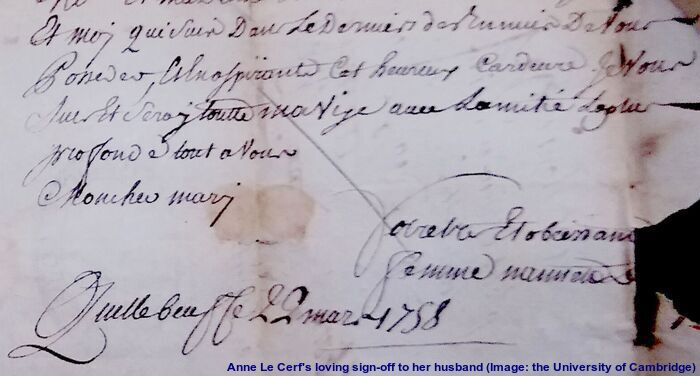
All those letters eventually reached England through various ports due to the promptness of the French Postal Department. However, Britain’s Royal Navy had taken those letters to the Admiralty in London and never opened. Hence, they were never delivered. Later, the collection found its place at the British National Archives in Kew. They have recently been opened and studied for the first time since they were written, i.e., in 1757-58.
Earlier in 2023, Professor Morieux discovered a box at the university library inside which three sets of letters were tied with a ribbon. After going through some of those letters, the professor realised that he was the first person to experience the 265-year-old untouched feelings of some people. “I realised I was the first person to read these very personal messages since they were written. Their intended recipients did not get that chance. It was very emotional,” he stated. However, reading all those letters was not an easy task for the Professor mainly because of undecipherable handwriting.
Professor Morieux has stressed: “I only ordered the box out of curiosity. There were three piles of letters held together by ribbon. The letters were very small and were sealed so I asked the archivist if they could be opened and he did.” He added: “These letters are about universal human experiences; they are not unique to France or the Eighteenth Century. They reveal how we all cope with major life challenges.” The Professor further said: “When we are separated from loved-ones by events beyond our control, like the pandemic or wars, we have to work out how to stay in touch, how to reassure, care for people and keep the passion alive. Today we have Zoom and WhatsApp. In the Eighteenth Century, people only had letters, but what they wrote about feels very familiar.”
Professor Morieux believes that although those letters are seemingly simple and personal, they should be considered as important documents of social history. French society had become heavily dependent on women as a result of the war. As the men had left the country to take part in the war, women had to run the households and to keep the French economy steady, apart from playing crucial political roles. Along with personal feelings, other issues, including family conflicts, complications in personal and social relations, and social problems, are also mentioned in those letters. Meanwhile, the newly-discovered letters are currently housed at the National Archives of Britain in Kew.
Boundless Ocean of Politics on Facebook
Boundless Ocean of Politics on Twitter
Boundless Ocean of Politics on Linkedin
Contact: kousdas@gmail.com

 ISMC
ISMC Boundless Ocean Of Politics