

Judiciary Expresses Concern Over Media Trials
The Supreme Court (SC) of India recently expressed deep concern over media trials, saying that television news channels cannot and should not act like the judiciary. The concern is not at all unreasonable, as there are a number of obstacles in getting justice in India. In particular, the incompetence and biasness of the administration often cause great problems for people who seek justice. Corruption is another issue that hampers the judicial process.
The electronic media can form, as well as influence, public opinion by holding media trials on any sensitive issue. The advice given by the Honourable Justices of the SC to the media to be fair, impartial and responsible is certainly valuable. However, a question needs to be put forward in the interest of Democracy with full respect for their wise opinion. It is also quite important to be careful so that the Freedom of Press (and journalists) is not curtailed in any way. It is certainly important for the media to act responsibly while publishing (or telecasting) news items and forming public opinion on any particular issue. However, there shall be a possibility that the Freedom of Expression will be controlled in the pretext of being responsible.
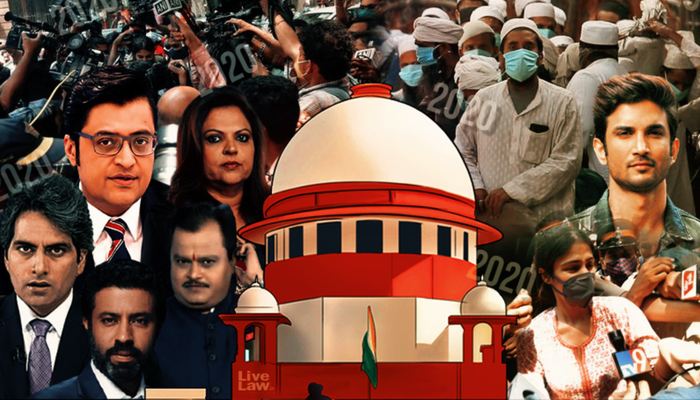
There is a particular cause for concern. To curb media trials, the Apex Court asked the Home Ministry of India to frame special guidelines for the Police, saying that the Police must follow the guidelines for sharing information related to criminal cases with journalists. The main purpose of this direction is that the information related to a case or a trial should not be published in the media in such a way so that it affects the trial process. The SC also sought views of the Police of various Indian provinces before the formulation of this provision. There is naturally a written or unwritten code of conduct on how the Police should share information about important cases with media persons, and the media, too, remain careful about how much they can reveal about pending cases or complaints. In other words, all the parties – the Police, the Administration and the Media – need to be held accountable.
The question arises here: Whether the risk of abusing the media shall increase if the administration gets a new opportunity to determine the criteria of responsibility? More specifically, the Police can take advantage of this opportunity and use the warning of a court to non-cooperate with journalists or harass the media. By suppressing media trials, the judiciary can actually force the media not to publish any report that could create troubles for the government. It means that if the media publish such a piece of news, then the government can take legal action against the media in the pretext of violation of rules.
At the moment, the socio-political situation in India causes so much anxiety. As the Legislature (read government) often deviates from Democratic Norms, there is definite reason for fear. The harsh reality is that the majority of the political leaders often try to curtail the Freedom of Expression, directly or indirectly. The ruling class is quite satisfied with the pro-government media. However, the government cannot tolerate criticism. If the repressive instincts and powers of the rulers to deal with the problem of media trials become stronger, then the solution may become even scarier than the problem itself. It is expected that the Honourable Judges of the Supreme Court shall give serious consideration to this particular issue. One should remember that the issue is to protect Democracy, and the Freedom of Press is one of the main bulwarks of this system.
Meanwhile, the Apex Court has called for stronger self-regulation among television news channels. During the hearing of a case involving News Broadcasters Federation (NBF) and News Broadcasters and Digital Association (NBDA) on September 18, 2023, Chief Justice of India (CJI) Dhananjaya Yeshwant Chandrachud made it clear that although the judiciary would not interfere in competition among the media houses, the self-regulation of television news channels should be tightened.
Boundless Ocean of Politics on Facebook
Boundless Ocean of Politics on Twitter
Boundless Ocean of Politics on Linkedin
Contact: kousdas@gmail.com

 ISMC
ISMC Boundless Ocean Of Politics